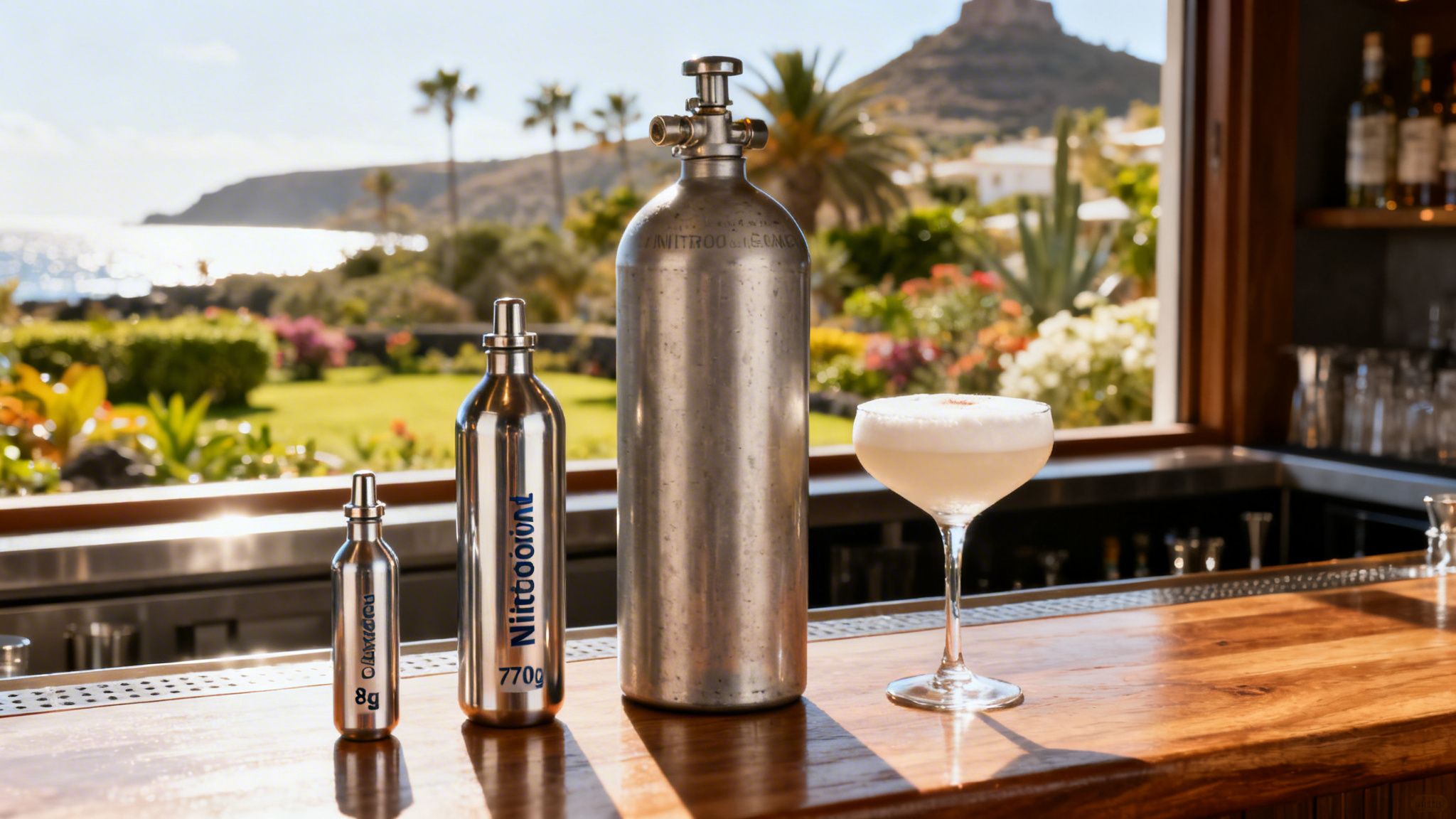

A Guide to Cylinder Types for Canary Islands Bars and Restaurants
Summary: This guide provides practical, no-fluff information for hospitality professionals in the Canary Islands on choosing the right types of nitrous oxide (N2O) cylinders. It covers the three main sizes—8g, 670g, and 2kg—outlining their ideal use cases, operational benefits, and return on investment. The focus is on helping bar, club, and restaurant managers make an informed decision to improve workflow, speed, and consistency, ultimately boosting profitability.
Key Points:
- Cylinder Sizes: The article details three primary "tipos de cilindro": 8g chargers for precision, 670g cylinders for balanced power and portability, and 2kg cylinders for high-volume operations.
- Practical Value: It offers a clear breakdown of which cylinder type is best suited for different business volumes, from small cafés to large nightclubs.
- Efficiency: The guide explains how upgrading from small 8g chargers to larger 670g or 2kg systems eliminates bottlenecks, reduces labor costs, and minimizes waste.
- Safety & Compliance: It provides a crucial checklist for ensuring product safety (CE, ISO certifications), gas purity (99.9% E942), and legal compliance (IGIC-ready invoices) in the Canary Islands.
- Tools & Resources: The content links to valuable internal resources and provides a decision-making flowchart to help businesses choose the right supplier and product.
When you’re deep in the weeds of a Saturday night service, the last thing you want to worry about is your equipment. For any bar, club, or catering operation in the Canary Islands, choosing the right tipos de cilindro for nitrous oxide isn’t just about inventory—it’s about workflow, speed, and consistency. This guide delivers the practical information you need to make the right choice, with no fluff.
A Practical Guide to N2O Cylinder Types
Think of it like this: you wouldn't send a bartender into a packed club with a single cocktail shaker. You'd set them up with the right tools to handle the volume. The same logic applies to N2O cylinders. The size you choose has a direct impact on how smoothly your prep line runs, especially when every second counts.
Whether you’re crafting bespoke cocktails in a high-end Santa Cruz bar or churning out hundreds of desserts for a hotel in Adeje, your choice of cylinder can make or break your service. Let's look at the main options you'll encounter in the professional world.
The Three Main Cylinder Sizes
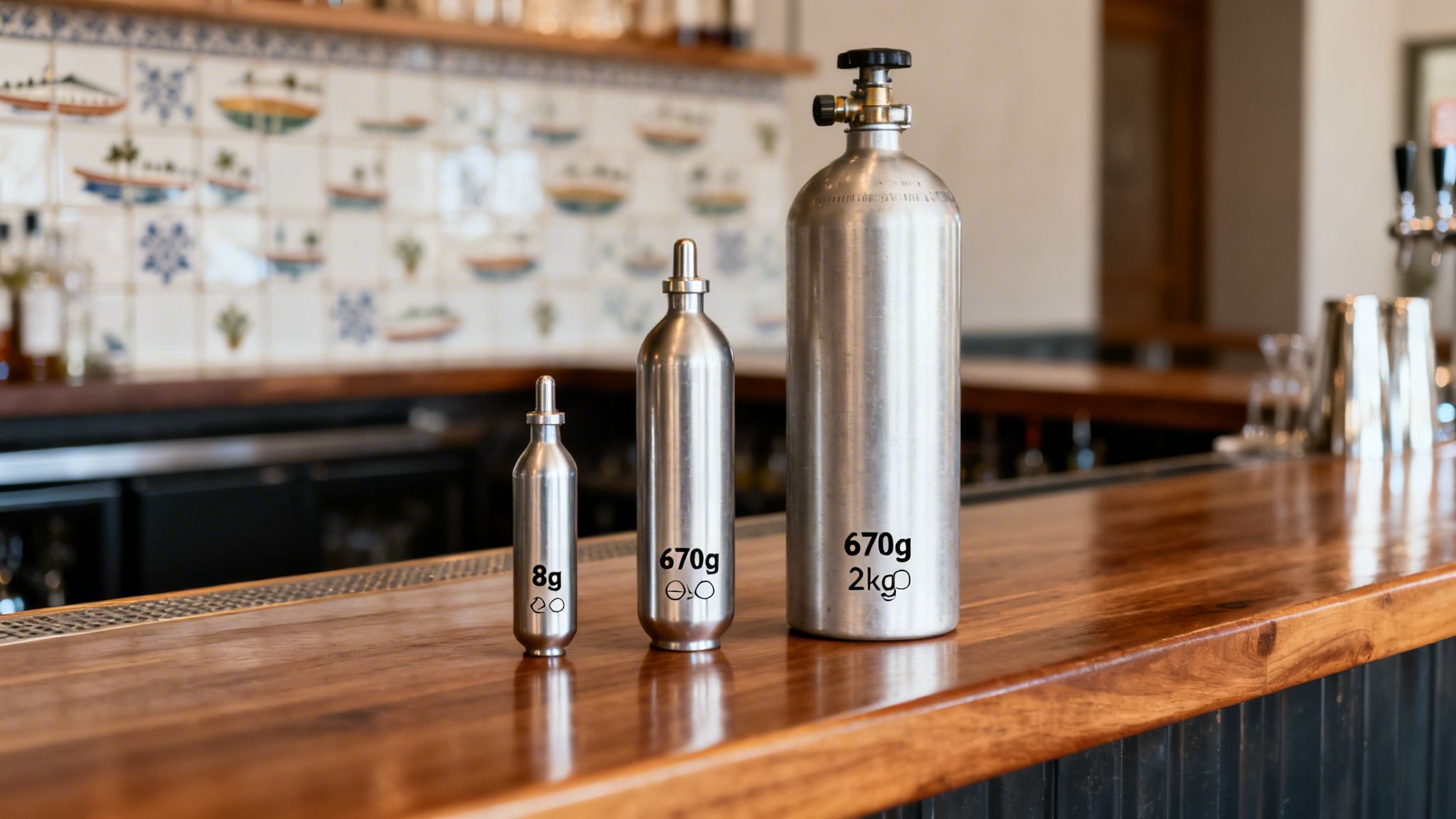
In hospitality, N2O cylinders are broken down by capacity. Each one is built for a different kind of operational pace.
- 8g Cream Chargers: These are the small, single-use cartridges. They're designed to charge a standard whipped cream dispenser one infusion at a time. Perfect for very low-volume use or recipe testing, but a major bottleneck in a professional setting.
- 670g Cylinders: This is where things get serious for professional venues. A 670g tank holds the equivalent of more than 80 of those little 8g chargers. You connect it to your dispenser with a hose and regulator, allowing for rapid, continuous infusions without constantly stopping to reload.
- 2kg Cylinders: For high-volume venues, this is the workhorse. One 2kg cylinder replaces around 250 of the tiny 8g chargers. It’s the go-to for busy nightclubs, large-scale catering, and any operation where efficiency is non-negotiable.
N2O Cylinder Types At a Glance
Here’s a quick breakdown to help you visualize which cylinder fits your venue’s needs.
This table makes the choice clear. While small chargers have their place, professional venues quickly see the value in upgrading to larger formats to keep service flowing.
The real difference isn’t just the amount of gas—it’s the shift in your entire prep process. Moving from 8g chargers to a 670g or 2kg system is like trading a winding back road for a motorway. You eliminate the constant, repetitive task of changing cartridges, freeing up your team to focus on service during those critical peak hours.
Understanding how these tipos de cilindro fit your business is the first step. To see professional-grade options we provide to businesses across the Canary Islands, explore the Kings Canisters product range. Making the right choice here will directly boost your speed and consistency, which translates to better customer experiences and a healthier bottom line.
Maximizing Efficiency with 2kg N2O Cylinders
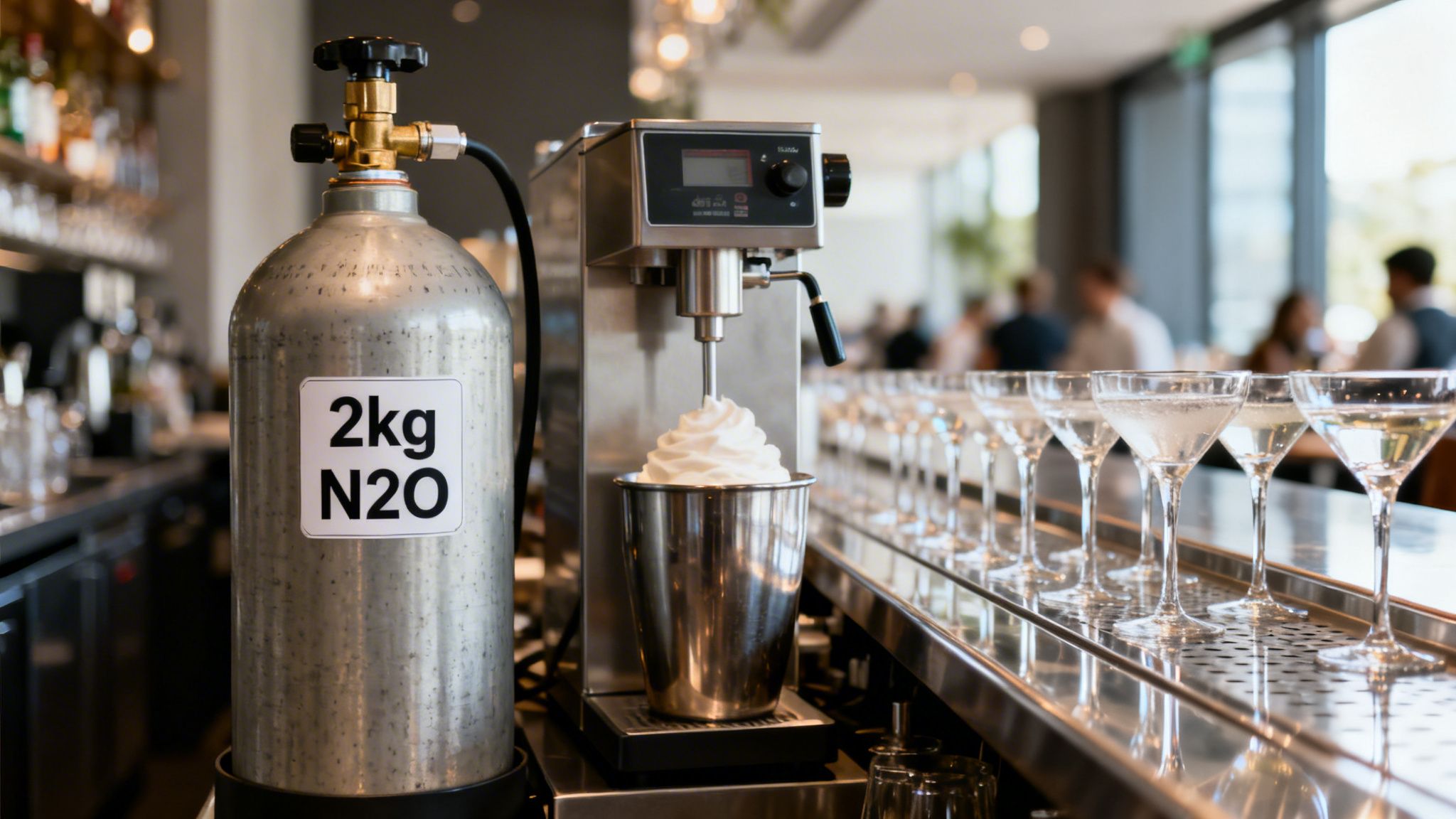
When the dockets are flying and your venue is packed, the last thing your team needs is an equipment bottleneck. This is exactly where the 2kg N2O cylinder proves its worth. For any high-volume bar, club, or large-scale catering operation, these large-format tipos de cilindro aren't just a convenience; they’re a core part of a profitable workflow.
Imagine getting through a frantic Saturday night service without ever having to change a gas cylinder. That’s the operational stability a 2kg tank brings to the table. For venues in Tenerife or Gran Canaria built on speed and scale, this format is the undisputed champion.
The main advantage is impossible to ignore: capacity. A single 2kg N2O cylinder holds the equivalent of roughly 250 individual 8g cream chargers. That massive volume translates directly into less labor, less waste from discarded metal chargers, and, most importantly, zero downtime during your busiest hours.
Built for Peak Performance
In a high-pressure bar, every second is currency. Bartenders lose valuable minutes over a shift just from the repetitive task of stopping, grabbing a new 8g charger, unscrewing the dispenser, and recharging it. That’s time that could be spent pouring drinks and serving customers.
Required Tool: To use a 2kg cylinder, you must have a pressure regulator and hose system. This is non-negotiable. It allows you to safely connect the high-pressure tank to your dispenser and control the gas flow for consistent results.
A 2kg tank, hooked up correctly, changes the game. It delivers a continuous, reliable supply of N2O, ensuring perfect foams and infusions every single time. It's about building a prep station that can keep up with your demand. Brands like FastGas and Great Whip have become standard issue in top establishments because their 2kg offerings are engineered for professional use.
Real-World ROI
The shift towards bigger cylinders is a clear trend. Across the Canary Islands—especially in Tenerife, Gran Canaria, Lanzarote, and Fuerteventura—the demand for 2kg N2O cylinders has surged.
We hear it directly from our B2B wholesale partners. Venues in busy tourist hubs like Adeje, Tenerife, report that switching to 2kg cylinders has eliminated prep downtime during peak hours. One manager mentioned it completely overhauled their process, finally stopping the constant waste from tiny, single-use chargers.
A 2kg cylinder isn't just a bigger tank; it's a strategic decision to prioritize uninterrupted service. By removing the need for constant reloads, you empower your staff to focus on quality and speed, directly boosting customer satisfaction and your bottom line.
To put it in perspective, here’s what switching to a 2kg system solves:
- Workflow Interruptions: Ends the frustrating stop-start process of changing 8g chargers.
- Inconsistent Results: Provides stable pressure for uniform foams and infusions.
- Excessive Waste: Eliminates the need to dispose of hundreds of tiny metal chargers.
- Inflated Labour Costs: Frees up your staff’s time for more valuable, customer-facing tasks.
Is the 2kg Cylinder Right for Your Venue?
While the benefits for high-volume settings are clear, a 2kg cylinder requires more initial investment and dedicated storage space. Be honest about your operational needs.
If your venue regularly serves over 100 cocktails or desserts requiring N2O infusions per night, the answer is almost certainly yes. The efficiency gains will quickly pay back the initial setup cost.
For a deeper dive, check our guide on 580g vs 2kg N2O cylinders to find the perfect fit for your business. Choosing the right equipment is about matching the tool to the task for the best possible return.
The Perfect Balance of Power and Portability with 670g Cylinders
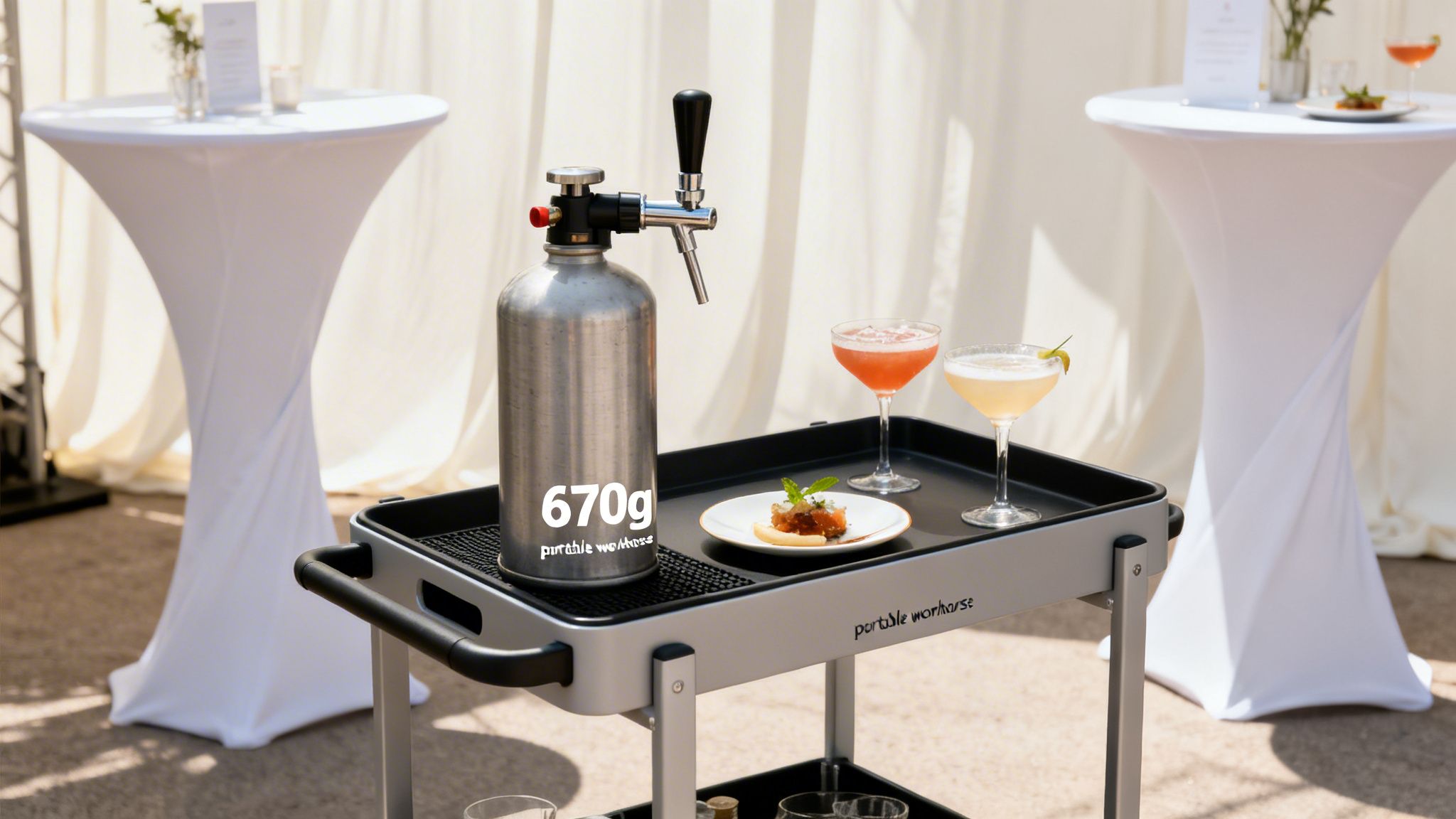
While the 2kg tank is our heavyweight champion, it’s not the right fit for every operation. Sometimes what you really need is a smart blend of solid capacity and real-world portability. That’s precisely where the mid-sized 670g cylinder shines—it’s the versatile workhorse in the world of professional tipos de cilindro.
Think of it as the perfect middle ground. It gives you a huge leap in efficiency over tiny 8g chargers, but without the sheer weight and footprint of a 2kg tank. This makes it a fantastic solution for businesses where mobility and smart use of space are just as critical as output. A pop-up bar at an event in Fuerteventura or a mobile catering setup for a wedding in Lanzarote are perfect examples.
The Sweet Spot for Modern Hospitality
There's a reason models like the Creme Deluxe 666g and FastGas 670g have become so popular: they hit this sweet spot perfectly.
A single 670g cylinder replaces over 80 individual 8g cartridges. The efficiency gains are immediate:
- Fewer Interruptions: Cut your cylinder changes dramatically during a busy shift.
- Smoother Workflow: Hook it up with a hose and regulator, and your bartenders can work without stopping.
- Less Waste, Less Clutter: You get rid of the mess and environmental footprint of binning dozens of small metal chargers.
Required Tool: Just like the 2kg tank, a 670g cylinder requires a compatible pressure regulator and hose system for safe and effective use.
And it’s not just for mobile gigs. In boutique hotels and restaurants where counter space is precious, a 670g tank can be tucked neatly away, providing all the power needed for dessert prep without getting in the way.
Ideal Use Cases for 670g Cylinders
This format is a firm favorite for advanced mixology programs and mid-sized venues. For catering teams and event organizers across the Canary Islands, the 670g N2O cylinders deliver that optimal balance. You can expect to power approximately 80-90 cocktails per cylinder, making them ideal for a beachside event in Lanzarote's Playa Blanca or Corralejo in Fuerteventura, where mobility is everything. You can find more on the logistics in our Efficiency in Every Pour knowledge hub article.
The 670g cylinder is the answer for businesses that have outgrown 8g chargers but don't yet require the industrial scale of a 2kg tank. It supports growth by boosting efficiency without demanding a major change in your physical setup.
This makes it an excellent choice for:
- Mid-sized Cocktail Bars: Venues serving a steady stream of complex cocktails.
- Mobile Bartending Services: Its portability is unmatched for events and festivals.
- Restaurants with Ambitious Dessert Menus: Gives consistent pressure for mousses and espumas.
- Catering Companies: Perfect for off-site events where quick setup and efficiency are crucial.
Choosing the right tipos de cilindro is a strategic decision. The 670g format offers a powerful, flexible, and efficient solution that fits the real-world needs of countless modern hospitality professionals.
When to Use Classic 8g Cream Chargers
With all the talk about big 2kg and 670g cylinders, it’s easy to think the classic 8g cream charger is obsolete. It’s not. In a professional bar or kitchen, think of it less as a production tool and more as a precision instrument.
Among the different tipos de cilindro, the 8g charger has a specific, and valuable, role when control and zero waste are more important than volume.
The Right Tool for the Right Job
The real strength of the 8g charger is its single-use, dedicated nature. Imagine a bartender crafting a high-end, one-off cocktail with a rapid-infused spirit. Using a small charger is perfect. There’s no risk of flavor contamination from a shared tank, and you use just enough N2O for that single serving.
Required Tool: A standard cream whipper dispenser. The 8g charger is designed to screw directly into the charger holder of these devices. No extra regulator or hose is needed.
I’ve seen them used most effectively in these situations:
- Recipe Development: Test a new foam or infusion in small, controlled batches.
- Single, Bespoke Creations: Craft that one unique cocktail for a special customer.
- Staff Training: A low-risk, low-cost way to teach new staff how to use a cream whipper.
- Very Low-Volume Needs: A small guesthouse serving a few desserts with whipped cream each day.
The Reality of a Busy Service
But let’s be honest. In a high-volume bar, relying on 8g chargers is a recipe for a bottleneck. During a busy Friday night rush, the constant changeovers—unscrewing the dispenser, binning the spent charger, inserting a new one—add up to lost time, frustrated bartenders, and impatient customers.
The 8g charger is a specialist's tool. It’s perfect for precision and experimentation, but it becomes a costly liability when you need speed and volume. Knowing when to use it is the mark of an efficient bar program.
While the 8g charger is perfect for specialized jobs, we've seen a 40% shift among our partners towards 2kg and 670g cylinders. Why? Because using small chargers during peak service in a busy spot like Las Palmas or Adeje can inflate labor costs by up to 25% just from the time spent on recharges. You can see more about these trends in Kings Canisters' professional offerings.
The takeaway is simple: the 8g charger is a valuable part of your arsenal, but it should be your specialist, not your workhorse. To get a better sense of how these tools fit into a modern bar's workflow, take a look at our guide on what cream chargers are used for in bars and restaurants.
Navigating Safety and Legal Compliance in the Canaries
Choosing the right N2O supply goes way beyond price. What truly protects your venue, your team, and your reputation is an unbreakable commitment to safety, purity, and full legal compliance. Using uncertified or industrial-grade gas isn't cutting a corner; it's a gamble with consequences no business can afford. This is your practical guide to getting it right.
What Certifications on Your Tank Actually Mean
When you’re looking at an N2O cylinder, a few key acronyms are your guarantee that you’re holding a legitimate, safe product. These aren't optional extras. They are non-negotiable proof that the gas inside has been tested to strict European standards and is legal for food preparation.
Here are the ones that matter:
- CE Marking: Confirms the cylinder meets all EU safety, health, and environmental rules. A must-have for any product sold in the European Economic Area.
- ISO 9001: An international standard for quality management, proving your supplier has traceable, consistent processes.
- AESAN Registration: Your local stamp of approval from the Spanish Agency for Food Safety and Nutrition, confirming the product is safe for the food trade in Spain.
Cited Resource: The European Commission provides detailed information on CE Marking, which is the cornerstone of product safety in the EU.
Taking delivery of a cylinder without these certifications exposes your business to massive legal and safety risks. Always demand to see proof of certification from any supplier.
Purity, Handling, and Disposal: The Professional Standard
The quality of your foams begins with the gas itself. For any culinary use, you must be using 99.9% pure, food-grade E942 nitrous oxide. Industrial-grade N2O can contain machine oils and chemical impurities that are not safe to ingest and will ruin the flavor of your work.
Proper handling is just as crucial.
- Tool for Storage: Cylinders must be stored upright in a cool, dry, and well-ventilated space, far from direct sun or heat sources.
- Tool for Disposal: Never toss a cylinder in general waste. Reputable B2B partners like Kings Canisters have a straightforward return or recycling program. It's the only responsible way to handle used tanks.
To help you stay on top of this, here’s a simple checklist.
N2O Safety and Compliance Checklist
In the professional hospitality trade, compliance isn't just about following rules; it's about building trust. Sourcing certified, pure N2O from a legitimate B2B partner demonstrates a commitment to quality that protects your customers, your staff, and your business license.
The Importance of Audit-Proof Paperwork
Finally, let’s talk invoices. Every single purchase of N2O for your business must be documented with a formal, legal invoice. Here in the Canary Islands, that means getting an IGIC-ready invoice with every single order. This is critical. It’s your proof of sourcing from a legitimate B2B specialist and keeps your accounts clean and ready for any potential audit. You can get a deeper dive into the local rules in our detailed guide on N2O legality and compliance in the Canary Islands.
Choosing the Right Cylinder for Your Business
We’ve talked theory, now let's get practical. All this information on the different tipos de cilindro is useless unless it helps you make a smarter decision for your venue in Tenerife, Gran Canaria, Lanzarote, or Fuerteventura. Picking the right cylinder is a strategic move that directly impacts your bar's speed, costs, and bottom line.
The Selection Checklist: Your Self-Assessment
Before you order, run through this quick self-assessment. Honesty here is key.
- Daily Drink & Dish Volume: On a busy night, how many cocktails, espumas, or infused dishes are you actually making?
- Menu Complexity: Is your menu built around high-volume, quick-pour foams or precise, single-serving infusions?
- Available Storage Space: Do you have a secure, well-ventilated spot for a larger 2kg cylinder or is a compact 670g a more realistic option?
- Budget and Workflow: Is your main goal to slash labor time and stop bartenders from fumbling with equipment during the evening rush?
Your answers shift the conversation from "what's the cheapest?" to "what delivers the best return for my specific business?"
Choosing the right cylinder is an operational decision, not just a purchasing one. Aligning cylinder size with your venue’s volume and workflow is the key to maximising efficiency and protecting your profit margins.
Matching Your Needs to the Right Product
Once you have your answers, finding the right cylinder is simple.
- High-Volume Venues (e.g., Nightclubs, Large Resorts): If you're pushing 100+ servings a night and speed is everything, the 2kg cylinder from brands like FastGas or Great Whip is your workhorse.
- Mid-Volume & Mobile Operations (e.g., Cocktail Bars, Caterers): For a solid balance of output and portability, the 670g cylinder (like the FastGas 670g or Creme Deluxe 666g) is the sweet spot.
- Specialty & Creative Applications: If you’re crafting unique, one-off cocktails, options like 8g chargers or flavored N2O cylinders offer precision and creativity.
This is how you ensure your equipment is an asset, not a bottleneck. For a closer look at building a reliable supply chain, check out our guide on how to open a wholesale account with Kings Canisters.
This flowchart maps out the two things that absolutely have to be right: certified products and legitimate business-to-business invoicing.
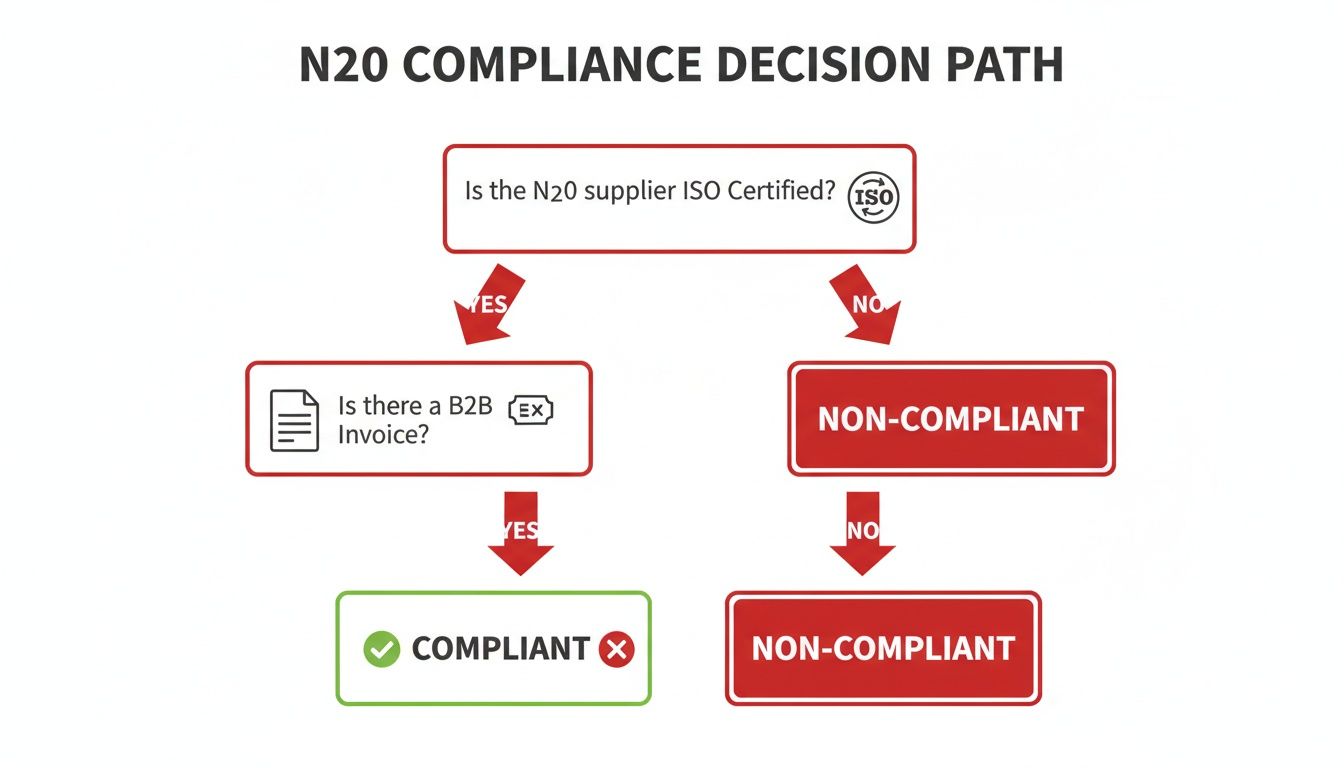
Think of it as your final check. Does the product have the right safety marks? Will you get a proper B2B invoice for your records? For any professional operator, both answers must be "yes."
Frequently Asked Questions (FAQ)
How many servings can I realistically expect from each cylinder type?
Yield is about how many signature cocktails or dessert portions you can make during a hectic service.
- 8g Charger: 1-2 servings per charger. Ideal for single-use precision.
- 670g Cylinder: 80-90 quality servings. The go-to for most professional bars.
- 2kg Cylinder: 250+ servings. The solution for non-stop, high-volume service.
Is a bigger cylinder always the better choice?
Not necessarily. The best cylinder fits your real-world workflow. A bustling beach club in Maspalomas trying to run on 8g chargers is a recipe for disaster, while a small café buying a 2kg tank is a waste of capital. The goal isn't the biggest tank; it's getting through a peak service with zero interruptions.
What tools do I need to connect the cylinder to my dispenser?
This is a critical safety and operational point.
- 8g Chargers: Fit directly into standard cream whippers. No extra tools needed.
- 670g & 2kg Cylinders: You must use a pressure regulator and hose system. This is non-negotiable for safely connecting the high-pressure tank to your dispenser and achieving a controlled, consistent flow.
Why is it so important to use food-grade E942 nitrous oxide?
Food-grade E942 nitrous oxide is certified 99.9% pure for a reason—it’s made to be consumed. Industrial-grade N2O, often found in automotive shops, contains contaminants like sulfur and machine oils that are unsafe and will ruin the flavor profile of your drinks and dishes. Using anything but certified E942 is a non-starter.
Ready to get your bar’s workflow dialed in with a supply you can count on? Kings Canisters provides the full range of certified, food-grade cylinders with reliable, same-day delivery across the Canary Islands. Let’s get your wholesale account set up so you can focus on service, not logistics.
Explore our professional solutions and open your wholesale account today.