

A Professional Guide to Nitrous Oxide (Protoxido de Nitrogeno) in the Canary Islands
Summary
This guide provides essential, practical information for hospitality professionals in the Canary Islands on using food-grade nitrous oxide (protoxido de nitrogeno, E942). We cover its culinary applications, from creating perfect whipped cream to rapid infusions, and emphasize the critical importance of purity, safety, and legal compliance. You will learn how to source certified gas, handle cylinders safely, navigate island-specific logistics, and streamline your procurement to reduce costs and improve efficiency. This is a no-fluff resource designed to give your business immediate, actionable value.
Key Points
- What it is: Food-grade nitrous oxide (E942) is a culinary propellant used for creating whipped creams, espumas, and rapid infusions.
- Purity is Critical: Only use certified 99.9% pure E942 nitrous oxide to avoid contaminating flavours, damaging equipment, and ensure food safety.
- Culinary Applications: Master techniques for rapid flavour infusions in spirits and oils, and create light, stable foams (espumas) from savoury or sweet ingredients.
- Safety First: Always store cylinders upright, secured, in a cool, ventilated area away from heat. Train all staff on proper handling and leak-checking procedures.
- Canary Islands Logistics: Partner with a local supplier who understands customs, IGIC tax, and can offer same-day delivery to manage inventory effectively.
- Cost Reduction: Switch from small 8g chargers to larger 2kg cylinders for high-volume use to cut costs and improve workflow. A verified B2B account is key.
In the world of professional hospitality, protoxido de nitrogeno (nitrous oxide) is the workhorse behind exceptional textures and next-level infusions. Known officially as E942, this food-grade gas is the secret to getting that impossibly smooth whipped cream, cloud-like espumas, and rapidly infused spirits. It delivers a quality that hand-whisking or other gases just can't touch.
What Is Protoxido de Nitrogeno and Why Your Venue Needs It
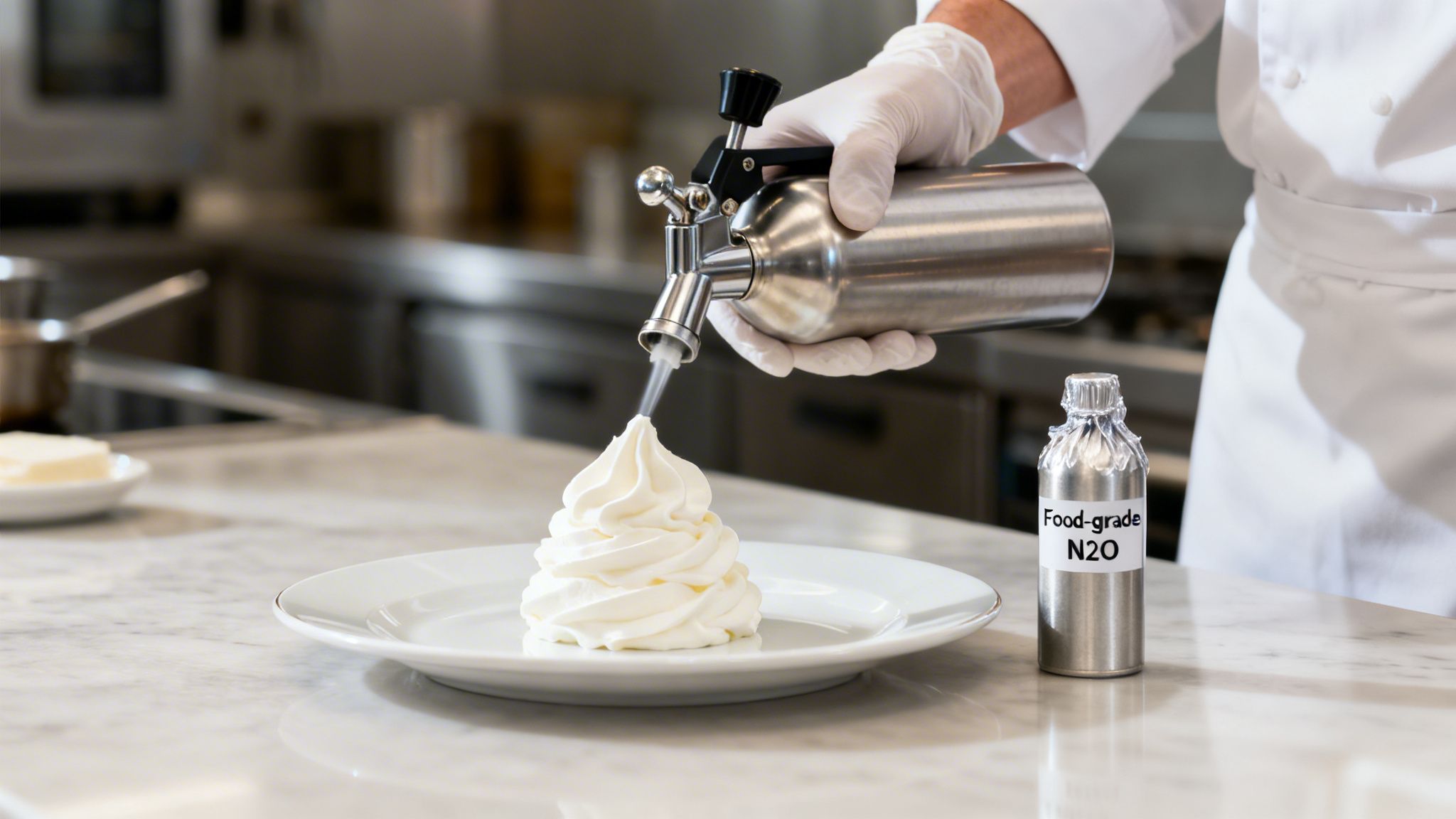
Think of food-grade nitrous oxide as a purpose-built culinary propellant. When you charge a cream dispenser, the protoxido de nitrogeno dissolves perfectly into fatty or alcoholic liquids under pressure. Releasing that pressure creates a network of incredibly fine, stable bubbles, resulting in a signature velvety mouthfeel that’s impossible to ignore.
This is precisely why the best chefs and bartenders across the Canary Islands, from packed-out bars in Las Palmas to exclusive resorts in Adeje, swear by it. It’s not just about making whipped cream faster; it's about control, consistency, and putting out a premium product, every single time. Those tiny, flavourless bubbles are the key.
The Purity Advantage
The quality of your final dish or drink hangs entirely on the purity of your gas. Food-grade nitrous oxide is held to a strict standard, usually clocking in at 99.9% purity. This guarantees you won't get any industrial oils, odd smells, or metallic aftertastes spoiling a delicate dessert or a high-end cocktail.
Using a non-certified gas is a risk no professional kitchen or bar should ever take. Impurities don't just ruin the flavour; they can clog and damage your expensive siphon equipment over the long run.
In this business, consistency is everything. Using certified E942 nitrous oxide means every single mousse, foam, and whipped topping comes out with the exact same flawless texture and clean taste. It protects your product, your equipment, and your reputation.
To give you a clearer picture, here’s a quick breakdown of what makes certified E942 so critical for your business.
Food-Grade N2O (E942) At a Glance
Ultimately, choosing certified gas is about removing variables. It’s one less thing to worry about when service gets hectic.
More Than Just Whipped Cream
While perfect whipped cream is its most famous trick, the real magic of protoxido de nitrogeno lies in its versatility. Once you understand what it can do, it opens up a whole new playbook for your menu.
- Silky Espumas and Foams: Create incredibly light toppings from vegetable purées, fruit juices, or even savoury broths that hold their shape and look stunning on the plate.
- Rapid Infusions: Force flavour into spirits, oils, and vinegars in minutes, not weeks. Imagine a bartender making a signature chilli-infused tequila to order right in front of the customer.
- Velvety Mousses and Creams: Achieve that perfectly smooth, stable dessert texture that's notoriously difficult to get right with gelatine and elbow grease alone.
Mastering this one tool gives you a serious creative and operational edge. It’s an essential part of the modern kitchen, delivering efficiency and innovation in one pressurised tank. To dig deeper into the possibilities, you can explore more about how cream chargers are used in bars and restaurants.
Understanding Purity Certifications and Food-Grade Standards
When you're sourcing protoxido de nitrogeno for your bar in Las Palmas or your resort kitchen in Adeje, what’s printed on the outside of the cylinder is every bit as important as the gas inside. Those aren't just logos; they are your guarantee. They’re the line between professional quality and a potentially serious mistake.
For any professional establishment, two marks are absolutely non-negotiable: E942 and CE approval. Think of E942 as the gas’s passport for food use in Europe—it confirms the nitrous oxide meets strict safety standards for consumption. The CE mark is its broader visa, showing it complies with all health, safety, and environmental rules for the European market.
Why Food-Grade Is the Only Option
There’s a world of difference between food-grade (E942) nitrous oxide and the industrial-grade stuff used for cars or medical equipment. The industrial version is a minefield of impurities—think industrial lubricants, sulphur compounds, and other contaminants you would never want anywhere near your kitchen.
Letting these into your culinary creations is a recipe for disaster. Here’s what happens:
- Ruined Flavours: An unmistakable metallic or chemical aftertaste can instantly destroy a delicate foam or a signature cocktail you’ve spent hours perfecting.
- Damaged Equipment: Those oily residues don’t just disappear. They build up inside your expensive cream whippers and siphons, causing clogs and eventually leading to equipment failure.
- Serious Health Risks: This is the most critical point. Serving a customer a product tainted with industrial chemicals isn't just bad service—it’s a genuine health hazard that opens your business up to massive liability.
The only way to avoid this is to work with a supplier who guarantees sealed, 99.9% pure cylinders. That purity level ensures a completely clean, neutral taste, letting the quality of your actual ingredients take centre stage.
Beyond the Gas: Your Supplier's Credentials
The gas itself is only half the story. You also need to know that the company bottling and handling it is operating professionally. This is where ISO 9001 certification becomes a vital signal. When a supplier is ISO 9001 certified, it means they have a documented, audited quality management system for everything from sourcing to bottling to delivery.
A supplier with ISO 9001 certification isn't just making promises; they have proven processes. It’s your assurance that you’ll receive a safe, consistent, and reliable product with every single order you place.
This links directly to traceability. A reputable B2B supplier should be able to trace every single cylinder right back to its point of origin, giving you a clear chain of custody. That transparency is your best defence against counterfeit or low-grade products sneaking into your supply chain. For a deeper dive into the nuts and bolts of this, our guide on nitrous oxide compliance for hospitality businesses covers it all.
Ultimately, asking pointed questions about certifications, purity, and traceability isn't being difficult—it’s just being a professional. Verifying your source protects your customers, your reputation, and your bottom line. It’s how you make sure every single foam, infusion, and mousse you create is not only incredible but also perfectly safe.
How to Elevate Your Menu With Foams and Infusions
Beyond a perfect whipped cream, protoxido de nitrogeno is your secret weapon for real culinary creativity. It's what allows a sharp chef or an inventive mixologist to play with textures and flavours in ways that used to be incredibly difficult or just took too long. This is how you turn a standard menu item into something people remember and talk about, from a delicate, airy foam to a spirit infused with fresh flavour in literally minutes.
The science is pretty simple, but the results are impressive. When you introduce protoxido de nitrogeno into a sealed siphon, the intense pressure forces the gas to dissolve into the liquid—it works especially well with fats and alcohols. The magic happens when you dispense it. Releasing that pressure causes the gas to expand instantly, creating a network of tiny, stable bubbles that gives you an unbelievably smooth and light texture.
In practice, this completely changes what you can do with everyday ingredients. A basic fruit purée transforms into a feather-light espuma to finish a dessert. A savoury broth becomes a stable foam, adding a whole new layer to a starter.
Creating Rapid Infusions: A Practical Guide
For any bar, one of the most powerful uses is rapid infusion. Traditional infusions can sit on a shelf for weeks. With a cream whipper and protoxido de nitrogeno, you can get a deep, complex infusion in less than two minutes. The high pressure literally shoves the liquid into the pores of your solid ingredients—herbs, spices, fruit—and pulls out their flavour and aroma at lightning speed.
Think about it: creating a signature cocktail with a custom-infused spirit, made fresh to order, right in front of the guest.
Example Mini-Guide: 2-Minute Pineapple-Infused Rum
- Prepare: Grab a 1-litre cream whipper and add 500ml of a good white rum and a handful of chopped fresh pineapple.
- Charge: Screw the lid on tight and charge it with two E942 cream chargers. Give it a hard shake for about 30 seconds.
- Rest: Now, let it sit for another 60 seconds. This is where the pressure does its work, forcing the flavour into the rum.
- Vent: This part is crucial. Hold the whipper perfectly upright and vent the gas slowly. If you rush it, you'll have a pineapple rum volcano on your hands. Once the hissing stops, you can unscrew the top.
- Strain: Pour the infused rum through a fine-mesh sieve to get rid of the pineapple chunks. It’s now ready for a world-class mojito or daiquiri.
The ability to rapidly infuse spirits, oils, or even vinegars opens a new frontier for menu development. It allows for on-the-fly creativity and gives bartenders a unique point of difference, transforming a standard drink order into a memorable piece of craft.
This technique is a game-changer for any busy bar. During a packed service in Tenerife or Gran Canaria, creating these bespoke flavours on demand means you aren’t prepping big batches of infusions that might just sit there, losing money.
Making sure your gas is up to the task is fundamental. You're not just creating a drink; you're creating an experience that relies on purity and safety.
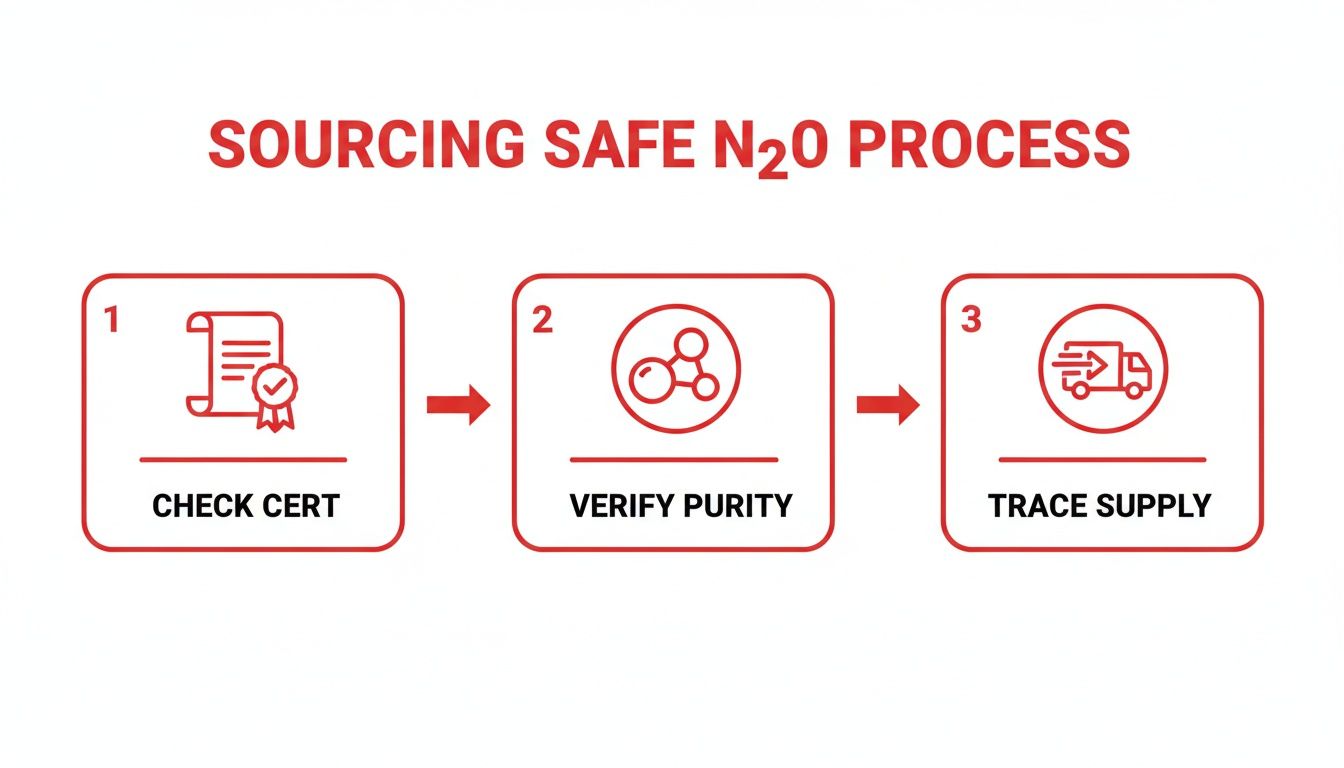
Following these three steps—checking certifications, verifying purity, and tracing your supply—isn't just bureaucracy. It's about protecting your craft, your equipment, and your customers.
Perfecting Espumas and Mousses
The same pressure principle is at play when making foams (espumas) and mousses, but here, it's all about texture. Protoxido de nitrogeno is brilliant because it's highly soluble in both fat and water. This allows it to create a much finer, more stable bubble structure than you'd get with something like CO2, which gives you the big, coarse bubbles you want for a fizzy drink, not a delicate foam.
This difference is what lets you create a stable beetroot foam to sit on a carpaccio starter, or a rich chocolate mousse that holds its airy structure without needing a ton of gelatine or egg whites to prop it up.
- Savoury Foams: Think vegetable purées, cheese sauces, or light broths. Add a little fat like cream or olive oil to help stabilise it, and you're good to go.
- Sweet Mousses: You can make classic chocolate, fruit, or coffee mousses with a velvety finish that feels far more professional, and with much less manual work.
For any high-volume kitchen, efficiency is everything. Constantly having to change tiny 8g chargers during a dinner rush is a major bottleneck. This is where larger protoxido de nitrogeno cylinders, like 2kg tanks, become an operational necessity. You connect a hose and regulator, and you can produce large, consistent batches of foam or cream without breaking your rhythm. It saves an incredible amount of time, reduces waste, and frankly, makes your whole kitchen run smarter.
Safe Storage and Handling Practices for N2O Cylinders
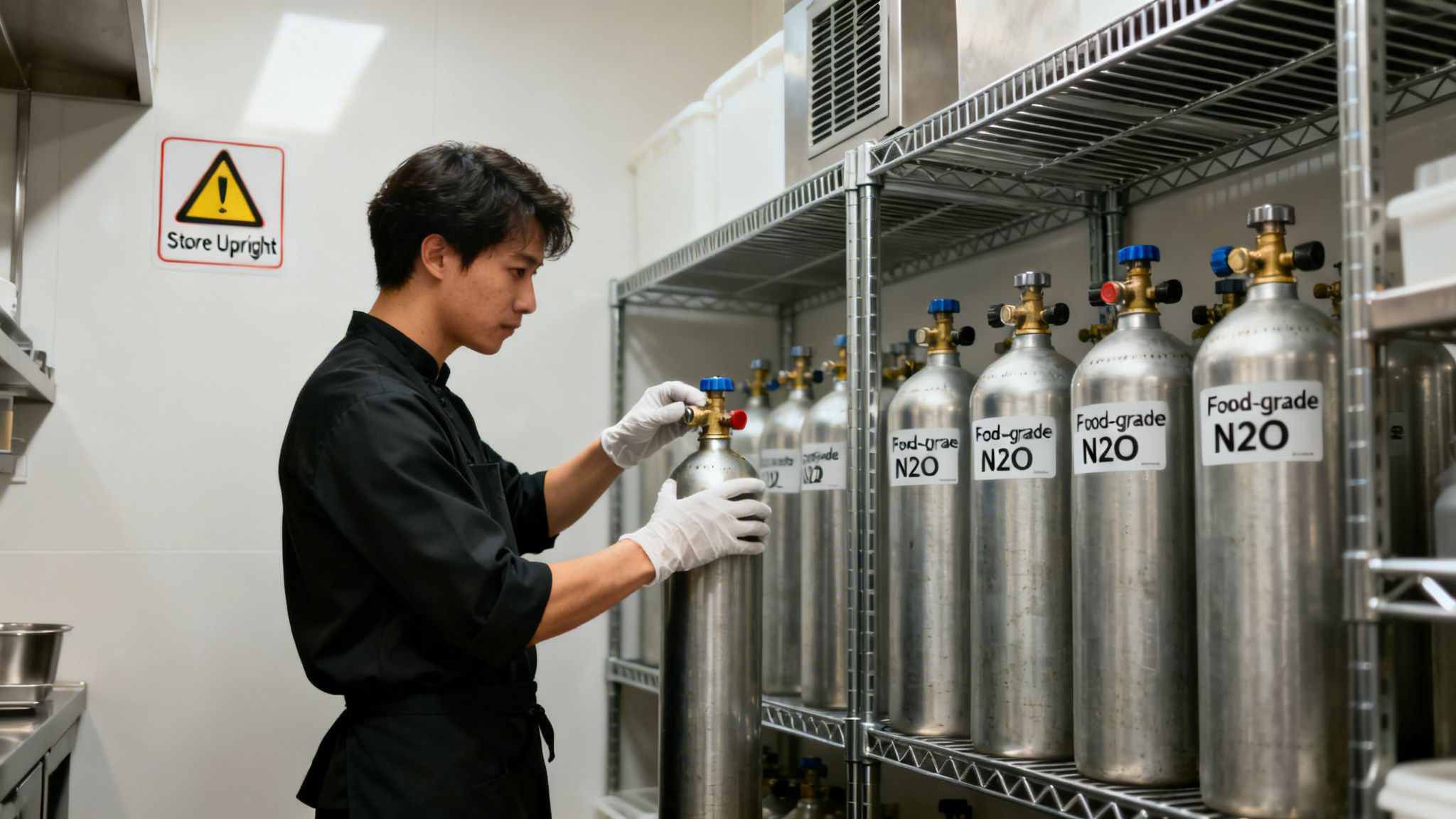
While protoxido de nitrogeno opens up a world of culinary creativity, none of it matters if you aren't handling it safely. In the controlled chaos of a busy kitchen or bar, safety can't be an afterthought. It has to be as ingrained in your team as knife skills or hygiene.
Think of a pressurised gas cylinder like a chef’s knife—it’s an indispensable tool that demands respect. You wouldn't leave a blade unsecured, and the same principle applies here. Getting your storage right is the first and most critical step to running a professional, compliant operation.
Core Storage Principles
The rules for storing protoxido de nitrogeno are straightforward and built on common sense. Your main goal is simple: keep the cylinders in a stable environment where they won't get knocked over, heated up, or damaged.
- Upright and Secured: Cylinders must always be stored vertically. Never on their side. Chaining them to a wall or using a sturdy bracket is essential to prevent them from tipping over, which is how most valve damage happens.
- Cool and Ventilated: Heat is the enemy of any pressurised gas. Keep your cylinders in a cool, dry, and well-ventilated area, far from direct sun, ovens, or any other heat source. The golden rule is to keep them below 50°C (122°F).
- Away from Flammables: N2O itself isn't flammable, but it is an oxidiser. That means it can make other materials burn much more intensely. It must be stored well away from flammable liquids and combustible materials.
Treat your gas storage area with the same discipline you apply to your walk-in. A clearly marked space for full and empty cylinders keeps things organised and dramatically cuts the risk of mistakes during a busy service.
This simple system stops the guesswork. Your team knows exactly where to grab a fresh cylinder and where to put the empty one, making the changeover process smooth and safe.
Staff Training and Handling Checklist
Proper training turns a list of rules into muscle memory. Every member of your team who might touch a protoxido de nitrogeno cylinder needs to be confident and competent, especially when working with larger cylinders that require regulators. The difference in handling various sizes is significant, and you can learn more about 580g vs 2kg N2O cylinders in our article.
Here's a practical checklist to run through with your staff:
- Inspect the Cylinder: Give it a quick visual check before use. Look for any obvious damage like dents or rust, paying close attention to the valve.
- Attach the Regulator Correctly: Make sure the regulator and valve threads match. Always start threading it by hand to avoid cross-threading, then tighten it firmly with the proper wrench. Don't go overboard.
- Check for Leaks: After attaching the regulator, open the valve slowly. A bit of soapy water brushed around the connection will instantly show a leak by forming bubbles. If you see them, close the valve and retighten.
- Handle with Care: Never drag or roll cylinders. For larger tanks, use a trolley, even if you’re just moving it a few feet. It prevents injuries and protects the cylinder.
If you ever have a leak you can’t stop, the procedure is direct: get the cylinder to a well-ventilated outdoor space, away from people and ignition sources, and let it empty. Lastly, remember that empty cylinders are not general waste. They need to be handled according to local regulations, which usually means returning them to your supplier. It’s the final step in taking professional responsibility for your tools.
Navigating Logistics and Regulations in the Canary Islands
Getting protoxido de nitrogeno in the Canary Islands isn't like ordering it on the mainland. The archipelago's unique geography creates a specific set of logistical traps. Getting it wrong means supply chain chaos, surprise costs, and major compliance headaches. The journey for a single cylinder involves a maze of customs, inter-island ferries, and specific local taxes that can easily trip up an unprepared business.
Mastering Island-Specific Logistics
The two biggest hurdles for any hospitality business here are, without a doubt, customs clearance and tax compliance. Every single shipment that arrives from outside the islands has to clear customs, a process that requires absolute precision with paperwork.
Then you have the IGIC (Impuesto General Indirecto Canario), our local value-added tax. A supplier doesn't just need to know how to apply it; they need to provide you with an invoice that will stand up to an audit. One tiny mistake can halt your delivery and create an accounting nightmare that takes weeks to fix.
A dedicated local logistics partner is your shield against this. They handle the entire gauntlet—from filling out customs declarations to calculating the final IGIC—to ensure your delivery arrives without a hitch, complete with a perfectly compliant, IGIC-inclusive invoice. This transforms a logistical nightmare into a simple, predictable delivery.
Choosing a supplier who lives and breathes the Canarian market is the single most important decision you'll make. It’s the difference between a smooth, reliable supply chain and constant, nagging uncertainty. To make sure you’re fully compliant, it’s worth reviewing our comprehensive guide on the legality of E942 in the Canary Islands.
The Real-World Value of Same-Day Delivery
In any busy kitchen or bar, especially in prime tourist spots, storage space is gold. When your demand swings wildly with seasonal tourism, it’s almost impossible to guess how much protoxido de nitrogeno you'll need. You either overstock and tie up cash, or understock and risk running out.
This is where a flexible delivery model stops being a "nice-to-have" and becomes a critical business tool. Having access to same-day delivery means you can stop guessing. You can run a lean, just-in-time operation, ordering what you need, exactly when you need it.
- Adapt to Demand: Instantly handle a packed-out weekend or a last-minute event without the fear of running dry.
- Maximise Space: Free up that precious storeroom space for other essentials instead of dedicating it to bulky gas cylinders.
- Improve Cash Flow: Order smaller amounts more often, keeping money in your business instead of letting it sit on a shelf.
That level of responsiveness is what gives you the stability to thrive in a market as dynamic as the Canaries. It's the key to maintaining consistently high quality without interruption.
Local Environmental Context
Our commitment to purity in the kitchen also connects to a bigger picture: our environment. High above Tenerife, at the Izana Atmospheric Observatory, scientists have been tracking atmospheric protoxido de nitrogeno (N2O) since the 1980s. The data shows a clear trend, with concentrations rising from about 310 parts per billion (ppb) in 1990 to over 332 ppb by 2020. This increase, largely tied to agricultural emissions, reminds us how important precise gas management is. You can dig into the atmospheric data yourself, courtesy of the NOAA Global Monitoring Laboratory's research at Izana.
For hospitality professionals, this is a powerful motivator. Using certified, traceable E942 cylinders not only guarantees a perfect foam or infusion but also supports the kind of responsible operation that protects the very beauty that draws people to our islands.
How to Streamline Your Procurement and Reduce Costs
For any serious hospitality operator in the Canary Islands, thinking about how you buy protoxido de nitrogeno shouldn't just be a hunt for the cheapest cylinder. That's a rookie mistake. Smart procurement is about building a relationship that actually drives down your long-term costs, guarantees you're always compliant, and gives your kitchen the creative freedom it needs.
It's about turning your supply chain from a headache into a genuine advantage.
When you partner with a dedicated B2B wholesaler, you unlock savings that sporadic, ad-hoc purchasing could never touch. High-volume venues in Tenerife and Gran Canaria can cut their procurement costs by 33% or more with the right distributor program. This isn’t just a one-off deal; it's a fundamental shift in how they operate, adding directly to their bottom line.
But a partnership like that has to be built on professional trust and legal ground. That’s why verified B2B transactions are non-negotiable.
Why Verified B2B Transactions Are Mandatory
A legitimate supplier will always ask for your business details, specifically your CIF/NIF (Código de Identificación Fiscal). This isn't just bureaucracy; it's the bedrock of a professional, legal supply chain. It’s how we ensure food-grade protoxido de nitrogeno goes exactly where it's intended—into a professional culinary setting—protecting both your business and ours from any potential misuse.
Frankly, this verification step is the first and clearest sign that you’re dealing with a serious, compliant partner. If you're ready to get set up, our guide explains how to open a wholesale account with Kings Canisters.
Smart Inventory Management for Cost Control
Controlling your costs and preventing a mid-service disaster comes down to managing your stock properly. It all starts with getting a real handle on your usage. Don't guess. Track how much gas you go through on a slow Tuesday versus a slammed Saturday night. That data gives you a baseline.
Strategic sourcing is ultimately about reliability. It’s the confidence that you can scale your creative offerings and meet any surge in demand without ever worrying if you’ll have the supplies you need.
Once you know your numbers, you can pick the right tools for the job.
- High-Volume Use: For busy bars and restaurant kitchens, large 2kg cylinders hooked up to a regulator system give you the best cost-per-gram and keep your team moving efficiently.
- Lower-Volume or Mobile Use: Smaller 666g canisters are perfect for catering gigs, smaller bars, or for specific, low-use infusions where you need something portable.
A good partner doesn't just sell you a tank; they help you analyse your workflow and recommend the most cost-effective setup. This isn't just about avoiding a stockout during a rush—it's about making sure you aren't tying up cash in stock you don't need. It’s the foundation of a resilient, profitable operation.
Local Business Information: Your Canary Islands Supplier
For businesses operating in the Canary Islands, sourcing protoxido de nitrogeno locally is the only practical solution. Kings Canisters is a dedicated B2B wholesaler based in the archipelago, providing a streamlined and compliant supply chain for the hospitality industry.
- Name: Kings Canisters
- Service Area: All Canary Islands, including Tenerife, Gran Canaria, Lanzarote, Fuerteventura, La Palma, La Gomera, and El Hierro.
- Products: Certified food-grade E942 nitrous oxide, including 666g and 2kg cylinders, regulators, and accessories.
- Key Services: Verified B2B accounts, IGIC-compliant invoicing, same-day delivery options, and expert logistical support for inter-island transport.
- Contact: Visit our website to open a professional account or inquire about our services.
Frequently Asked Questions (FAQ)
When you're running a busy kitchen or bar, you need straight answers on protoxido de nitrogeno. Here’s what we hear most often from professionals like you, and the practical advice we give.
Is it legal for my business to buy and use nitrous oxide?
Yes. Food-grade nitrous oxide, properly labelled as E942, is completely legal for professional B2B use in the hospitality sector across the Canary Islands. The key is partnership. A legitimate supplier won't just sell you a cylinder; they'll require your CIF/NIF to verify you're a registered business. This isn't red tape—it's your assurance that you're operating within the regulations and using the gas for its intended culinary purpose.
What’s the real difference between canister sizes?
The difference isn't just size; it's efficiency and cost.
- Small Canisters (8g): These are fine for home use. In a professional kitchen, they are a workflow killer, forcing you to stop and reload constantly.
- Large Cylinders (666g to 2kg): This is the professional standard. One 2kg cylinder does the work of roughly 250 of the smaller 8g chargers. The maths is simple: less downtime, lower cost-per-use, and a much smoother service.
For any high-volume application—whipped cream, espumas, rapid infusions—moving to a larger format is one of the quickest ways to improve your team’s performance during the rush.
Which gas is right for my menu?
The product you choose should serve your creative vision. For most applications, like creating delicate foams or a perfect whipped cream, you need a completely neutral base. High-purity, unflavoured products are the industry workhorses because they let your core ingredients speak for themselves.
However, if you're creating unique cocktail infusions or a dessert with a twist, flavoured options can add an extra dimension directly into the infusion. It's a smart shortcut that delivers a memorable experience.
It’s also important to understand the context of what you’re using. While Spain’s primary source of N2O emissions comes from agriculture, the hospitality industry's responsibility is to focus on product purity and safety. Sourcing certified 99.9% pure protoxido de nitrogeno ensures your creations are safe for consumption. This is a critical distinction, especially in a market where tourism accounts for 35% of the Canary Islands' GDP. For a deeper look at the national emissions data, the World Bank offers detailed insights into agricultural N2O emissions in Spain.
Ready to streamline your supply chain and unlock new creative possibilities? Partner with Kings Canisters, the Canary Islands' dedicated B2B wholesaler for certified E942 nitrous oxide. We handle the logistics so you can focus on quality. Explore our product range and open your professional account today.