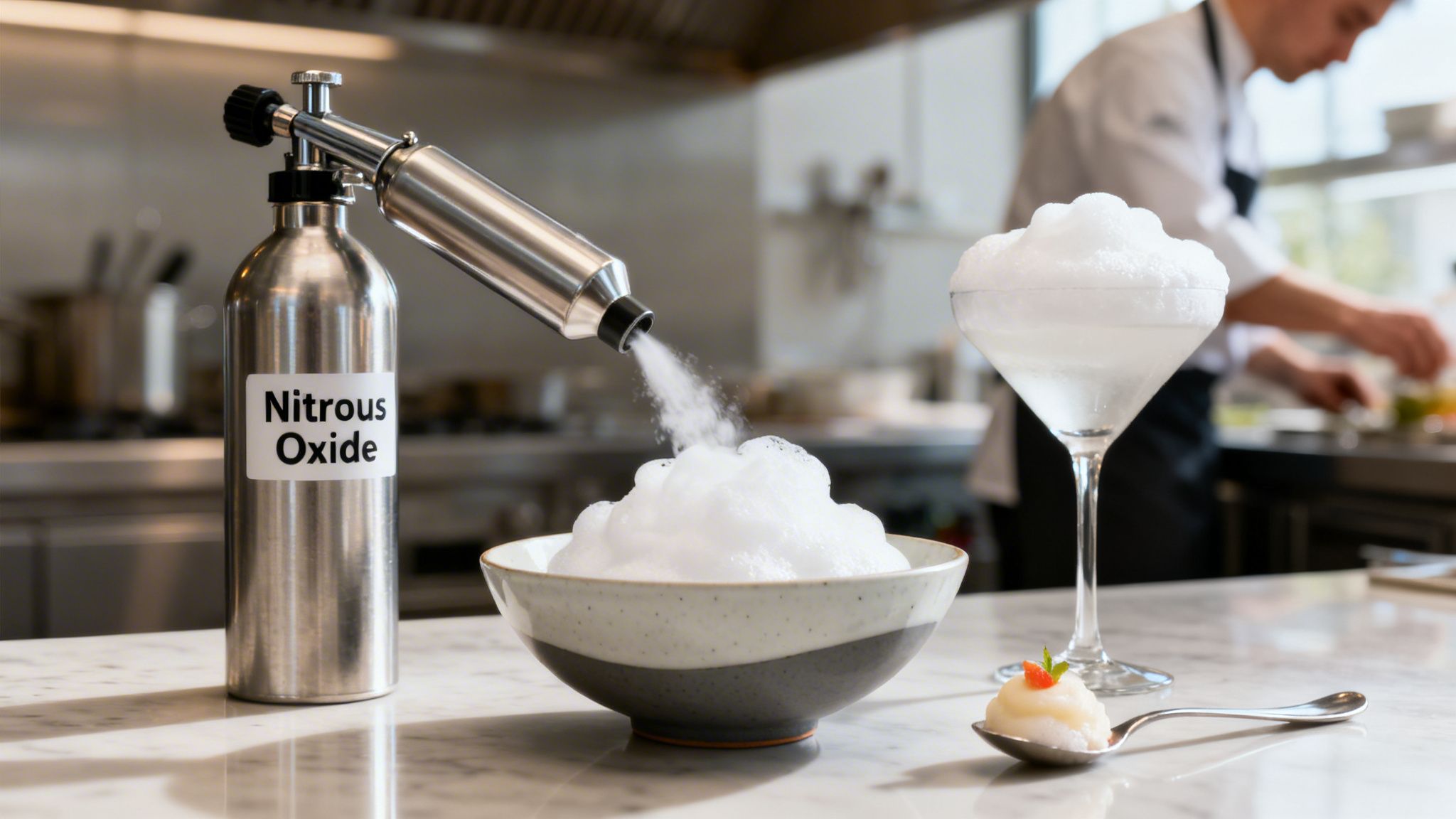

What Is Nitrous Oxide Used For in Modern Cuisine?
Summary: This guide provides a practical overview of food-grade nitrous oxide (E942), explaining its role in professional kitchens and bars. We'll cover everything from the science of creating perfect foams and rapid infusions to choosing the right equipment, ensuring safety, and navigating local regulations in places like the Canary Islands. This is a no-fluff resource for chefs and bar managers who need actionable information.
Key Points
- Primary Use: Nitrous oxide (N2O) is a food additive (E942) used as a propellant to create stable foams, creams, and mousses with a superior texture.
- Key Advantage: It offers speed, consistency, and preservation. N2O is bacteriostatic and prevents oxidation, keeping preparations fresh.
- Creative Applications: Beyond whipped cream, N2O is used for making savory 'espumas' and, crucially, for rapid flavor infusion in spirits and cocktails.
- Efficiency: Large-format cylinders (670g to 2kg) are far more cost-effective and efficient for commercial use than small 8g chargers.
- Safety & Legality: Only use certified, 99.9% pure food-grade E942. For businesses in the Canary Islands, sourcing from a B2B supplier with proper IGIC invoicing is essential for compliance.
What Is Nitrous Oxide And Why Is It In Your Kitchen?

In the culinary world, we're talking about food-grade nitrous oxide (N2O), officially known as the food additive E942. Its job is to act as a propellant, but its unique properties are what make it a game-changer for any serious chef or bartender.
When you charge a whipping siphon with N2O, the gas dissolves perfectly into fatty liquids like cream or oil-based infusions. It sits there, waiting under pressure. The magic happens when you pull the trigger.
That sudden drop in pressure causes the dissolved gas to expand, creating millions of tiny, uniform bubbles. The result? A foam or cream with a much finer, more consistent texture that holds its shape far longer than anything you could whip by hand. It’s the key to a superior mouthfeel and a polished, professional look.
Here's a quick breakdown of what makes E942 so essential.
Food Grade Nitrous Oxide At A Glance
Essentially, it’s the tool that separates good texture from great texture.
The Professional Advantage
For any bar or restaurant, the benefits here are all about efficiency and creativity. I’ve seen kitchens where a sous chef spends valuable minutes whipping cream to order during a busy service—it’s just not sustainable.
With a siphon, a chef can prep a large batch of cream, foam, or mousse that stays fresh and ready to dispense for hours. This isn't just a matter of convenience; it’s about guaranteeing every plate and cocktail that leaves the pass has the exact same high-quality finish.
Across the Canary Islands, from the bustling resorts in Tenerife’s Costa Adeje to the high-end venues in Las Palmas, food-grade nitrous oxide is what allows the top kitchens and bars to deliver that flawless experience, night after night.
It also opens the door to so much more creativity, like crafting delicate savoury espumas or rapidly infusing spirits for unique cocktails. For a deeper dive into these applications, you can read our guide on what cream chargers are used for in bars and restaurants. This level of efficiency is exactly why larger formats, like our professional canisters, have become a staple in any establishment that values quality and speed.
The Science Behind Creating Perfect Foams And Textures
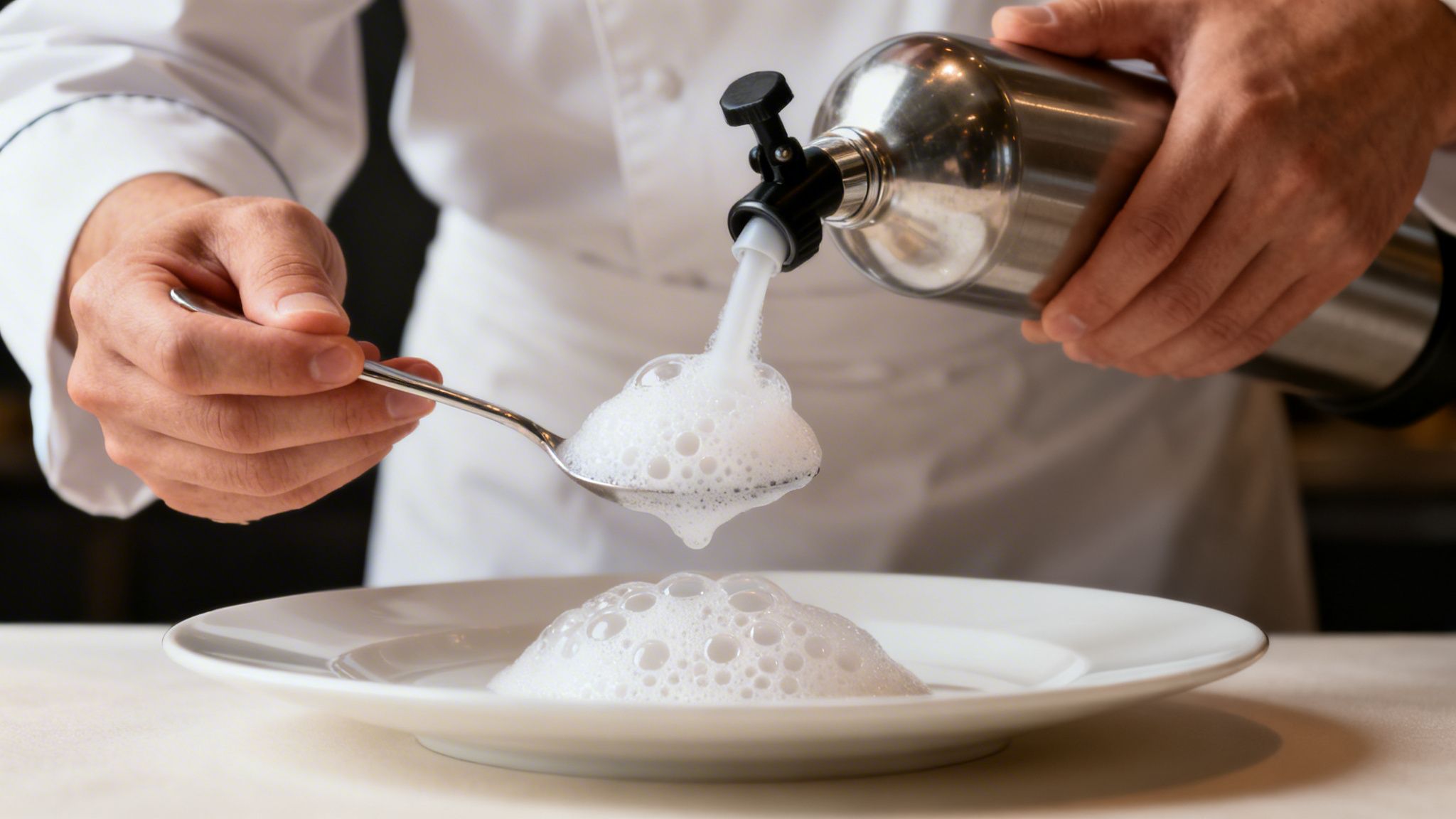
Ever wondered how a simple gas manages to create that flawless, silky-smooth finish in your espumas and creams? It’s not magic, but it’s close. The whole process is a brilliant bit of physics, all happening inside a pressurised whipping siphon.
When you charge a siphon filled with a liquid—anything rich in fat or protein works best—the nitrous oxide (N2O) gas gets to work. Under high pressure, the N2O dissolves completely into the liquid. It's the same principle that forces carbonation into water to make soda, but the results are entirely different.
The real transformation happens the moment you pull the trigger. That instant release of pressure causes the dissolved N2O to rapidly expand and turn back into a gas. This creates millions of incredibly fine, stable bubbles that get trapped by the fat and protein molecules in your liquid base.
Why N2O Is Superior To Air
This is where you really see the value of nitrous oxide. You could try whipping with plain air, but N2O has two massive advantages that make it a non-negotiable tool in any professional kitchen.
- No Oxidation: Air is roughly 21% oxygen, and oxygen is the enemy of freshness. It reacts with food, causing it to spoil and changing the flavour and colour of delicate ingredients like avocado or fresh cream. Nitrous oxide, on the other hand, is inert in this context and won't cause those issues.
- Bacteriostatic Properties: On top of that, N2O is also bacteriostatic. This means it actively stops bacteria from growing, keeping your preparations safer and fresher for much longer inside the sealed siphon. This is a game-changer for reducing waste and ensuring product quality.
Once you understand
para que sirve el oxido nitrosoat this level, you see its true genius. It isn’t just a whipping agent; it’s a preservation tool that protects your ingredients’ quality and integrity from the prep station to the final plate.
The result of all this science? You get a finished product with up to four times the volume you could ever hope to achieve by whipping by hand. This incredible yield produces an exceptionally light, airy texture that's impossible to get any other way.
For any business, whether you're running a busy café in Tenerife or a fine-dining spot in Las Palmas, this translates directly to your bottom line. You use less base product to create more finished volume, which boosts your margins while giving your guests a better experience.
To see how these principles work across different products and equipment, have a look at our articles on product education. This is the scientific edge that delivers consistent, high-quality results every single time.
Creative Menu Applications Beyond Whipped Cream
Perfectly stiff whipped cream is a great start, but it's only scratching the surface. The real magic happens when you push beyond the basics and start using nitrous oxide as a tool for genuine culinary invention. This is where you graduate from simply following a recipe to creating signature items that get people talking.
Think of your siphon less as a cream whipper and more as a texture and flavour accelerator. The same process that aerates cream can take a rich vegetable purée or a complex, savoury sauce and transform it into a delicate ‘espuma’. This light-as-air foam delivers an intense hit of flavour with a sophisticated texture that genuinely surprises the palate. It’s an elegant touch that elevates a dish instantly.
Rapid Flavour Infusion for Cocktails
For any bar manager, the most exciting application is easily rapid infusion. I’ve seen bartenders' eyes light up when they realise they can infuse bourbon with the smoky notes of paprika or a crisp gin with fresh cucumber and mint in less than two minutes. This is a process that, traditionally, would mean steeping your ingredients for days, sometimes even weeks.
It's all down to pressure. When you combine a spirit with flavouring agents—think herbs, spices, or fruit—inside a siphon and charge it with N2O, you're essentially forcing the flavour into the liquid. The high pressure opens up the cell walls of the botanicals, and the gas acts like a super-efficient vehicle, carrying all those aromatic compounds directly into the alcohol. It’s almost instantaneous.
This technique is a complete game-changer for a cocktail programme. It opens up a world of possibilities, allowing for:
- On-Demand Creations: You can serve truly unique, high-margin infused cocktails without the headache of long prep times.
- Menu Flexibility: Experiment with seasonal ingredients and new flavour combinations with practically zero waste. If an idea doesn't work, you've only lost a single serving.
- Unforgettable Experiences: Offer guests signature drinks they simply can't get anywhere else.
Streamlining Infusions with Flavoured Chargers
You can take the efficiency even further. For mixologists working in the high-energy nightclubs of Las Palmas, products like Miami Magic Strawberry are designed to deliver 20% more vibrant infusions per gram. Their distributor program has been shown to cut preparation time by a staggering 33%—a massive advantage when you consider Tenerife's bar scene alone serves an estimated 2.5 million cocktails every month. For anyone curious about how these economic footprints are measured, the Spanish government's data portal has some interesting insights.
When a bartender asks
para que sirve el oxido nitrosoin a professional context, the answer is about speed and intensity. You are achieving in minutes what used to take weeks, unlocking a new level of creativity and service agility for your bar.
This rapid infusion method empowers bartenders to stop thinking in terms of a static menu and start developing a constantly evolving list of signature cocktails. From spicy tequila infusions for next-level margaritas to complex, fruit-forward vodkas for martinis, the bar is transformed from a point of service into a laboratory of flavour.
Once you master these techniques, you're not just using a tool; you're adopting a whole new philosophy for menu development. For more practical ideas, have a look through our guide on the versatile uses of cream chargers. This is the kind of innovation that makes an establishment stand out in a crowded market, driving both customer loyalty and healthier profit margins.
Choosing The Right Nitrous Oxide Supply For Your Business
Thinking about your nitrous oxide supply isn't just about restocking a pantry item; it's a serious business decision. For any professional kitchen or bar, the choice you make here directly hits your efficiency, your costs, and ultimately, the quality of your service. It's a classic case of what seems like a small detail having a huge impact on your workflow.
Those tiny, individual 8g chargers might be fine for a bit of fun at home, but they’re a recipe for disaster in a commercial setting. I’ve seen busy bars burn through dozens in a single service. Every time a canister runs dry, a bartender has to stop, grab a new one, and reload the siphon. That lost time adds up, creating frustrating bottlenecks behind the bar and driving up your labour costs without you even realising.
The professional answer is simple: it’s time to move up to large-format canisters.
Why Cylinder Size Is Everything For Efficiency
For any professional venue, from a small café in La Laguna to a sprawling resort in Costa Teguise, the numbers tell the real story. When you look at the cost-per-gram, the bigger you go, the more you save.
To make the right call, you need to match your hardware to your demand. We've put together a quick comparison to help you find the sweet spot for your operation.
Nitrous Oxide Cylinder Comparison For Professional Use
The takeaway is clear: while small chargers have their place, a professional operation's efficiency truly begins with 670g canisters and is perfected with 2kg cylinders. This decision is crucial whether your main goal is creating texture or infusing flavour.
This chart helps break down how your culinary goal should influence your equipment choice.
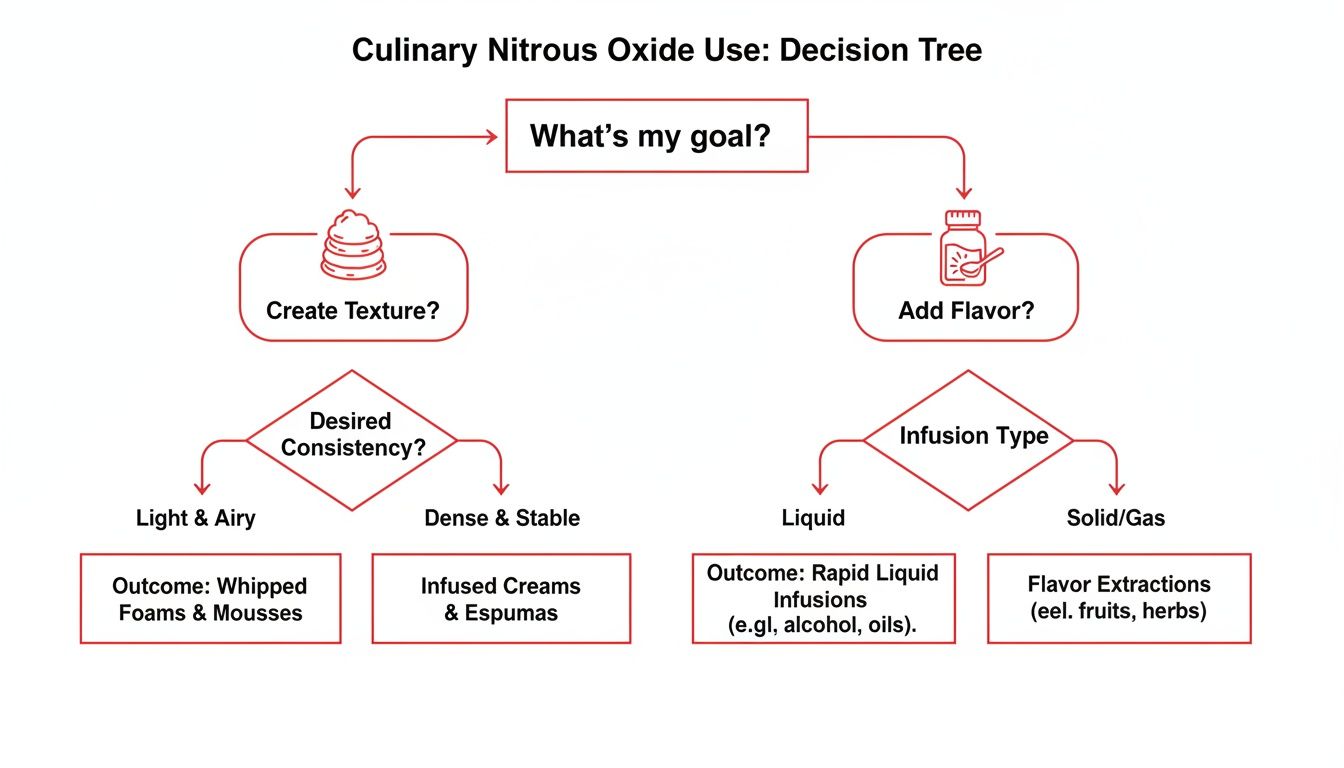
As you can see, high-volume texture work—the bread and butter of many modern kitchens—practically demands larger, more efficient canisters to keep the service running smoothly.
A bustling cocktail bar in Las Palmas or a resort kitchen in Adeje during peak season isn't just "upgrading" when they switch to a 2kg tank; they're making a necessary strategic move. The time saved from fewer reloads goes straight back into service, protecting your revenue.
Purity and Certification: The Non-Negotiables
Beyond size, the single most critical factor is the purity of the gas itself. Always, without exception, insist on 99.9% pure, food-grade E942 nitrous oxide. This isn’t just a quality preference; it’s a guarantee of food safety and predictable, consistent results in every foam, cream, and infusion you create.
Look for key certifications like ISO 9001 and CE markings on the packaging. These aren’t just logos; they are your assurance that the product meets strict European standards for quality and safety. Settling for uncertified or industrial-grade gas is a gamble you can’t afford to take with your customers' health or your business's reputation.
To make sure you’re properly equipped, you can explore a full range of professional-grade nitrous oxide canisters and accessories designed for the demands of the trade. Getting this right is fundamental to both your performance and your peace of mind.
Navigating Logistics And Compliance In The Canary Islands
Running a top-tier hospitality business in Tenerife, Gran Canaria, or Fuerteventura is a different game entirely. Your success isn't just about the quality of your menu; it's about mastering a supply chain riddled with customs hurdles, unique tax laws, and the constant need for absolute reliability—especially when the summer season hits its peak.
This is never truer than when sourcing professional-grade nitrous oxide. It’s not a simple purchase. It’s about securing a dependable, legal, and efficient supply line so your service never, ever stops. A single stockout on a busy Saturday night isn't an inconvenience; it's lost revenue and a hit to your reputation. This is where a specialist B2B partner becomes your most critical asset.
A proper local supplier isn't just a seller; they're your logistics team on the ground. They handle the entire chain of custody, from clearing customs to guaranteeing compliant storage and, most importantly, providing reliable daily delivery across the islands. It’s the invisible backbone of a smooth-running operation.
The Problem: The Missing Paper Trail
One of the first red flags I see with pop-up suppliers is the invoice. For any registered business in the Canary Islands, this is a make-or-break detail. A professional supplier must provide a proper IGIC-ready invoice with every single order. There's no grey area here.
Without it, you're flying blind. These documents are fundamental for:
- Clean Accounting: Keeping your financial records accurate and ready for inspection.
- Tax Compliance: Correctly declaring your expenses and managing your IGIC filings.
- Audit-Proofing Your Business: Creating a professional paper trail that proves legitimate operational spending.
Cutting corners on invoicing exposes your business to serious financial and legal headaches. It’s the clearest sign that separates a legitimate career supplier from someone just shifting boxes.
I often tell new managers that the question of
para que sirve el oxido nitrosoquickly evolves. It stops being about what it does in the kitchen and becomes about how you source it legally and efficiently to keep your doors open. A solid supply chain, with correct invoicing, is your first line of defence.
The Resolution: A Secure And Legal Supply Line
Partnering with a dedicated wholesaler like Kings Canisters means you’re not just buying gas; you’re buying peace of mind. It ensures you have a legal and steady flow of certified E942 nitrous oxide, protecting your venue from the chaos of stock shortages and the legal pitfalls of a shadowy supply chain. You can finally stop worrying about inventory and start focusing on your guests.
Of course, knowing the rules is half the battle. We always advise clients to fully understand the local regulations. For a detailed breakdown, our guide on the legality and compliance of N2O in the Canary Islands is an essential read. It’s about ensuring your operation is 100% compliant so you can deliver an exceptional experience without ever looking over your shoulder.
Safe Storage And Handling Best Practices
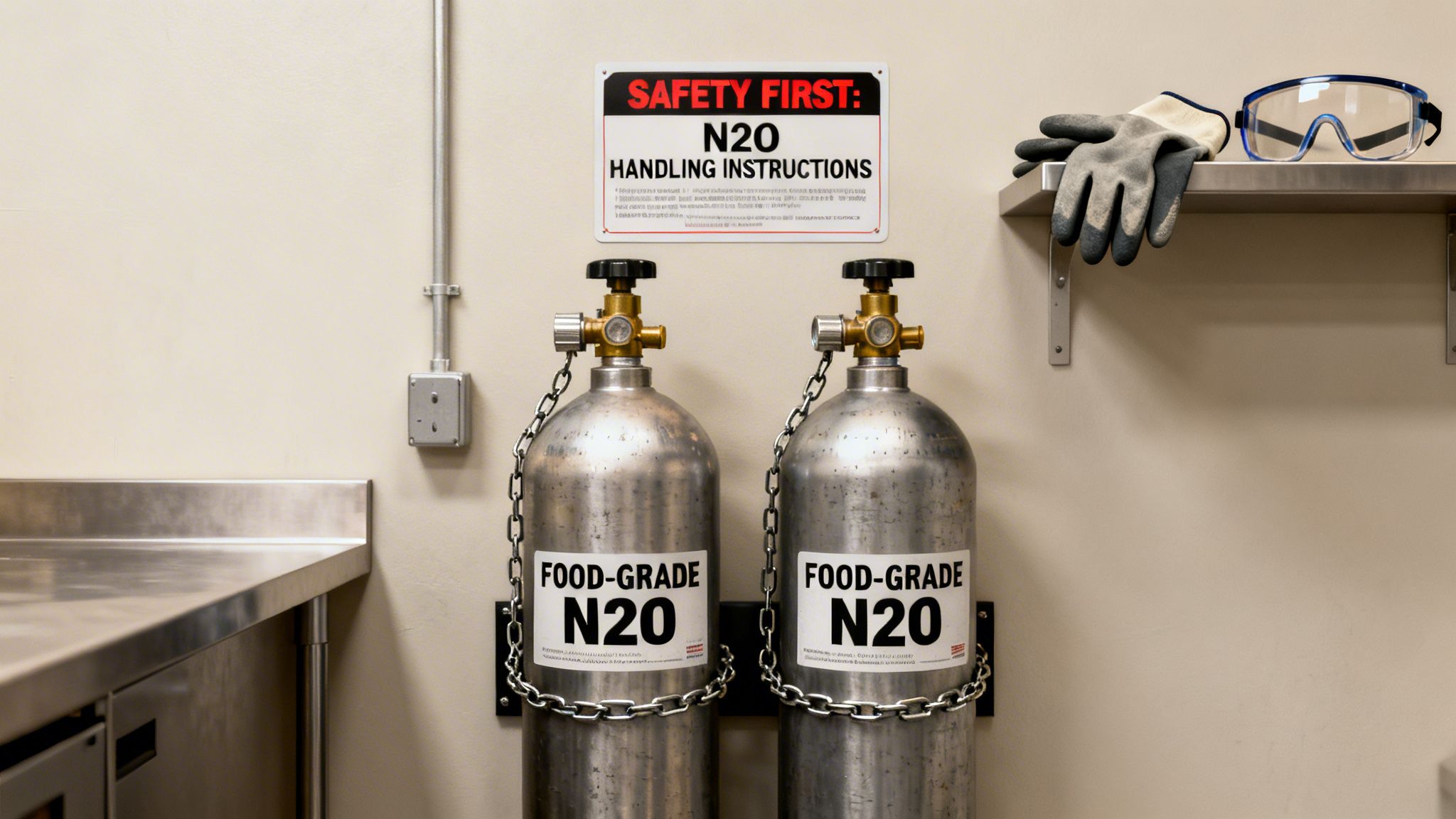
In a professional kitchen or bar, true excellence isn't just about what you create—it's about how you create it. When you’re working with pressurised gas like nitrous oxide, your team's safety protocols are just as important as your recipes. This isn't about ticking boxes for a health inspector; it’s about building a culture of respect for the tools of our trade and protecting your staff, your customers, and your reputation.
The first rule is simple: treat your cylinders with care. They should always be stored upright and secured to prevent them from tipping over. Find a spot that’s cool, dry, and well-ventilated—well away from the intense heat of the grill, direct sunlight, or busy service lines. A falling cylinder is a risk no one needs during a busy shift.
Purity Is Non-Negotiable
Here’s something I can't stress enough: not all nitrous oxide is the same. The only gas that should ever enter your kitchen is certified, food-grade E942. We're talking about 99.9% pure N₂O, free from the machine oils, metallic residue, and other nasty impurities found in industrial or automotive-grade gas.
Using uncertified gas isn't cutting a corner; it's gambling with your customers' health and the integrity of your menu. You wouldn't use subpar ingredients, so why risk contaminated gas?
When your team truly grasps
para que sirve el oxido nitrosofrom a safety standpoint, they understand that only certified E942 is fit for purpose. It’s a line you just don't cross.
This is precisely why a reliable B2B supply chain is so critical. We’ve all seen the news stories from other parts of Europe about the health problems linked to illicit or recreational use. Professional suppliers like Kings Canisters help uphold the industry’s integrity by sticking to the rules: providing gas that meets AESAN certifications, adhering to ISO 9001 standards, and issuing a proper IGIC invoice for every single order. If you're curious about how data helps track these kinds of economic and safety trends, you can explore some insights from the Spanish government data portal.
Correct Cylinder Handling Procedures
Proper handling doesn’t stop once the cylinder is in storage. The connection is where many preventable mistakes happen. Attaching a pressure regulator isn't complicated, but it demands a moment of focus.
- Check the Threads: Before you connect anything, give the threads on both the cylinder valve and your regulator a quick once-over. Look for dirt, dust, or any damage that could compromise the seal.
- Tighten Firmly, Not Fiercely: Use the right spanner to get a good, snug fit. You’re aiming for a seal that won't leak gas, not trying to break a world record. Overtightening can damage the threads for the next person.
- Open the Valve Slowly: This is a big one. Crack the main valve open slowly. This lets the pressure build in the regulator and hoses gradually, preventing a sudden shock to the system that could damage your equipment.
Embedding these simple habits into your team's daily routine transforms them from rules on a page into a professional workflow. It’s how you ensure safety, efficiency, and consistent quality, service after service.
FAQ: Your Nitrous Oxide Questions Answered
When you're running a busy kitchen or bar, you need straight answers. Here are some of the most common questions we get from chefs and managers about using nitrous oxide professionally.
How many servings can I get from a 2kg cylinder?
The first question I always get from chefs looking at the big 2kg nitrous oxide cylinders is about value. They see the size and wonder if it's overkill, but the numbers speak for themselves. From a single litre of cream, one of these tanks can help you create over 500 portions of perfect whipped cream. The exact yield will shift a bit depending on the fat content of your liquid and how dense you want the final foam, but the output is massive. It’s a game-changer for high-volume service.
Is it legal to buy large nitrous oxide canisters in the Canary Islands?
Yes, it is 100% legal for any registered business with a valid CIF/NIF to buy and use food-grade (E942) nitrous oxide for professional culinary work. We only operate on a B2B basis, ensuring every transaction is fully compliant with both Spanish and EU law. You’ll always get a proper, IGIC-ready invoice. The professional, B2B sale of certified E942 for kitchens is completely legitimate and worlds away from the illegal recreational market.
What’s the difference between food-grade and other types of nitrous oxide?
This is a non-negotiable point. Food-grade nitrous oxide (E942) is manufactured under strict purity controls to be free of industrial oils and contaminants that ruin flavor and can be harmful. Gases for medical or automotive use are not produced for human consumption. Always insist on certified E942 from a supplier who understands the culinary trade.
Can I use nitrous oxide to make drinks fizzy?
No, nitrous oxide and carbon dioxide do two very different jobs. N2O is a texturizer, creating a rich, dense foam with tiny, stable bubbles (think nitro coffee). If you want the sharp, acidic fizz of soda or sparkling water, you need carbon dioxide (CO2). They are not interchangeable.
Local Business Information: Kings Canisters
Kings Canisters is the premier B2B supplier of food-grade E942 nitrous oxide for the hospitality industry in the Canary Islands.
- Service Area: Tenerife, Gran Canaria, Fuerteventura, Lanzarote.
- Products: Professional-grade nitrous oxide cylinders (670g, 2kg, 3.3kg), whipping siphons, and pressure regulators.
- Key Feature: Guaranteed daily delivery, compliant IGIC invoicing for all business customers, and a commitment to supplying only certified, 99.9% pure E942.
- Contact: www.kingscanisters.com