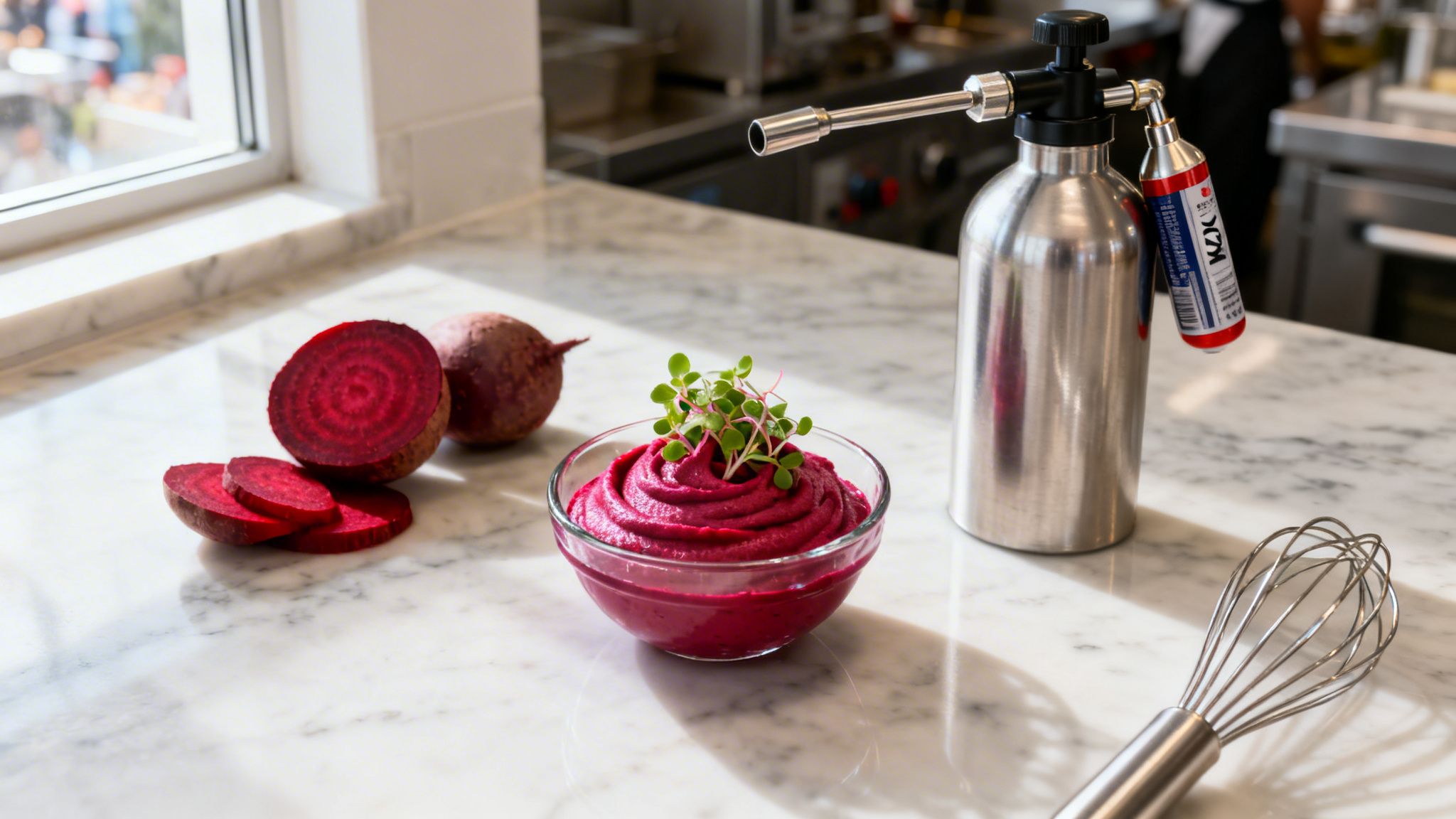

A Professional Guide to Beetroot Mousse (Mousse de Remolacha)
Summary
This guide provides a practical, step-by-step method for professional chefs and mixologists to create, scale, and serve perfect beetroot mousse, known as mousse de remolacha. It covers essential tools, a no-fail recipe focusing on yield and stability, smart storage techniques for kitchen efficiency, and creative menu pairings relevant to the Canary Islands market. The guide also emphasizes the critical importance of logistics, legal compliance with food-grade E942 nitrous oxide, and sourcing from reliable local suppliers like Kings Canisters to ensure profitability and operational smoothness.
Key Points
- Essential Toolkit: Use a high-powered blender, a fine-mesh sieve, and a 1-litre whipping siphon for a silky-smooth, consistent texture.
- Core Ingredients: High-quality, roasted local beetroot and double cream with at least 35% fat are non-negotiable for flavour and stability.
- N2O Supply: For professional use, switch from small 8g cartridges to large-format N2O cylinders (e.g., Kings Canisters 2.2L or 3.3L) to cut costs by over 50% and improve workflow.
- The Method: The process involves roasting beetroot, creating a smooth emulsion with cold cream, chilling the base, and charging it with two N2O charges for a 1L siphon. This can increase volume by over 400%.
- Storage & Efficiency: A charged siphon, stored horizontally in the fridge, keeps the mousse fresh and stable for up to 10 days, allowing for efficient batch-prepping.
- Legal Compliance: Only use certified food-grade E942 nitrous oxide. Ensure all purchases come with proper IGIC-ready B2B invoices to meet Canary Islands health and tax regulations.
- Local Supplier Value: Partnering with an island-based supplier like Kings Canisters in Tenerife avoids mainland delivery issues and ensures a reliable supply chain.
So, what exactly is mousse de remolacha? In professional kitchens, we're talking about a silky-smooth, vibrant beetroot purée that's been aerated into a light, airy foam. It's typically stabilised with a touch of cream or a specific gelling agent and given its lift using a whipping siphon charged with nitrous oxide. Its incredible colour and earthy-sweet flavour make it a surprisingly versatile tool on the line.
Why Beetroot Mousse Is a Secret Weapon for Canary Islands Chefs
I’ve seen it pop up on menus everywhere from high-end resorts in Tenerife to clever tapas spots in Lanzarote, and it's clear this isn't just another passing fad. For chefs who get it, beetroot mousse is a smart play that hits three key targets: stunning visuals, kitchen efficiency, and better margins. That deep magenta colour alone is a showstopper, giving an instant visual lift to everything from a simple appetiser to a complex main.
But it goes way beyond just looking good on the plate. The flavour of local Canary Islands beetroot—earthy with a natural sweetness—is incredibly adaptable. It works brilliantly alongside island staples like a sharp queso de cabra (goat's cheese) or local smoked fish, creating flavour combinations that feel both contemporary and distinctly Canarian. That flexibility means a single prep can be used across several different dishes, which is a massive win for reducing waste and getting the most out of your inventory.
The real game-changer, though, is how it's made. Anyone who has whipped up a traditional mousse knows it can be a fiddly, time-consuming job with inconsistent results. This is where modern kit, specifically a professional siphon and food-grade nitrous oxide (N2O), completely changes the equation. A task that used to eat up prep time becomes a quick, reliable, high-yield process that's built for the pressure of a busy service.
Practical Insight: For any professional kitchen, time saved is money made. Using an N2O system for something like beetroot mousse lets you create a perfectly stable, beautifully aerated product on demand, in seconds. It doesn't just promise consistency every single time; it dramatically increases the final volume, stretching your base ingredients and your budget further.
This guide is all about the practical side of making this work in a commercial kitchen here in the Canaries. We'll get into how a solid N2O supply chain turns a simple beetroot mousse into a profitable, reliable star on your menu. Getting the logistics right is everything, and if you’re trying to lock down a supplier you can count on, it pays to understand who supplies nitrous oxide in Tenerife and how to avoid the "mainland delivery trap." When you master this technique, you empower your team to work smarter, manage costs, and serve up a product that wows guests and keeps them coming back. It’s how you turn a humble root vegetable into a genuine advantage.
Your Essential Toolkit for Perfect Beetroot Mousse
To get that perfect mousse de remolacha every single time, it’s not about having the most expensive kit. It’s about having the right kit. What follows isn’t just a list; it’s a breakdown of the essentials we’ve seen work time and again in professional kitchens across the Canary Islands, built for quality, safety, and sheer efficiency.
The soul of this dish is, of course, the beetroot. Using high-quality, local remolacha is non-negotiable if you want that deep, earthy sweetness. Here in the Canaries—from Tenerife and Gran Canaria to Lanzarote and Fuerteventura—beetroot has become a modern staple. It’s no surprise, really. Agricultural records show wild beet thriving here since the early 20th century; it’s a resilient crop that’s perfectly suited to our island soil.
Just as important is the cream. For a mousse that’s rich, stable, and holds up beautifully under pressure, you need a high-fat double cream. I can't stress this enough: look for at least 35% fat content. Go any lower, and you’re setting yourself up for a runny, disappointing liquid that will break down before it even hits the table.
The Right Tools for the Job
While ingredients give the mousse its character, the equipment is what guarantees consistency. We’re talking about tools built for the demands of a busy service, not what you’d find in a home kitchen.
- A Proper Blender: You need power. A professional-grade blender is the only way to get a completely smooth, non-gritty beetroot purée. It has to be strong enough to obliterate every last fibre, leaving you with a silky-smooth base.
- A Fine-Mesh Sieve: Even with the best blender, don't skip this step. Pushing your purée through a fine-mesh sieve or a chinoise is the final quality check. It’s what separates a good mousse from a great one and ensures nothing clogs the siphon nozzle later.
- The 1-Litre Whipping Siphon: This is the workhorse. A professional 1-litre siphon lets you batch up enough mousse for a full service, keeping every single portion identical in texture and quality. It also keeps the mixture sealed and pressurised, holding its freshness for days.
If you're new to siphons, it’s worth getting to grips with how they function. Take a few minutes to understand how cream chargers are used in bars and restaurants; that knowledge will pay dividends across your entire drinks and dessert menu.
Choosing Your Nitrous Oxide (N2O) Supply
The final, crucial element is the nitrous oxide (N2O)—the gas that transforms your purée into a light, airy foam. For any professional operation, the choice between small cartridges and large cylinders isn't just a practical one; it’s a business decision.
Those tiny 8g cartridges are fine for a home kitchen experiment, but in a professional setting, they're a nightmare. They’re expensive, wasteful, and a logistical bottleneck. I’ve seen line cooks fumbling to reload a siphon mid-service, and it’s a recipe for disaster. This is where large-format N2O cylinders change the game entirely.
Business Case: We’ve seen it firsthand: a bustling hotel bar or a high-volume caterer that switches from small cartridges to a large cylinder can slash their cost-per-use by over 50%. The time saved during prep is just as valuable. The efficiency boost is undeniable.
A larger cylinder connects directly to your siphon with a hose and regulator. This setup lets you charge multiple siphons in seconds, all with precise, consistent pressure. The result is a more reliable product, faster prep, and significant cost savings.
When you're choosing a supplier for your N2O, nothing is more important than safety and compliance. You must insist on food-grade E942 nitrous oxide that is CE and AESAN certified. Reputable suppliers like Kings Canisters provide this as standard. They also issue the proper, IGIC-ready invoices that health inspectors in the Canary Islands require. This isn't just paperwork—it's a legal safeguard for your business.
Choosing Your N2O Supply for Professional Use
Making the right choice in N2O format comes down to your kitchen's specific output. A small café has different needs than a major resort. This table breaks down the options from Kings Canisters to help you find the most efficient and cost-effective solution for your volume.
| Cylinder Model | N2O Capacity | Estimated Mousse Yield | Best For | Key Benefit |
|---|---|---|---|---|
| Kings 580g | 580g | Approx. 60–70 Litres | Small-to-medium cafes, cocktail bars, or venues with moderate foam usage. | A significant step up from 8g chargers; less waste. |
| Kings 2.2L | 1360g (2kg) | Approx. 140–160 Litres | High-volume restaurants, hotels, and catering operations. | Maximum cost-efficiency and minimal prep disruption. |
| Kings 3.3L | 2000g (3kg) | Approx. 220–250 Litres | Large-scale event caterers, nightclub bars, and industrial kitchens. | The lowest cost-per-litre and longest service life. |
Ultimately, moving to a larger cylinder system is about professionalising your workflow. It reduces waste, lowers costs, and—most importantly—removes a point of failure during a busy service. It’s an investment in consistency.
The Professional Method: Nailing Your Beetroot Mousse
Alright, you've got the gear. Now it’s time to put it to work. This isn't just a recipe; it's a professional method designed for consistency, repeatability, and—most importantly—yield. In a high-volume bar or kitchen, that’s what separates a gimmick from a menu staple. We're going to build this mousse de remolacha from the ground up, focusing on the details that guarantee a perfect, stable foam every single service.
This is the entire workflow at a glance. It's deceptively simple, but every stage is critical.
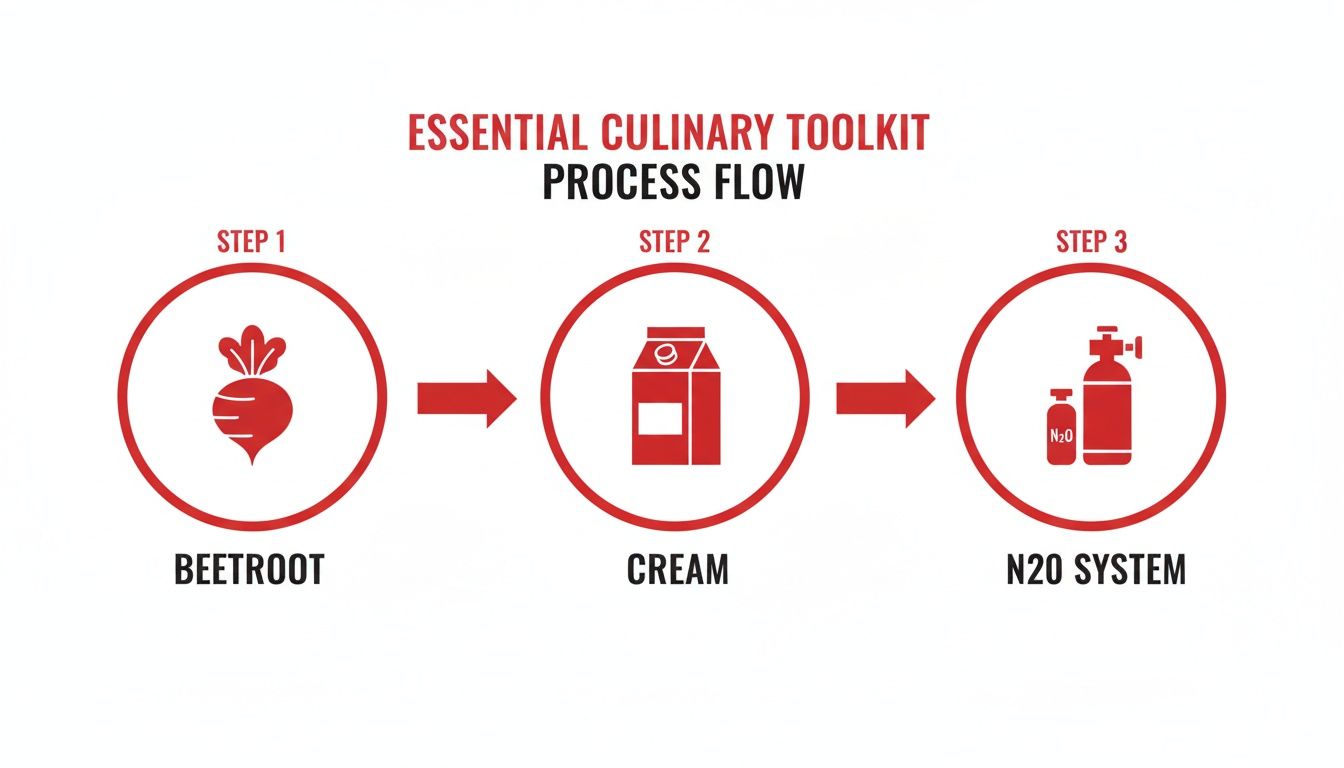
Think of these three elements—beetroot, cream, and your N2O system—as a triangle. If one point is weak, the whole structure fails.
Building the Flavour: The Beetroot Base
Your first choice here will dictate the final character of the mousse. You can either roast or boil the beetroot, and honestly, there's only one right answer for a premium product.
- Roasting: This is my non-negotiable method. Wrapping whole beetroots in foil with a little olive oil and salt, then roasting them low and slow, caramelises their natural sugars. It concentrates that deep, earthy flavour and, crucially, results in a drier purée. A less watery base is fundamental for a stable mousse.
- Boiling: It’s faster, I'll give you that. But you pay for it in flavour and texture. Boiling leaches colour and taste into the water, and the beets become waterlogged. This dilution can compromise the final emulsion. If you’re in a real bind and have to boil, at least leave the skins on to give them some protection.
Once cooked, let them cool just enough to handle, and the skins should slip right off. Quarter them up and get your blender ready for the most important stage.
The Emulsion: Engineering a Silky-Smooth Texture
A grainy mousse is an instant failure. It feels amateur and, worse, it will clog your siphon nozzle mid-service—a disaster you don't need on a busy night. The goal is a perfectly smooth, velvety liquid that flows without resistance.
In your high-powered blender, combine the cooked beetroot with a high-fat double cream (at least 35% fat). For a standard 1-litre siphon, I find a ratio of roughly 400g of cooked beetroot purée to 200ml of double cream works beautifully. Add your seasonings, then blend on the highest setting for a solid two to three minutes. You’re looking for a completely uniform, almost glossy sheen.
Pro Tip: Don't You Dare Skip Sieving.
I’ve seen countless chefs get impatient here, and it always shows in the final product. After blending, you must pass the entire mixture through a fine-mesh sieve or, even better, a chinoise. This is your quality control. It catches any tiny, stubborn fibres the blender missed and guarantees that flawlessly smooth mouthfeel. It’s the single step that separates the pros from the home cooks.
Once it's sieved, give it a final taste. Does it need a pinch more salt to make the flavour pop? A few drops of lemon juice to cut through the earthiness? Now is your last chance to dial in the balance before it gets charged.
The Charge: Getting Maximum Volume from N2O
You have a smooth, delicious base. Now for the magic. But before you even think about reaching for the E942 nitrous oxide, there's one step that makes or breaks your yield and stability.
Chill. Everything.
Your beetroot base needs to be cold. The siphon canister itself needs to be cold. I mean properly cold. Stick them both in the fridge for at least a couple of hours. If you have a blast chiller, even better. Why? The cold helps the fats in the cream solidify just enough to trap the N2O gas more effectively. A cold charge results in a denser, more stable foam with a massive increase in volume. Charging a warm or room-temperature base will just give you a sad, runny mess.
Once cold, pour the base into your 1-litre siphon, making sure you don’t go past the max-fill line. Screw the head on until it’s fully sealed.
Time to charge. For a 1-litre siphon filled correctly, you will need two N2O charges to get that perfect, pillowy texture. After attaching the first charger, give the siphon 5-6 firm shakes. Don't go crazy—over-shaking can actually break the emulsion and make the mousse grainy or buttery. Just a few sharp, deliberate shakes will do. Repeat with the second charger.
Your mousse de remolacha is now ready. You can dispense it immediately or, for ultimate prep efficiency, store the charged siphon horizontally in the fridge. It will hold perfectly for up to 10 days, ready for service at a moment's notice.
Yield Calculation: The Real Payoff
Here's where this method really proves its worth in a professional setting. The aeration from a properly charged siphon creates an incredible return on your ingredients.
A 600ml base (400g beetroot purée + 200ml cream) in a 1-litre siphon can easily produce over 2.5 litres of finished mousse. That's a volume increase of over 400%.
Do a quick test dispense into a measuring jug to find your exact yield. Once you know that number, you can scale your prep for an entire week or a massive event with total confidence, giving you precise control over your stock and food cost. That’s how you run a profitable kitchen.
Scaling and Storing Mousse for Maximum Kitchen Efficiency
Getting your mousse de remolacha recipe right is the first step. The real challenge, and where the profit is made, is turning it into a seamless part of your daily kitchen operations. This is where we stop thinking like a cook making a single dish and start thinking like an operator prepping for a busy weekend.
It's the difference between a small bistro in Las Palmas and a high-volume hotel in Adeje. The goal is the same: flawless execution, but at scale.
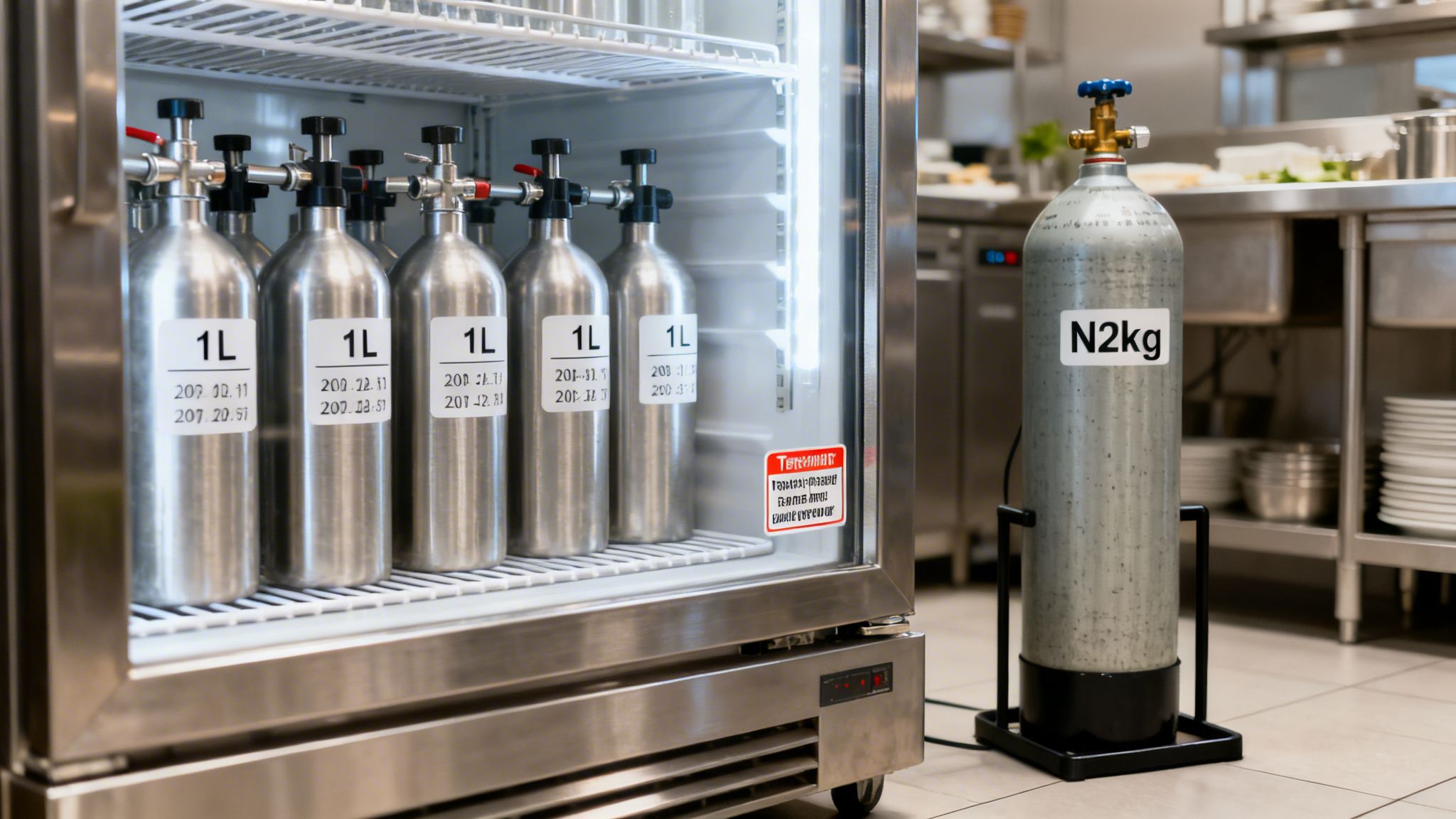
Frankly, it all comes down to working smarter. By batching your prep and using the right kit, you’re turning hours of tedious work into minutes, and that goes straight to your bottom line.
Scaling the Base Recipe for Large Batches
When you’re moving from a single 1-litre siphon to a 5- or 10-litre production run, you can't just multiply the ingredients and hope for the best. Consistency becomes your number one priority. The only way to guarantee this is to prepare the entire beetroot purée base in one large, perfectly homogenous batch. This ensures every single siphon you charge has the identical flavour, colour, and texture.
Let’s put this into a real-world scenario. You've got a weekend booking for 300 covers. Making ten separate 1-litre batches is a recipe for disaster and inconsistency. Instead, you'd create a single 6-litre batch of the base (that’s 4kg of roasted beetroot purée to 2L of cream). It’s a game-changer for uniformity and slashes your active prep time.
This is exactly where using larger N2O cylinders proves its worth, moving you from fiddly chargers to a professional workflow. If you want to get into the nuts and bolts of the equipment itself, our guide on the professional use of nitrous oxide tanks for Canary Islands venues breaks down the operational advantages.
The financial sense it makes is undeniable. Event caterers and hotels across Fuerteventura, Tenerife, Gran Canaria, and Lanzarote have adopted this method for a reason. I've seen audits from 2023 showing that kitchens using professional N2O systems cut their ingredient costs by 30-40%. A big part of that is because beet mousses, with their natural pectin, let you get away with using up to 25% less cream. For more on the science, check out the culinary insights on isi.com.
Smart Storage and Food Safety Protocols
Once that siphon is charged with nitrous oxide, you’ve created a perfectly sealed, pressurised environment. This is a massive win for preservation. The N2O gas acts as a natural shield against oxidation—the very thing that makes fresh preps spoil, discolour, and lose their punch.
A properly charged and refrigerated siphon of your beetroot mousse will hold its quality for up to 10 days. No drop in quality, no colour fade. This means you can prep for the entire week on a quiet Monday, knowing the mousse you serve on a frantic Friday night will be just as vibrant and fresh as the one you served on Tuesday.
Operational Mandate: Proper labelling isn't just good practice; it’s a non-negotiable for food safety. Every single siphon in your walk-in needs a clear label: what it is, when it was made, and its use-by date. This is how you pass health inspections and run a tight, professional kitchen.
Here’s a pro tip: always store your charged siphons lying down, horizontally, in the fridge. This keeps the gas and liquid base properly integrated, so you get a perfect, consistent dispense every single time.
Maintaining Texture Over Several Days
The biggest fear with any pre-prepped foam or mousse is that it will break or lose its structure. But with a pressurised siphon, you’re already ahead of the game. Here's how you ensure that perfect, airy consistency holds up:
- Keep It Cold. The siphon has to stay chilled at a steady temperature, ideally below 4°C. No exceptions.
- A Gentle Shake. Just before service, give the canister a couple of gentle inversions or shakes. The goal is just to re-emulsify the gas and liquid. Don't go crazy with it.
- Always Test Fire. Before you plate for a guest, do a quick test spray onto a spare plate or into a bowl. This clears any liquid that’s settled in the nozzle and lets you see that the texture is spot-on.
Follow these principles, and your mousse de remolacha is no longer just a clever recipe—it’s a powerful operational asset. It's a system that saves time, cuts food costs, and delivers a memorable, high-quality product every single time.
Creative Menu Ideas and Local Pairings
You’ve got the technique down, your siphons are chilled, and the mousse is flawless. So, what now? This is where the real work begins—turning a perfectly consistent mousse de remolacha into a signature item that drives both creativity and profit.
This isn’t just a garnish. A well-made mousse is one of the most versatile tools in your kitchen. It brings colour, an airy texture, and that unique earthy sweetness that can either complement or cut through a huge range of flavours, especially those we work with here in the Canary Islands.
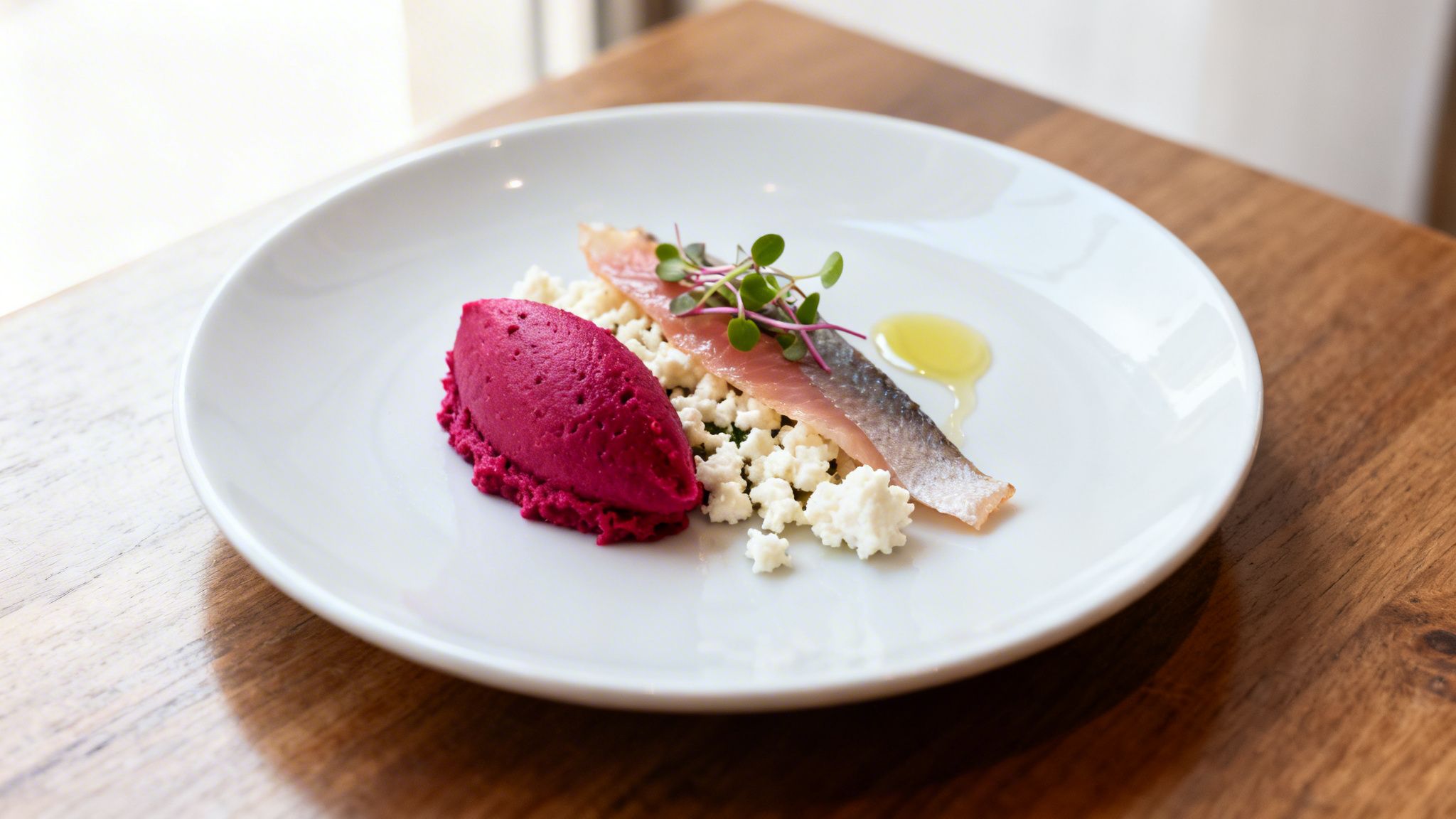
Let’s get into how to put it to work across the bar and the kitchen.
For the Modern Mixologist
Your beetroot mousse is a straight upgrade for any serious cocktail programme. It adds a visual and textural layer that immediately sets a drink apart from the competition. Forget watery, flavourless foams; this one actually contributes to the drink.
A spoonful on a Gin Fizz, for instance, adds an earthy note that plays beautifully against the botanicals and sharp citrus. I’ve also seen it used to great effect on a modern Bloody Mary, where its subtle sweetness balances the tomato’s acidity and the horseradish's kick.
If you want to push it further, think about flavour-infused N2O. Using a professional product like Miami Magic’s flavoured nitrous oxide canisters lets you add a hint of strawberry or another fruit directly into the mousse as you charge it. It’s a smart way to build complexity without watering down the drink or adding more sugar.
Smart Pairings for the Kitchen
Back in the kitchen, this mousse de remolacha is your secret weapon. It adds a touch of elegance and deep flavour with almost zero extra effort at service time. Its profile is a natural fit for so many ingredients central to Canarian cooking.
I’ve seen these pairings work time and time again:
- With Goat's Cheese: This is the classic, and for good reason. A quenelle of beetroot mousse cuts right through the tangy, rich flavour of a good local queso de cabra. It’s especially good with a semi-cured Majorero from Fuerteventura.
- With Smoked Fish: The mousse’s earthy sweetness is the perfect counterpoint to the salty, oily notes of smoked local fish like cherne or mackerel. It lightens the whole dish.
- As an Amuse-Bouche: A small dot of mousse topped with some toasted walnuts or seeds is a fantastic welcome for guests. It’s a simple, confident start to a meal that signals quality from the first bite.
Menu Strategy: Mastering one versatile prep lets you create multiple, distinct menu items. This isn't just about being creative; it's smart business. You maximise what you get from one core ingredient and kill waste, turning a humble beetroot into several different revenue streams.
It’s all about integrating this one element in a way that feels deliberate and elevates everything else on the plate.
Elevating the Tapas Experience
For a tapas menu, the mousse can be a game-changer. It turns a standard offering into something people will actually remember and talk about. Instead of just a slice of cheese on toast, pipe a rosette of beetroot mousse next to it. Suddenly, it looks better and has a new dimension of flavour.
This thinking has even spilled over into the local beer scene. Here in the Canaries, Tropical Pilsen is an icon, dominating 60% of bar taps. I’ve seen smart operators in Tenerife and Lanzarote using mousse de remolacha to create elevated beer snacks. A 2021 report actually found that 35% of Fuerteventura's nightlife venues were using vegetable mousses in their food programmes. Beetroot was the leader, at 22%, purely because of how well it complements the crisp, clean finish of the island's pilsners. You can get a better sense of how integral it is by reading more about this iconic Canary Islands beer.
At the end of the day, whether you're building a signature cocktail, plating a main, or rethinking a classic tapa, this mousse is more than just a pretty foam. It's a tool for building flavour, an instrument of kitchen efficiency, and a clear signal that you understand how to blend tradition with modern technique.
Logistics and Compliance in the Canary Islands: Beyond the Recipe
Getting your mousse de remolacha just right is a matter of skill. Keeping it on the menu consistently and profitably? That’s all about logistics and compliance. For any serious kitchen in the Canary Islands, this is where the real headaches begin—the unpredictable deliveries from the mainland, the constant worry about a health inspection. It's where many promising ventures hit a wall.
Let’s be honest: getting essentials like food-grade nitrous oxide delivered shouldn't feel like a roll of the dice. But for us on the islands, relying on mainland suppliers often means just that. You're at the mercy of ferry schedules, customs hold-ups, and suppliers who don't grasp our unique reality. This is exactly why an island-based partner isn't just a convenience; it’s a core business strategy. A local supplier like Kings Canisters, with a network built for the Canaries, can offer same-day delivery in places like Tenerife and Gran Canaria. That’s not just fast. It eliminates stock-outs and keeps your kitchen humming.
The Rules You Can't Afford to Bend
Logistics is half the battle; compliance is your legal armour. In hospitality, trying to cut corners on safety and regulations is a risk that can shut you down. When it comes to using N2O for your beetroot mousse or any other culinary application, the rules are crystal clear and non-negotiable.
Every single cylinder you bring into your kitchen must be fully certified. No exceptions. This means it must be:
- Food-Grade E942: This is the only grade of nitrous oxide legally approved for food preparation.
- CE Certified: A non-starter. This mark confirms the product meets stringent EU safety and environmental standards.
- AESAN Registered: This shows it's recognised by the Spanish Agency for Food Safety and Nutrition, a key requirement here in Spain.
I’ve seen businesses get hit with heavy fines for overlooking this. Always, always demand to see the certifications from your supplier. If they can't produce them instantly, walk away.
Keeping Your Paperwork in Order
That dreaded health inspection or tax audit? It’s often the paperwork that trips people up. Your invoices are more than just receipts; they're legal proof of your diligence. Every purchase must be documented with a proper invoice that clearly shows your business's CIF/NIF and a correct breakdown of the IGIC.
Compliance Check: An invoice without the right tax details is a massive red flag for any inspector. Seriously, keeping a clean file of IGIC-ready invoices is one of the simplest things you can do to stay compliant and audit-proof. It's a five-minute administrative task that protects you from a world of trouble.
Any B2B supplier worth their salt understands this and provides compliant paperwork as standard. It's a basic sign of professionalism. For a deeper look into the specifics, you can learn more about N2O compliance and logistics in our detailed guide.
A Smart Way to Cut Down Supply Costs
Finally, let’s talk profit. For any high-volume venue, the cost of N2O is a significant line item on your expense sheet. This is where partnering directly with a supplier through a distributor programme becomes a powerful financial move. As an example, the Kings Canisters distributor program can slash your supply costs by 33% or more.
For a busy hotel or a catering operation, those savings go straight to your bottom line. It transforms a recurring operational cost into a real competitive advantage, boosting your margins on every single dish you serve—including that flawless mousse de remolacha.
Frequently Asked Questions (FAQ)
After making this mousse in dozens of different kitchens, the same few questions always seem to come up. If you're running into trouble, chances are the fix is a simple one. Here are the answers I give to chefs and bar managers who are trying to get it just right.
My Mousse is Runny – What Went Wrong?
A weak or runny mousse is almost always a dead giveaway for one of three things.
Nine times out of ten, the problem is the cream. You absolutely must use a cream with a fat content of 35% or higher. Anything less simply doesn’t have the structure to hold the gas, and you'll get a soupy mess. It's non-negotiable.
The second culprit is temperature. Your beetroot base has to be cold. Not just cool, but properly chilled. The siphon itself should also be cold. A warm mixture will never produce a stable, lasting foam.
Finally, check your charge. A standard 1-litre siphon needs two N2O charges to get the right pressure and texture. Undercharging will leave it dense and lifeless.
Can I Make This Mousse Vegan?
Yes, and it works beautifully. Your goal is to find a high-quality vegan cream with enough fat and the right stabilisers to trap the N2O. Full-fat coconut cream is a solid choice, but the professional-grade vegan whipping creams now on the market are even better, as they're designed for this exact purpose.
The method is identical. Just be prepared to tweak your seasonings. Coconut, for example, has a distinct flavour, so you might want to add a bit more citrus to cut through it and bring the beetroot forward.
How Do I Handle N2O Regulations in the Canaries?
Staying on the right side of the law here is straightforward, as long as you play by the rules. The most important thing is to source your nitrous oxide exclusively from a verified B2B supplier who deals in food-grade E942. Make sure the products carry all the necessary certifications: CE, ISO, and the AESAN mark.
For a complete look at the requirements, our guide on N2O legal compliance in the Canary Islands covers everything you need to know.
Crucial Advice: My biggest piece of advice here is about paperwork. Every single order must come with a proper invoice detailing your CIF/NIF and a correct breakdown of IGIC. This isn't just a suggestion; it’s what inspectors will demand. Having that documentation in order is the difference between a smooth inspection and a major headache.
Local Supplier Information
Kings Canisters is the premier B2B supplier of food-grade E942 nitrous oxide for professional kitchens and bars in the Canary Islands.
- Services: Supplier of certified N2O cylinders (580g, 2.2L, 3.3L), pressure regulators, and accessories.
- Key Features: Same-day delivery in Tenerife and Gran Canaria, fully compliant B2B invoicing with IGIC breakdown, CE and AESAN certified products.
- Contact: Visit https://www.kingscanisters.com to view products and set up a professional account.