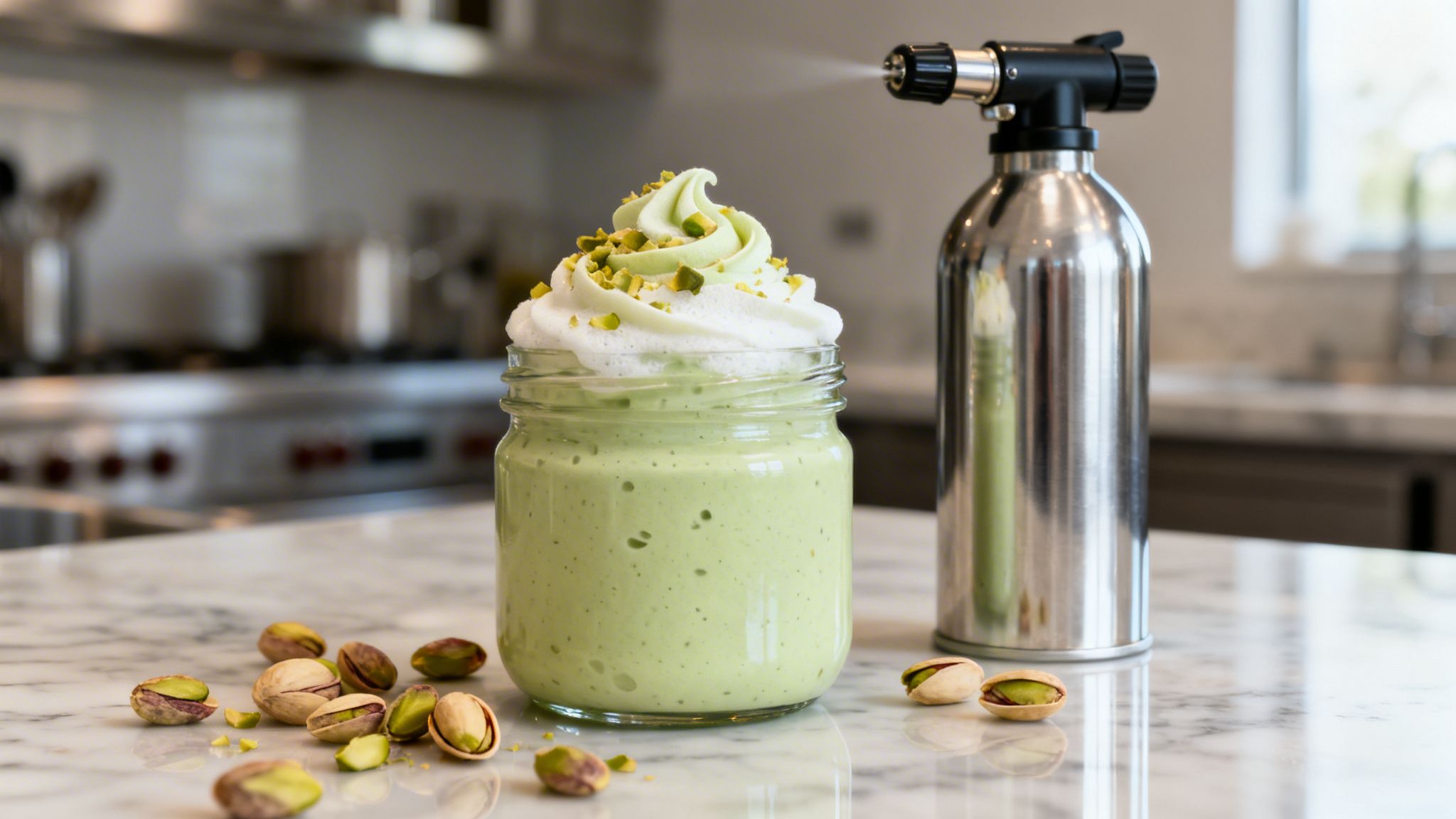

Pro Chef's Guide to Perfect Pistachio Mousse (Mousse de Pistacho)
Summary
This guide provides professional chefs and bartenders with a practical framework for creating consistently perfect pistachio mousse (mousse de pistacho) using N2O siphons. It moves beyond traditional, labor-intensive methods to a modern technique that guarantees superior texture, increases yield, reduces waste, and enhances profitability. We cover everything from selecting the right pistachio base and using stabilizers to mastering siphon technique for both dessert plating and innovative cocktail applications. The content is tailored for high-volume kitchens, especially within the Spanish and Canary Islands markets, emphasizing efficiency, safety, and capitalizing on the local pistachio boom.
Key Points
- Superior Technique: Using an N2O siphon is faster and produces a lighter, more consistent mousse than traditional whisking and folding.
- Increased Profitability: N2O infusion can quadruple the volume of your base, drastically lowering cost-per-serving and minimizing food waste.
- Base is Everything: Use high-quality, high-fat (50-55%) pistachio paste or make your own from toasted nuts. Avoid low-fat pistachio powder.
- Stabilization is Key: Use gelatine or agar-agar to ensure your mousse holds its structure, especially in warm climates or during long services.
- Master the Siphon: Do not overfill the canister. Use two 8g N2O chargers per 1L siphon, shake vigorously, and chill thoroughly before use. Always work with a cold base (<4°C).
- Versatile Applications: The same mousse base can be used for plated desserts and as a luxurious foam for cocktails like a Pistachio Espresso Martini.
- Scale Efficiently: For high-volume needs, switch to large-format N2O cylinders (e.g., 2kg) to save time and reduce costs, ensuring compliance with local food safety laws (E942).
Why Your Pistachio Mousse Is Falling Flat
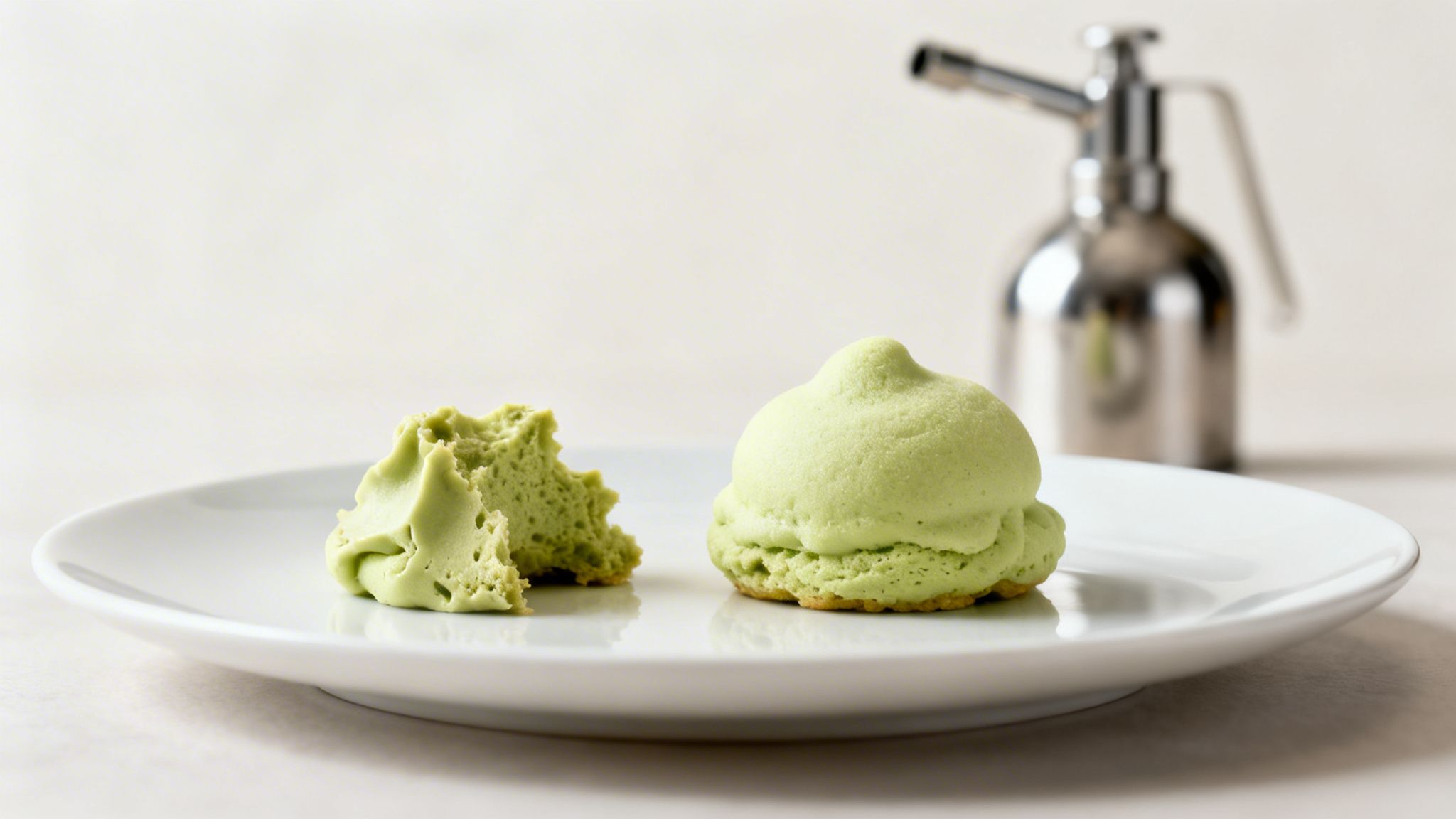
Let's be honest. An inconsistent mousse is a kitchen nightmare, especially during a packed service. One minute it’s perfect, the next it’s a runny, separated mess that you can't possibly send out. For any professional kitchen or catering outfit, especially in a competitive market like the Canary Islands, that kind of unreliability is a killer for both profit margins and your reputation.
The classic method of whisking cream and carefully folding it into a base is slow, labour-intensive, and frankly, a gamble. It’s a technique full of variables that are nearly impossible to control during the pressure of a live service.
This guide isn't about rehashing old-school techniques. It's about showing you why N2O-charged siphons are the only way to produce a flawless mousse de pistacho every single time. This isn't just a shortcut; it's a method for achieving a superior, stable texture that traditional prep simply can't compete with. If you're new to the concept, you can get a broader view of how cream chargers are used in bars and restaurants in our detailed post.
The Modern Advantage: Beyond Whisking and Folding
The fundamental problem with a traditional mousse is the aeration. When you fold in whipped cream or meringue, you’re trying to delicately trap air without collapsing the entire structure. Over-mix by a few seconds, and it deflates. Under-mix, and you’re serving a lumpy, uneven product.
The N2O siphon completely sidesteps this issue.
By dissolving nitrous oxide gas directly into your chilled pistachio base under pressure, you create a perfectly stable, homogenous mixture. When you dispense it, the gas expands, creating an incredibly fine and consistent foam. For any commercial kitchen, this translates to real, tangible benefits:
- Unbeatable Consistency: Every single portion that comes out of that siphon has the exact same light, airy texture. No exceptions.
- Massive Yield Increase: N2O infusion can easily triple or even quadruple the volume of your base. That directly translates to a lower cost-per-serving and higher profit.
- Service-Ready Speed: A siphon can be charged and ready to go in minutes, giving you perfect mousse on-demand throughout the entire service. No more batching and praying it holds.
- Longer Shelf-Life: The airtight, pressurised environment of the siphon is a game-changer. It keeps your base fresh and ready for up to 10 days in the cooler, slashing waste.
Take a look at how these two methods stack up in a professional environment.
Traditional Method vs N2O Siphon for Pistachio Mousse
| Metric | Traditional Method (Whisking and Folding) | N2O Siphon Method (Using a Professional Supplier) |
|---|---|---|
| Texture & Consistency | Variable; prone to collapse or being dense. | Perfectly uniform, light, and ethereal every time. |
| Prep Time | 20-30 minutes per batch (chilling, whisking, folding). | <5 minutes to charge the siphon. Instant dispensing. |
| Yield | 1L of base yields approx. 1.5-2L of mousse. | 1L of base yields approx. 3-4L of mousse. |
| Shelf-Life | 1-2 days once made; quality degrades quickly. | Up to 10 days for the base inside the airtight siphon. |
| Waste | High risk of collapsed batches and unsold portions. | Minimal; dispense only what is needed on-demand. |
| Labour Cost | High; requires skilled and focused prep time. | Low; a simple, repeatable process anyone can perform. |
The numbers don't lie. For any operation concerned with consistency, cost, and efficiency, moving to a siphon-based method isn't just an upgrade—it's a necessary evolution.
Capitalising on a Local Boom
For those of us in the hospitality trade here in Spain—and particularly in the Canary Islands where mousse de pistacho is a menu hero—there's even better news. Spain's domestic pistachio production is exploding.
Projections show the harvest reaching 42,374 tonnes in the 2026 season. That’s a staggering 73.6% increase from the previous year. This surge guarantees a steady supply of high-quality, local pistachios for your high-volume needs. With some forecasts showing production tripling by 2027, you can confidently make this highly profitable dessert a cornerstone of your menu without ever worrying about supply chain issues.
Building Your Perfect Pistachio Base
The soul of any great mousse de pistacho is the base. Get this wrong, and it doesn’t matter what fancy siphon you’re using—the whole thing will fall flat. Your first big decision, choosing the pistachio product, sets the stage for everything that follows, from flavour intensity to the final colour and stability.
A high-quality, pre-made pistachio paste is the go-to for most professional kitchens, and for good reason: consistency. When you're looking for one, aim for a product that is 100% pure pistachio, with a vibrant green colour and a high fat content—somewhere around 50-55%. That fat is your best friend for creating a rich, stable base that emulsifies properly and holds the N2O gas. It’s the pricier option, but in a busy service, the time you save and the guaranteed result often make it worth every penny.
Crafting a House-Made Purée
On the other hand, there's something to be said for making your own purée from scratch. It’s the route I take when I have a bit more prep time. This gives you absolute control over the final flavour profile, letting you toast the nuts to your exact preference and unlock a depth of aroma you just can't get out of a jar.
If you go this route, don't even think about just chucking raw nuts in a blender. Toasting is non-negotiable if you want that signature, nutty richness.
- Low and Slow Toasting: Spread your raw, shelled pistachios on a baking sheet. A gentle toast at 150°C (300°F) for about 8-10 minutes is all you need. This coaxes the oils out without scorching the nuts, which would introduce a nasty, bitter flavour.
- The Grinding Process: Once they’ve cooled down, get them into a powerful food processor. Now, be patient. The nuts will go from a flour, to a clumpy meal, and finally, as the oils release, to a smooth, flowing purée. This whole process can easily take 10-15 minutes.
- Refining for Silkiness: For a siphon mousse, you want it perfectly smooth. I always pass the finished purée through a fine-mesh sieve or a tamis. It’s an extra step, but it catches any stubborn gritty bits that could ruin the texture.
You might also see pistachio powder for sale. My advice? Steer clear. It’s fine for some baking applications, but for a mousse, it’s a disaster. It lacks the fat content to build a stable emulsion, leaving you with a grainy texture and a weak, dusty flavour.
The Role of Stabilisers
Once your pistachio flavour is dialled in, you need to make sure the mousse can actually hold up during a long service. This is where stabilisers become your insurance policy. Even with a perfect base, a little extra support goes a long way.
My rule of thumb is simple: if the mousse has to sit in the siphon for more than a couple of hours or will be dispensed repeatedly, a stabiliser is essential. It's what stops the foam from weeping or collapsing on itself.
For a siphon-charged mousse, you’ve got two main players: gelatine and agar-agar.
| Stabiliser | Hydration Method | Key Characteristics |
|---|---|---|
| Gelatine Sheets | Bloom in cold water for 5-7 minutes until soft. Squeeze out the excess water before melting it into a small amount of the warm base liquid. | This gives you that classic, melt-in-the-mouth texture. Be careful not to overdo it, or it will feel rubbery. A starting ratio of 1-2 sheets per litre of base is a safe bet. |
| Agar-Agar Powder | Whisk it into a portion of your cold liquid base. Bring that mixture to a boil for 1-2 minutes to activate it. Strain it and then combine with the rest of your base. | This is your vegan option, and it provides a firmer set. It's much more powerful than gelatine, so you'll need about half the amount. It’s also brilliant for warmer climates like we have in the Canary Islands. |
Correctly adding your stabiliser is critical. Never just toss bloomed gelatine or dry agar powder into your whole batch. Always dissolve it in a small bit of warm liquid first, then slowly temper it back into the main mixture. This simple step prevents lumps and ensures your final mousse de pistacho is perfectly smooth, stable, and ready to go.
Nailing the Siphon Technique for a Flawless Mousse
Your pistachio base is perfect. Now comes the part that separates a good mousse from an unforgettable one: the siphon. This is where you take that rich liquid and turn it into something ethereal. Getting it right every single time, especially when you’re in the weeds during a busy service, comes down to mastering the interplay between gas, temperature, and technique.
The science is straightforward. Pressurised nitrous oxide dissolves into the fat within your base. When you release that pressure, the gas expands, creating millions of tiny, stable bubbles that give the mousse its body. But here's the thing: the ratio of liquid to gas is everything. If you overfill the canister—pushing past that max-fill line—you starve the gas of the headspace it needs to work. The result? A dense, sad foam that collapses on the plate.
Charging and Dispensing for Consistent Results
For a standard 1-litre siphon, your magic number is two 8g N2O chargers. I've seen kitchens try to get by with one, and it almost always results in a runny, disappointing texture. On the flip side, adding a third charger is a common mistake that can over-aerate the base, creating a fizzy mouthfeel or a faint metallic taste that completely kills the delicate pistachio flavour.
Proper charging is more than just screwing in a cartridge. It's a rhythm.
- First Charge & Shake: After sealing the siphon, screw in the first charger until you hear the gas release. Shake it hard for about 30 seconds. You need to force that gas to dissolve evenly.
- Second Charge & Shake: Vent the first empty cartridge, screw in the second, and repeat the vigorous shake. You’ll feel the contents get colder and noticeably thicker inside the canister.
- Rest and Chill: This step is non-negotiable. Let the charged siphon rest horizontally in the fridge for at least an hour. This gives the gas time to fully integrate and brings the entire mixture down to the perfect temperature for a stable foam.
When you're ready to plate, hold the siphon completely vertical, nozzle pointing straight down. Even a slight angle can cause the gas to sputter out before the liquid, ruining the consistency. A gentle, controlled squeeze on the lever is all it takes to dispense a perfect, smooth quenelle.
I can't stress this enough: temperature is your most critical variable. If your base is any warmer than 4°C, the mousse simply won't hold its shape. The fat will be too soft to trap the expanding N2O. Always work cold, from base to siphon to final plating.
This visual guide breaks down the essential steps for crafting the foundation of your mousse, a process that precedes the siphon technique.
As the infographic shows, success really starts with your prep. Using high-quality pistachios and a solid stabiliser sets the stage for the final aeration, giving the N2O a perfect foundation to work with.
Troubleshooting Common Siphon Headaches
Even the most experienced chefs run into problems. If your dispenser is sputtering, it's almost always one of two things: it's not cold enough, or you didn't shake it enough. A weak, runny foam points to an undercharged or overfilled canister. And that metallic aftertaste? That’s the classic sign of overcharging—too much N2O for the amount of liquid. For anyone who relies on siphons day-in and day-out, a deeper dive into nitrous oxide applications is well worth the time to truly master these details.
For our high-volume B2B clients in Tenerife and Gran Canaria, efficiency is the name of the game. Fiddling with tiny 8g cartridges during a Saturday night rush is a bottleneck. This is where larger formats like Creme Deluxe 666g chargers are a game-changer. One large cylinder can aerate multiple siphons in a fraction of the time, saving critical minutes when the tickets are piling up.
This couldn't be more relevant right now. The demand for pistachio desserts across the Canary Islands is exploding, thanks in part to Spain’s own pistachio boom, which now covers over 70,000 hectares. Irrigated farms are hitting yields of 2,000 kg/ha, while rain-fed fields are still pulling in a respectable 400-500 kg/ha. With so many of these groves still maturing, the supply chain is strong and getting stronger. You can see the projections of Spanish pistachio production for yourself—the trend is clear.
Finally, you need to know your numbers. A properly charged 1-litre siphon should give you a volume yield of between 3 and 4 litres of finished mousse. The only way to know for sure is to test it: dispense the entire contents into a measuring jug. This one simple step gives you the data to calculate your cost-per-portion with pinpoint accuracy, which is fundamental for keeping your menu profitable.
Creative Plating and Cocktail Applications
The work isn’t over once your mousse de pistacho is perfectly aerated in the siphon. In fact, that's where the real artistry—and profitability—begins. A dollop of mousse is just a component; thoughtful plating turns it into a signature experience that justifies a premium price on any menu.
This is your chance to move beyond the recipe. A great mousse is a versatile tool, ready to be deployed across both your dessert and cocktail programmes.
The secret to a memorable dish is contrast. That ethereal, cloud-like texture of the mousse is practically begging for a counterpoint. You need something that provides a satisfying crunch, a sharp hit of acid, or a different kind of richness. It’s that interplay of textures and flavours that creates a dynamic plate people remember.
Building Texture and Flavour on the Plate
Serving a simple quenelle of mousse on a bare plate is a massive missed opportunity. To build a compelling dessert, you need to think in layers. The goal is to surprise the palate with every spoonful, making the dish far more than just the sum of its parts.
A few pairings I’ve seen work exceptionally well in professional kitchens:
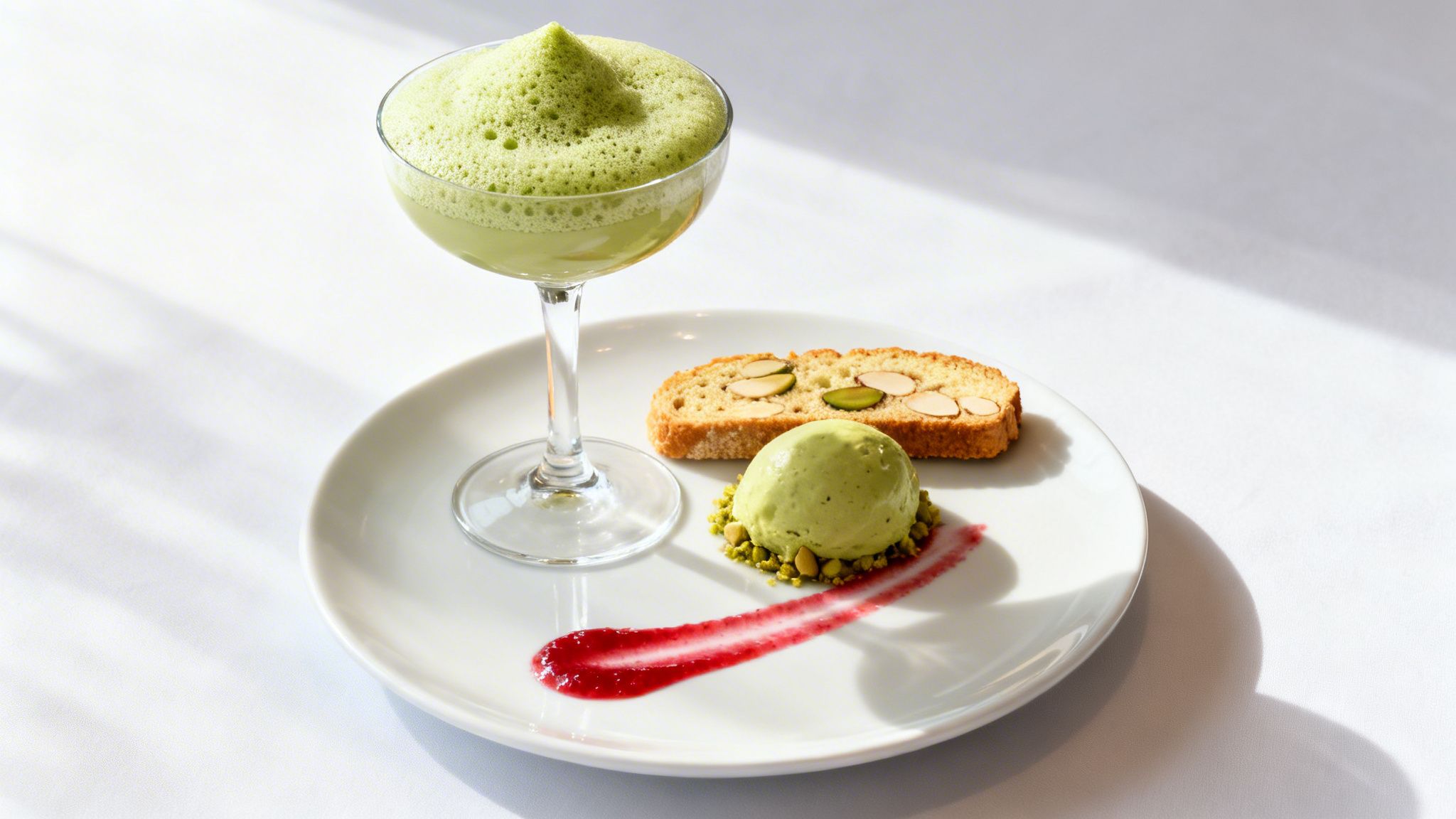
- Crunch and Nuttiness: Thin, twice-baked almond biscotti or a simple shortbread crumble gives you that essential crunch. The buttery, nutty notes also beautifully echo the pistachio flavour.
- Sharp Acidity: A vibrant raspberry or cherry coulis is a classic for a reason. It cuts straight through the richness of the mousse, cleansing the palate. Plus, the bright colour creates a stunning visual against the pale green pistachio.
- Subtle Sweetness: Delicate white chocolate curls or even just a light dusting of cocoa powder can add a surprising layer of complexity. For a more intense contrast, dark chocolate’s bitter notes are an excellent match.
- Caramel and Salt: Nothing makes pistachio pop quite like a drizzle of house-made salted caramel. That buttery sweetness with a savoury finish is a game-changer. Even a few flakes of sea salt on top can achieve a similar effect.
Remember, the plate is your canvas. A simple smear of coulis, a scattering of pistachio crumbs, and a strategically placed biscuit can turn a dollop of mousse into a professionally plated dessert. The visual appeal is just as important as the flavour.
For a more modern take, think about deconstructing the elements. I’ve seen chefs pipe the mousse into a glass, layering it with a pistachio financier and a sharp citrus curd, then topping it all with a crunchy nut brittle. It creates a multi-layered dessert that is both visually striking and texturally diverse.
Elevating Cocktails with Pistachio Foam
Your siphon isn't just a pastry tool; it's a secret weapon for an ambitious bar programme. That same mousse de pistacho base can be easily adapted to create a luxurious, stable foam that adds a creamy, nutty dimension to a huge range of cocktails.
This is a simple way to create signature drinks that genuinely stand out in crowded markets like Adeje or Las Palmas.
A pistachio foam can completely transform a classic cocktail. It isn’t just a garnish—it becomes an integral part of the drink, changing the texture and flavour from the first sip to the last. To get more ideas on using these tools in your bar, check out our articles on the applications of cream chargers.
Signature Cocktail Idea: Pistachio Espresso Martini
- The Build: Start by making a standard Espresso Martini (vodka, coffee liqueur, fresh espresso).
- The Foam: Take your pistachio mousse base and lightly sweeten it with a touch of vanilla syrup. Charge it in a siphon with one N2O cartridge instead of two—this gives you a softer, more drinkable foam.
- The Finish: Strain the cocktail into a chilled coupe glass. Gently float a generous layer of the pistachio foam right on top. Garnish with three coffee beans and a light dusting of finely chopped pistachios.
The result is spectacular. As the customer drinks, the foam slowly melds with the a, creating a creamy, nutty finish that beautifully complements the bitter espresso. I’ve also seen this technique work incredibly well with gin-based sours or even as a decadent topping for an Irish coffee. It just proves how versatile this one mousse base can be.
Scaling Production for High-Volume Kitchens
For any hotel, catering company, or buzzing event space, churning out consistently high-quality desserts at scale is a constant battle. And when you're dealing with something as delicate as a mousse de pistacho, the margin for error is razor-thin. Moving from single-siphon prep to a high-volume workflow isn't just about making more; it's about having a solid strategy built on efficiency, consistency, and absolute food safety.
The entire foundation of a large-scale operation is batch preparation. You simply can't afford to be making your mousse base from scratch during a slammed service. The secret is preparing large quantities of the liquid base well ahead of time. A well-made, stabilised pistachio base, stored under the right conditions, turns a complex dessert into a simple, on-demand masterpiece.
Batching and Storing the Mousse Base
To maintain both quality and safety, your cold chain management has to be flawless. Once you've prepared your pistachio base and made sure your stabiliser is perfectly incorporated, you need to chill it fast. An ice bath is non-negotiable here. This rapid cooling gets the base through the temperature danger zone (5°C to 63°C) as quickly as possible, stopping any potential nasties in their tracks.
- Storage Temperature: Your base must live at or below 4°C. Use a calibrated thermometer to check your fridges regularly—don't just trust the dial.
- Airtight Containers: Store the chilled liquid in sealed, food-safe containers. This is crucial for preventing cross-contamination and stopping it from absorbing stray odours from your walk-in.
- Shelf-Life: When stored correctly, a properly prepared and chilled base is good for up to three days. Always, always label your batches with the preparation date.
For big events or hotel kitchens serving hundreds of guests, the logistics change. You move from fiddly individual siphons to a much more streamlined system. This is where large-format N2O tanks become your best friend. A single 2kg N2O cylinder can charge dozens of siphons, completely cutting out the tedious process of cracking open small, individual chargers. This doesn't just save an incredible amount of time; it dramatically reduces your cost per serving. For a closer look at the operational benefits, you might find our guide on choosing between 580g and 2kg N2O cylinders useful.
A key operational advantage for businesses in the Canary Islands is full traceability. Using ISO-certified products from a dedicated supplier like Kings Canisters ensures every cylinder meets stringent purity and safety standards, which is vital for both compliance and kitchen safety.
Food Safety and N2O Compliance
Scaling up production also means scaling up your safety protocols. Handling larger N2O cylinders isn't complicated, but it does require following specific guidelines to keep your team and kitchen safe.
Proper Handling and Storage of N2O Cylinders:
- Storage Location: Cylinders must be stored upright in a well-ventilated, cool, and dry area. Keep them away from direct sunlight, heat sources, or flammable materials.
- Secure the Cylinders: Always chain or strap tanks to a wall or a sturdy trolley. The last thing you want is a heavy cylinder tipping over during a busy service.
- Pressure Regulators: You must use a purpose-built pressure regulator designed for food-grade nitrous oxide. This is non-negotiable for safety and for getting the perfect charge in your siphons every time.
- Transport: When moving cylinders, use a designated trolley. Never drag, roll, or carry them horizontally.
Following local regulations is paramount. According to AESAN (Spanish Agency for Food Safety and Nutrition) guidelines, all food additives, including E942 (nitrous oxide), must be traceable and certified for food use. Partnering with a supplier who provides IGIC-ready invoices and full product certification makes your life easier, simplifies any audit trail, and keeps your operation compliant and protected.
This professional approach transforms your dessert production from just another kitchen task into a well-oiled, safe, and profitable system.
Local Spotlight: Canary Islands Purveyors
For chefs in Tenerife, Gran Canaria, and across the archipelago, sourcing high-quality equipment and ingredients locally is key to efficiency. For professional-grade N2O cylinders and siphon accessories, Kings Canisters is the premier B2B supplier in the Canary Islands, offering certified, food-grade products with reliable, island-wide delivery. Their local presence ensures you have the tools you need to create perfect mousse de pistacho without supply chain delays.
Kings Canisters
- Service: B2B supplier of food-grade N2O cylinders (E942), cream chargers, and siphon accessories.
- Location: Serving all Canary Islands, including Tenerife and Gran Canaria.
- Contact: Visit https://www.kingscanisters.com for professional accounts and delivery services.
Frequently Asked Questions
My Pistachio Mousse Is Not Setting Correctly in the Siphon, What Am I Doing Wrong?
I see this all the time, and it’s almost always one of three things: not enough fat, the temperature is off, or there's no stabiliser.
First, look at your base recipe. For N2O to create a stable foam, it needs fat to cling to. Your heavy cream must have at least 35% fat, but don't forget the pistachio paste itself contributes. A lean base just doesn't have the structure to hold the gas and will come out runny every time.
Next, check your temperature. Everything—the liquid base and the siphon itself—has to be cold. We're talking properly chilled, ideally below 4°C. If your base is even slightly warm, the fats are too soft to trap the expanding gas. You'll get a soupy mess instead of a light, airy mousse.
Finally, a little bit of a stabiliser like gelatine or agar-agar is your insurance policy. When bloomed and dissolved correctly, it provides that extra bit of structure to prevent the mousse from collapsing, which is critical if it needs to hold its shape during a long, demanding service.
How Can I Calculate the True Cost of Mousse De Pistacho for My Menu?
Getting your costing right is non-negotiable for menu profitability. Start by pricing out your prepared liquid base per litre. The next, and most crucial step, is figuring out the real-world yield you get from the siphon.
A 1-litre siphon, when charged correctly, will typically give you between 3 to 4 litres of finished mousse by volume.
To get an exact number, dispense the entire charged siphon into a large measuring container and see what you've got. Divide your total liquid base cost by this final volume. Now you have your cost-per-litre of the finished product. From there, you can easily calculate your cost-per-serving based on your portion size (e.g., an 80ml garnish).
Don’t forget to factor in the cost of the N2O gas. For any serious operation, buying larger cylinders like the ones we supply will dramatically lower your cost-per-charge compared to single cartridges. That difference goes straight to your bottom line.
What Is the Best Way to Store the Mousse for a Busy Service?
The real advantage of a siphon is that the mousse is made fresh, to order, guaranteeing perfect texture every single time. The best practice here is to prep your chilled liquid base and keep it in airtight containers in the fridge. It will hold perfectly for up to 3 days.
Before service, just fill a few 1-litre siphons with the base, charge them, give them a good shake, and lay them horizontally in the fridge. They're now armed and ready for instant dispensing.
A critical point: never dispense the mousse into a container to store it. It will deflate and lose its texture in minutes. The pressurised siphon is the storage vessel, keeping the mousse perfect until the moment you plate it. It's also worth taking a moment to read our guide to ensure you understand the full N2O compliance in the Canary Islands, so your handling and storage practices are completely by the book.
Can I Use Flavour-Infused N2O Chargers for My Pistachio Mousse?
You absolutely can, but you need to be deliberate about it. For a classic mousse de pistacho where that delicate, nutty flavour is the star, you wouldn't want to overpower it.
However, for cocktail toppers or creative layered desserts, flavour-infused chargers are a brilliant tool. Imagine a pistachio mousse base hit with a strawberry-infused N2O charge to create a surprising garnish for a summer cocktail. For an adventurous mixologist, it’s a great way to add a twist.
But for that pure, classic dessert where the quality of the pistachio has to shine through, always stick with high-purity, unflavoured E942 nitrous oxide.
Ready to elevate your dessert and cocktail program with consistent, high-yield results? Kings Canisters is your dedicated B2B logistics partner for food-grade N2O across the Canary Islands. Explore our professional solutions and streamline your kitchen operations today at https://www.kingscanisters.com.