

A Professional Guide to Heavy Whipping Cream
Summary
This guide provides professional chefs, bar managers, and hospitality operators with practical, actionable information on using heavy whipping cream. We cover why a high milk fat content (36%+) is crucial for stable foams, compare whipping methods (manual, electric, N2O siphon), and detail how to maximize yield and profit using N2O siphons. The guide also offers essential protocols for safe storage and handling in warm climates like the Canary Islands, sourcing strategies for local businesses, and answers to frequently asked questions to ensure quality, safety, and operational efficiency.
Key Points
- Fat Content is King: Heavy whipping cream must have at least 36% milk fat to create a stable, professional-grade foam that holds its structure.
- N2O Siphons Offer Maximum Efficiency: Compared to manual or electric mixing, nitrous oxide (N2O) cream siphons provide instant speed, superior consistency, and a yield (overrun) of 300-400%, drastically reducing cost-per-serving.
- Temperature is Non-Negotiable: For optimal results and safety, both the heavy whipping cream and the siphon canister must be chilled to 2-4°C.
- Safety and Shelf Life: Storing whipped cream in a sealed, refrigerated N2O siphon extends its freshness and safety for up to 10 days, thanks to the anaerobic and bacteriostatic environment created by N2O gas.
- Sourcing Locally is Critical: For Canary Islands businesses, partnering with a local B2B supplier who provides IGIC-compliant invoicing and certified, food-grade products is essential for compliance and operational reliability.
What Pro Kitchens Need to Know About Heavy Whipping Cream
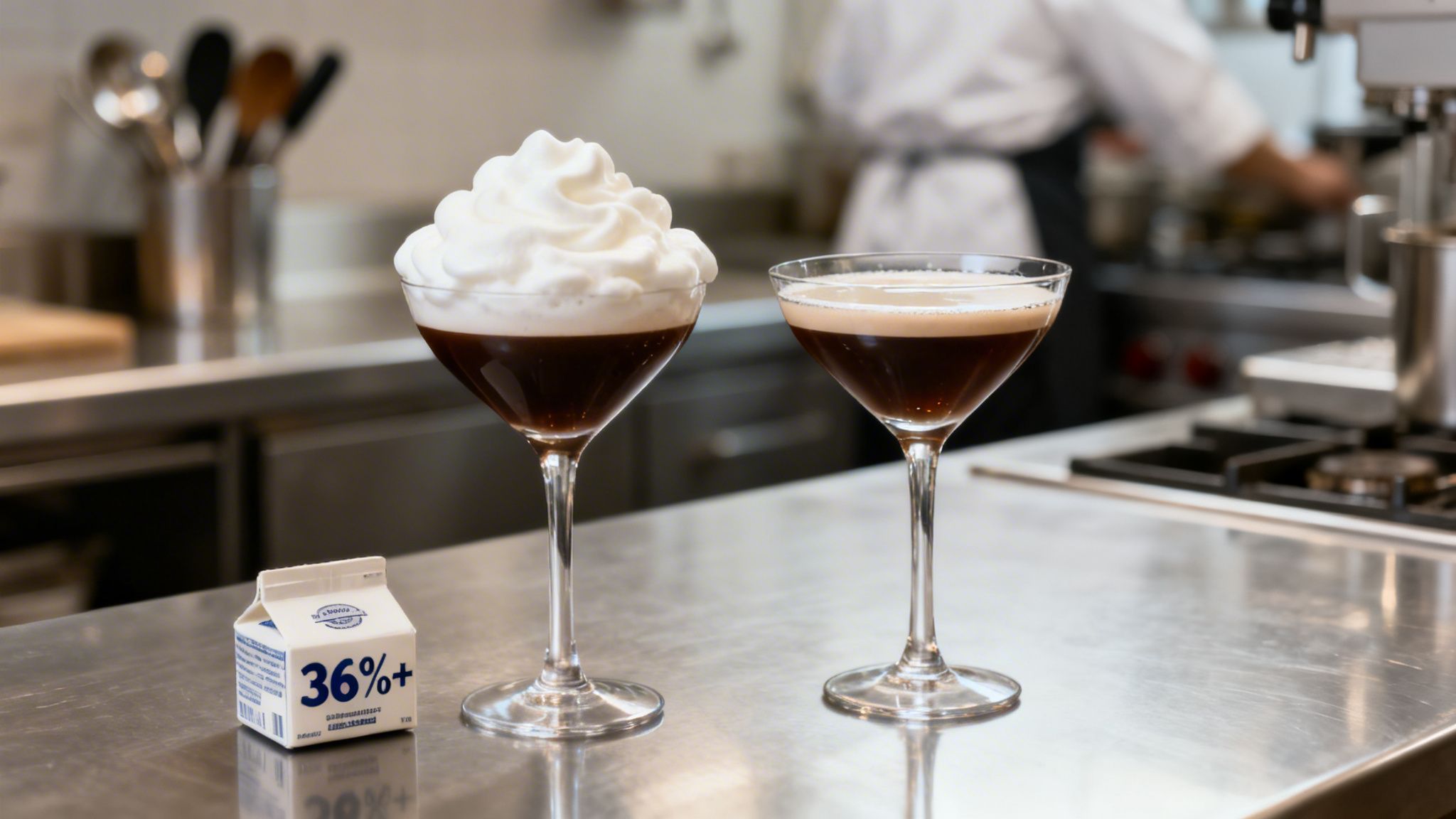
For a busy bar or restaurant, heavy whipping cream isn’t just an ingredient on a prep list. It's a core component that directly impacts the quality of your final product. The science is simple: when you agitate cream, the fat globules bond together, trapping air and creating a stable structure.
Think of it this way: trying to make a firm foam with a lower-fat cream (like standard whipping cream, which sits around 30% fat) is like building a wall with flimsy bricks. It might stand up for a minute, but it will quickly collapse into a sad, watery puddle. For a signature cocktail, that’s a disaster.
Why Milk Fat Percentage Is Everything
That minimum 36% milk fat is the benchmark for a reason. It’s the key to getting consistent, professional results every single time. Here’s what that high fat content delivers:
- A Stable, Lasting Foam: The fat creates a strong, protective network around the air bubbles, stopping them from collapsing.
- Structure That Holds: This stability is crucial for toppings on both hot and cold drinks or desserts, ensuring they look just as good for the customer as they did when they left the pass.
- Incredible Mouthfeel: Fat is a carrier for flavour, and it provides that smooth, rich texture that customers instantly recognise as high quality.
When your venue's reputation is built on consistency, using the right product is essential. It ensures the last espresso martini you serve on a frantic Saturday night is just as impressive as the first. This is where getting back to basics is so important; you can find more deep dives on essential product knowledge that build a solid foundation for your kitchen.
A Pillar of the Canary Islands Hospitality Market
Nowhere is this need for quality more obvious than in the fast-paced hospitality scene across the Canary Islands. In tourism-heavy zones like Tenerife and Gran Canaria, heavy whipping cream is a cornerstone for high-volume bars, exclusive clubs, and busy event caterers. The market reflects this demand—Spain's whipping cream market was valued at USD 178.25 million in 2024 and is expected to rocket to USD 389.41 million by 2033.
That explosive growth is being driven by the islands’ booming tourism sector. In 2023 alone, Tenerife welcomed over 7 million visitors, all looking for premium experiences.
For a beverage director in Adeje or a head chef in Las Palmas, mastering heavy whipping cream isn't just a culinary skill. It's a business strategy. Your ability to consistently produce a high-quality product is what separates a decent venue from a destination.
Choosing Your Whipping Method for Speed and Quality
How you turn liquid cream into a finished product isn't just a kitchen task—it's a business decision. The method you choose directly impacts your labour costs, service speed, and the final quality of the drink or dessert you put in front of a paying customer. In a high-volume professional kitchen, every minute and every gram of product counts.
Let's cut straight to what works in a real-world commercial setting. We’ll look at the three main ways to get the job done—by hand, with a mixer, and with a nitrous oxide (N2O) cream siphon—and see how they stack up when the pressure is on.
The Artisan Approach: Manual Whisking
There's a certain old-school charm to whipping cream with a whisk. It’s a classic technique that looks great on a cooking show but falls apart in a busy commercial environment, especially in the fast-paced Canary Islands hospitality scene. It's almost entirely impractical.
The process is slow and physically exhausting. Worse, the final product is wildly inconsistent from one bartender to the next. It might work for a single, carefully crafted dessert, but it simply can’t keep up with the demands of a Saturday night rush.
The Workhorse: The Electric Mixer
An electric mixer—whether a hand model or a big stand mixer—is a huge improvement over manual whisking. It brings a level of reliability and consistency that a human arm just can't match over a long, demanding shift. You can make a decent batch of whipped cream with a stable texture pretty quickly.
But for a fast-paced bar, this method creates its own set of problems.
- The Batch Bottleneck: You can only make so much at once. When you run out mid-service, a bartender has to stop making drinks to whip another batch, killing your workflow.
- The Quality Clock: Once whipped, the cream sits in an open bowl, exposed to air and fluctuating kitchen temperatures. It starts to deflate and lose its texture almost immediately.
- The Yield Question: A mixer typically doubles the volume of the liquid cream, giving you about a 100% overrun. It’s a respectable yield, but nowhere near the most efficient.
The real headache with mixers is the "just-in-time" problem. The cream is perfect the second it’s whipped, and it's all downhill from there. This forces a disruptive cycle of re-whipping cream throughout the service.
The Modern Standard: N2O Cream Siphons
For any modern, high-volume venue, the cream siphon charged with nitrous oxide is the undisputed champion of speed, quality, and efficiency. This tool uses pressurised N2O gas to aerate heavy whipping cream almost instantly, creating an incredibly light and stable foam on demand.
The advantages for a professional setting are clear. The entire process is sealed, hygienic, and ridiculously fast. A bartender can produce perfect whipped cream in seconds, not minutes. This is particularly true when you step up to larger format N2O systems, which get rid of the need to constantly swap out small, single-use chargers. To see how these larger cylinders improve kitchen workflow, you can learn more about how Fastgas systems are changing the game.
To make the choice even clearer, let’s put these methods side-by-side and look at the numbers.
Comparing Whipping Methods for Professional Kitchens
The right tool depends on your volume, your standards, and your staffing. This table breaks down the key operational differences to help you decide which method truly fits your business needs.
| Method | Speed | Consistency | Yield (Overrun) | Labour Intensity | Best For |
|---|---|---|---|---|---|
| Manual Whisk | Very Slow | Low | 80-100% | Very High | Single servings, home use |
| Electric Mixer | Moderate | High | 100-150% | Moderate | Batch prep, bakeries |
| N2O Cream Siphon | Instant | Very High | 300-400% | Very Low | High-volume bars, restaurants |
As you can see, when speed and efficiency are what drive profit, the N2O cream siphon offers a massive return on investment. The incredible yield and on-demand production make it the standard for any serious hospitality operation.
How to Maximise Yield with N2O Cream Chargers
Moving to nitrous oxide (N2O) cream siphons isn't just about speed; it's about seeing heavy whipping cream for what it really is: a serious profit centre for your menu. This is where the smart money is made, turning a basic dairy product into a high-margin star. But getting it right consistently comes down to understanding the science behind the siphon.
It's not whipping in the traditional sense. When you use a whisk or a mixer, you're just forcing air into the cream. With a siphon, the N2O gas is forced into the sealed canister under pressure, where it actually dissolves into the fat of the cream. This is a process called lipid solubility.
You’re essentially creating a stable, gas-infused liquid. When you press the lever, the sudden drop in pressure causes the dissolved N2O to expand instantly, creating an incredibly light and consistent foam. The bubble structure is much finer and more durable than anything you can achieve by hand, giving you a product that holds its shape longer and has a much better mouthfeel.
This diagram shows the leap in efficiency from old-school methods to the professional siphon.
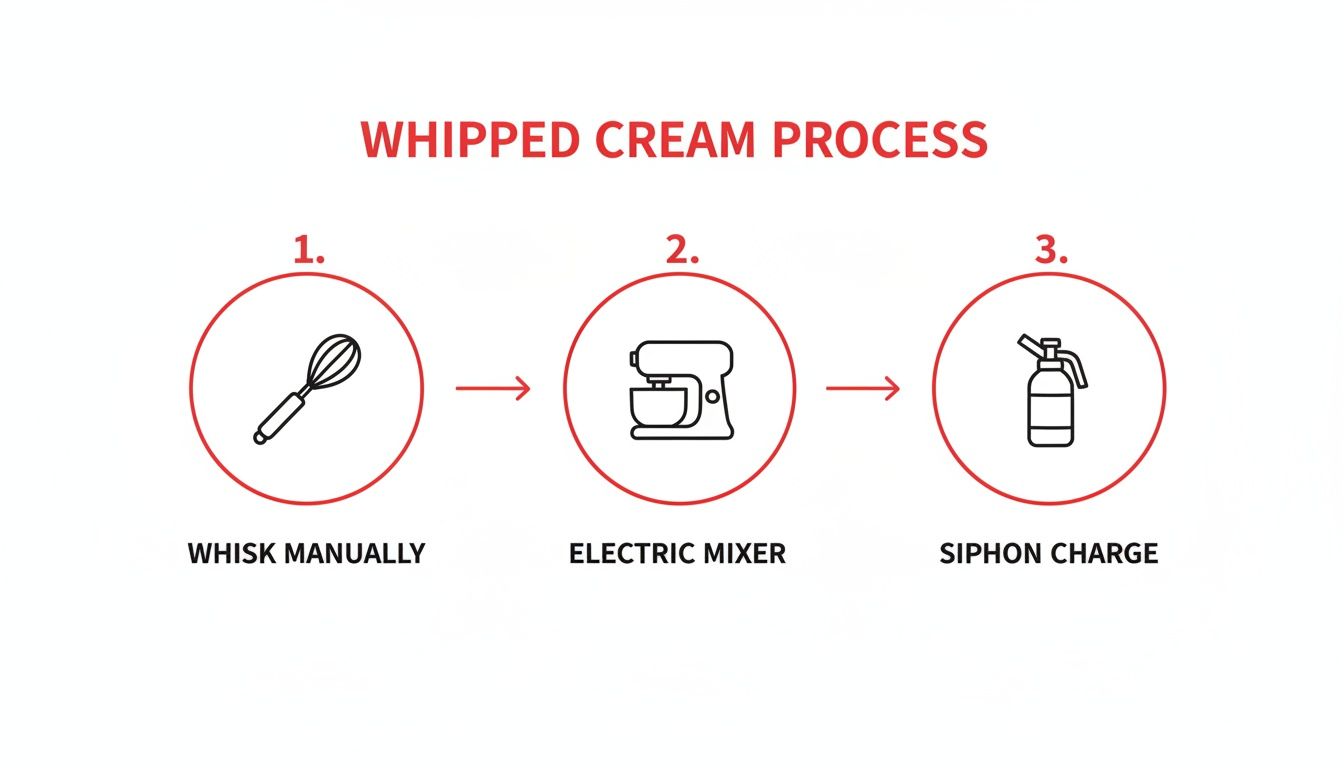
For any professional kitchen or bar where time and consistency are money, the N2O siphon is the clear winner.
The Power of Overrun and Profit
The single biggest business advantage of using N2O is the huge increase in overrun—the industry term for the increase in volume from liquid to whipped product. A good stand mixer might double your volume, giving you 100-150% overrun. An N2O siphon, on the other hand, can easily quadruple it, hitting an overrun of 300-400%.
This means that one litre of liquid heavy whipping cream can produce up to four litres of finished whipped product. This is a game-changer. You’re quadrupling your yield, which directly slashes your cost-per-serving and drives up the profit margin on every dessert and cocktail you sell.
For a busy bar in Tenerife or a resort in Gran Canaria, that kind of efficiency is massive. It means less stock to manage, less waste, and more profit from every carton of cream in the fridge.
A Step-by-Step Guide to Perfect Dosing
Getting that perfect, cloud-like foam every single time is all about nailing the dosing and technique. Using a large-format N2O cylinder (like a 670g or 2kg tank) with a pressure regulator system is the best way to guarantee precision and control.
Here’s a practical guide to train your team:
Start Cold: Your heavy whipping cream needs to be straight from the fridge (around 2-4°C). Your siphon canister needs to be cold, too—chill it in the fridge or an ice bath before you start. Cold temperatures are crucial for helping the N2O dissolve properly into the fat.
Fill Correctly: Never overfill the canister. Stick to the max fill line—it's usually about half to two-thirds of the canister's capacity. If you overfill it, there isn't enough room for the gas to work its magic, and you'll get a poor result.
Charge with Precision: Connect the regulator hose to your siphon. Introduce the N2O gas slowly until you hear the flow stop. The goal is to add just enough gas to pressurise the canister. Overcharging will give you a watery, "spitty" foam.
Shake to Infuse: Once it's charged, give the canister a few vigorous shakes—about 5-7 times is usually right. This distributes the N2O evenly. Be careful not to over-shake, as this can make the cream dense and buttery. Consistency is key.
Test and Serve: Hold the siphon straight down (vertically) and gently press the lever. The first little bit might come out liquid, which is perfectly normal. After that, you should have a perfectly formed, light, and stable cream.
Creating Signature Flavoured Foams
This is where the real creativity comes in. An N2O siphon is a fantastic tool for making custom-flavoured foams that can set your menu apart. You just need to add your flavouring agents before you charge the canister.
- Sweeteners: Stick to powdered sugar or liquid syrups (like vanilla or caramel). They dissolve easily and won't clog the nozzle.
- Liqueurs and Extracts: A dash of a quality liqueur like Amaretto or an Irish cream works wonders for cocktail toppings.
- Fruit Purées: If you're using fruit, make sure it's strained completely. Any seeds or pulp will clog the siphon mechanism and cause a real headache during service.
With this technique, you can go from a classic Chantilly cream to a unique mango foam for a signature cocktail in minutes. To see more real-world examples, you can learn more about what cream chargers are used for in bars and restaurants in our detailed guide.
Troubleshooting Common Siphon Issues
Even the best-run kitchens run into problems. Here’s a quick guide for fixing the most common issues right in the middle of a busy service.
| Issue | Likely Cause(s) | Solution(s) |
|---|---|---|
| Watery or Runny Cream | Under-shaking, cream or canister not cold enough, not enough gas. | Shake the canister a couple more times. Get everything properly chilled next time. Check if your gas cylinder is empty. |
| "Sputtering" or Gassy Dispensing | Over-pressurised, or the siphon wasn't held vertically. | You'll have to vent the gas, open it, and start again. And always dispense with the siphon pointing straight down. |
| Cream Is Too Thick or Buttery | You over-shook the canister. | Unfortunately, there's no going back from this. You've basically made butter. Find another use for it and start a new batch, shaking it less. |
Once your team masters these simple steps, you'll stop seeing heavy whipping cream as just another ingredient and start treating it like the consistent, profitable, and creative asset it truly is.
Safe Storage and Handling in the Canary Islands Climate
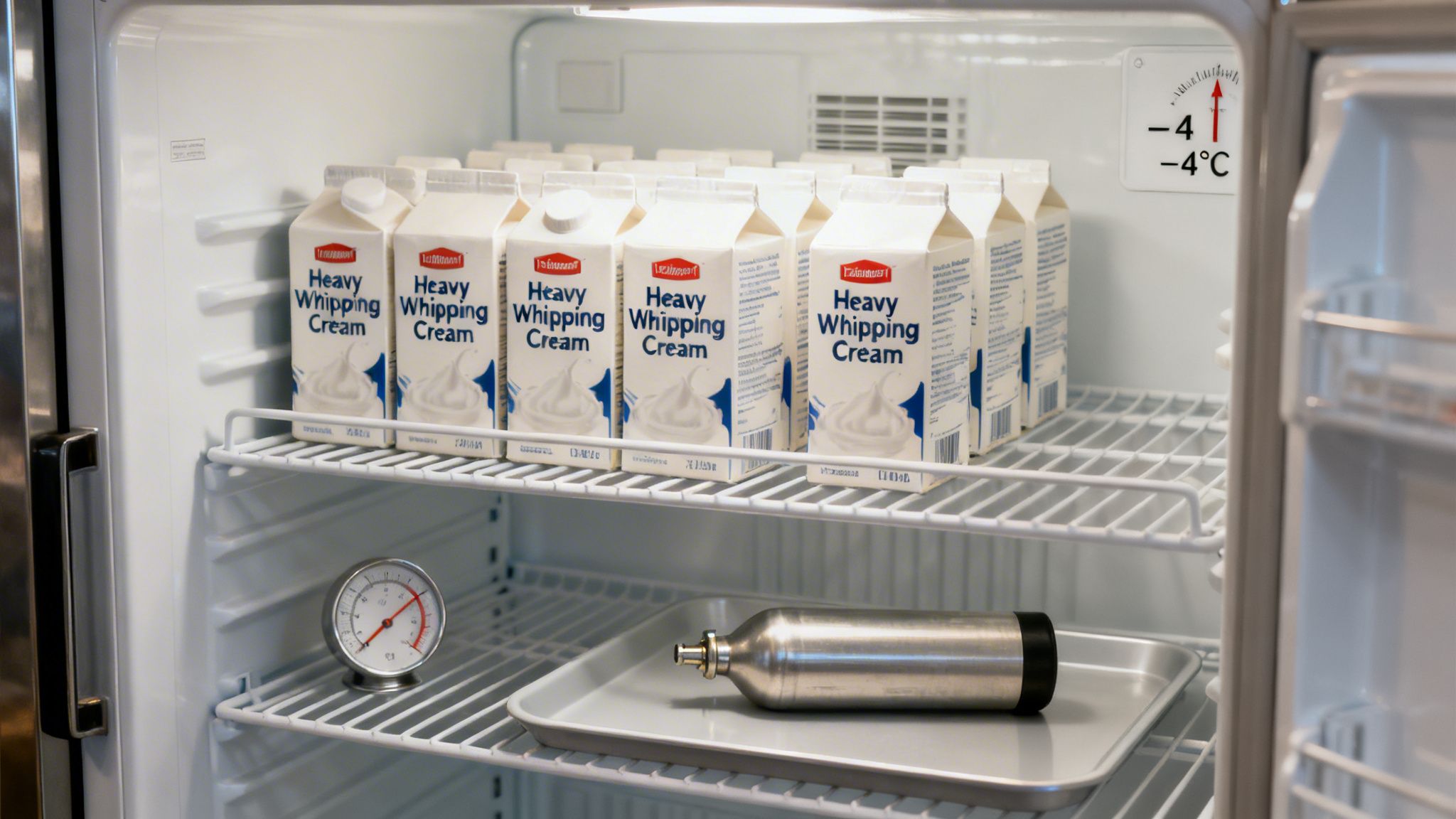
In the Canaries, where the ambient heat can turn dairy into a liability in minutes, food safety isn't just about passing an inspection. It's the bedrock of your reputation. For a product as delicate as heavy whipping cream, getting storage and handling wrong can cost you more than just spoiled stock—it can risk a customer’s health and your standing with the authorities.
The first line of defence is a non-negotiable one: temperature. Your liquid heavy whipping cream must live in a refrigerator holding a steady 2°C to 4°C. This isn’t a suggestion; it’s the critical zone that slows bacterial growth and keeps your cream prime for whipping. A calibrated thermometer in your fridge isn't an accessory; it’s an essential piece of kit.
The Professional’s Secret to Extending Shelf Life
Once whipped, the clock starts ticking. Fast. Cream whipped and left in an open bowl is exposed to everything—air, contaminants, and temperature spikes. In a busy service environment, it can start to break down and become unsafe in as little as two hours. It’s a huge headache for any professional kitchen.
This is where a nitrous oxide (N2O) cream siphon stops being a gadget and becomes a fundamental tool for quality and safety. When you charge a siphon, the N2O gas creates a sealed, anaerobic (oxygen-free) environment. And nitrous oxide isn’t just for aeration; it has known bacteriostatic properties, meaning it actively stops many common aerobic bacteria from growing.
The result is a game-changer. Whipped cream stored in a properly refrigerated N2O dispenser stays perfectly fresh, stable, and safe for up to 10 days. That's a massive leap from the few hours you get with an open bowl.
This extended life cuts product waste to almost zero and gives you perfectly aerated cream on demand, without the constant grind of making fresh batches. You move from a reactive workflow to a proactive one. If you want to see how this efficiency scales up, you can learn more in our guide on professional nitrous oxide tanks for Canary Islands venues.
The Non-Negotiable Siphon Cleaning Protocol
That 10-day lifespan only works if your equipment is spotlessly clean. A dirty nozzle or a grimy gasket is a breeding ground for bacteria, completely defeating the purpose of the sealed system. A strict cleaning routine isn't just good practice—it's what lets you face any AESAN health inspection with complete confidence.
Make this routine a reflex after every single use to guarantee food safety:
- Total Disassembly: Once the dispenser is empty, take it apart. Everything. Unscrew the head, pop out the gasket, and remove the decorator tip and its valve.
- A Proper Wash: Clean every component in hot, soapy water. Use those small brushes that come with the siphon—they are essential for scrubbing inside the head, the valve, and the tips to get all the cream residue out.
- Rinse and Sanitise: Rinse every part thoroughly with clean water to remove all soap. For that extra layer of safety, a final rinse in a food-safe sanitising solution is a smart move.
- Air Dry Completely: Never reassemble a wet siphon. Let all the parts air dry on a clean surface. Trapped moisture is a perfect home for bacteria.
Building these storage and cleaning habits into your daily operations is how you protect your customers, your stock, and your business. It's the professional standard for handling heavy whipping cream in any demanding venue.
Getting Your Supplies on the Islands: A High-Volume Guide
Running a hospitality business in the Canary Islands isn't like running one on the mainland. It's a different game with its own set of rules. I've seen countless managers get tripped up by the unique logistical puzzle of getting essential supplies like heavy whipping cream and food-grade nitrous oxide to their door.
What looks like a simple online order can quickly turn into a customs nightmare, stuck at the port while your weekend service hangs in the balance. For a high-volume bar or restaurant, running out of a core ingredient isn't just an inconvenience; it’s a direct hit to your reputation and your bottom line. That's why your choice of supplier is one of the most critical operational decisions you'll make.
Finding a Partner, Not Just a Seller
This is where a specialised B2B partner who actually understands the Canary Islands becomes your secret weapon. I’m not talking about a faceless website that just happens to ship here; I mean a team on the ground that lives and breathes the local supply chain, from navigating port authorities to ensuring every delivery complies with regional regulations.
This is especially true for products like N2O tanks, which are governed by strict transport and handling rules. A professional partner guarantees that every cylinder you receive is fully certified, food-grade, and delivered according to all safety protocols. It makes your business audit-proof before the product even crosses your threshold.
I’ve learned over the years that the real value isn't the product itself—it's the certainty of its arrival. Knowing you have a partner guaranteeing same-day or next-day delivery across Tenerife, Gran Canaria, and the other islands turns your supply chain from a source of stress into a competitive advantage.
This kind of reliability lets you operate with a much leaner inventory. You don't have to tie up precious capital in backstock or worry about spoilage. Instead, your team can put all their energy where it belongs: creating amazing experiences for your customers.
Why IGIC-Compliant Invoicing Is a Deal-Breaker
For any legitimate business here, fiscal compliance is non-negotiable. Every purchase must be documented correctly, and that means applying our local tax, the Impuesto General Indirecto Canario (IGIC). A generic invoice from a mainland supplier simply won’t hold up during a tax inspection.
A professional B2B supplier provides a clean, audit-ready, IGIC-compliant invoice with every single order. This isn't just paperwork; it's your protection. It’s a clear, official record proving you operate within the local tax framework, shielding your business from serious financial and legal headaches. In a place where regulatory checks are common, compliant invoicing is your first line of defence.
The Power of Certified, Consistent Product
In the world of high-end cocktails and molecular gastronomy, purity is everything. When you use N2O to infuse or whip heavy whipping cream, that gas becomes an ingredient in your final product. Using cheap, uncertified gas from an unknown source is a massive risk. It can introduce foul metallic tastes and oily residues that will ruin a drink in seconds.
This is why professionals only work with suppliers offering food-grade E942 nitrous oxide with 99.9% purity from trusted brands like Fastgas. Certification is your guarantee of:
- Safety: The product is free of industrial contaminants and completely safe for consumption.
- Consistency: Pure N2O delivers a clean taste and reliable yield, so every serve is as perfect as the last.
- Traceability: A certified product has a clear supply chain history, which is essential for meeting food safety standards.
A dedicated B2B partner is built to provide this level of quality consistently. The table below illustrates the kind of efficiency you can unlock by using professional-grade N2O cylinders.
N2O Cylinder Yield and Cost-Efficiency Snapshot
This table shows the real-world output you can expect from professional-grade N2O cylinders, highlighting the cost and labour savings for a busy venue.
| Cylinder Type | N2O Purity | Estimated Servings (per 1L Cream) | Best for Volume | Key Advantage |
|---|---|---|---|---|
| Fastgas 670g | 99.9% | Approx. 100-120 | Medium to High | An excellent balance of size and output for busy bars. |
| Great Whip 2kg | 99.9% | Approx. 300-350 | High to Very High | Maximum efficiency, reducing tank changes during peak service. |
By securing a stable supply of certified products like these, you remove the guesswork from your prep. Your team gets the tools they need to perform at their best, time and time again. If you're ready to make the switch, our guide on how to open a wholesale account with King's Canisters walks you through the straightforward process.
Ultimately, smart sourcing in the Canary Islands is about building a resilient and profitable operation. It’s choosing a partner who removes logistical headaches, ensures you’re fully compliant, and delivers the quality your customers expect.
Frequently Asked Questions (FAQ)
Can I use lower-fat cream in a nitrous oxide whipper?
For professional results, the answer is a firm no. You must use a true heavy whipping cream (nata para montar) with a milk fat content of at least 36%. The science of a siphon requires a high concentration of fat for the nitrous oxide gas to dissolve into, which creates a stable, rich foam. Using a lighter cream (around 30% fat) will result in a thin, watery foam that collapses almost instantly, compromising the quality of your final product.
How do I keep whipped cream stable in the heat of the Canary Islands?
Temperature control is critical. Always start with both your heavy whipping cream and the siphon canister chilled to 2°C to 4°C. Once charged, the sealed dispenser insulates the cream. For maximum stability during service, especially in warm environments like a terrace or beach club, keep the charged dispenser in an ice bucket between uses. This ensures every serving is perfectly chilled and firm.
Why is a local B2B supplier with IGIC invoicing so important?
Operating a legitimate business in the Canary Islands requires strict adherence to local tax and food safety regulations. A professional B2B supplier who understands the local market provides audit-ready invoices with the correct IGIC tax applied, which is essential for any fiscal inspection. They also guarantee that products like food-grade N2O are fully certified to AESAN standards, protecting your business from legal and financial risk and proving you run a safe, professional operation.
What is the real-world yield difference between 8g chargers and a 2kg tank?
The efficiency gain is massive. A single 2kg N2O tank provides the same amount of gas as approximately 250 individual 8g chargers. For any busy bar or restaurant, switching to a large tank eliminates workflow interruptions from changing small cartridges, drastically cuts down on metal waste, simplifies stock management, and significantly lowers your cost-per-litre of whipped cream. This directly translates to higher profit margins and a smoother, more efficient service.
Ready to streamline your operations with reliable, certified supplies? As the Canary Islands' dedicated B2B partner, Kings Canisters provides audit-ready invoices and same-day delivery on professional-grade N2O. Explore our full range of products.