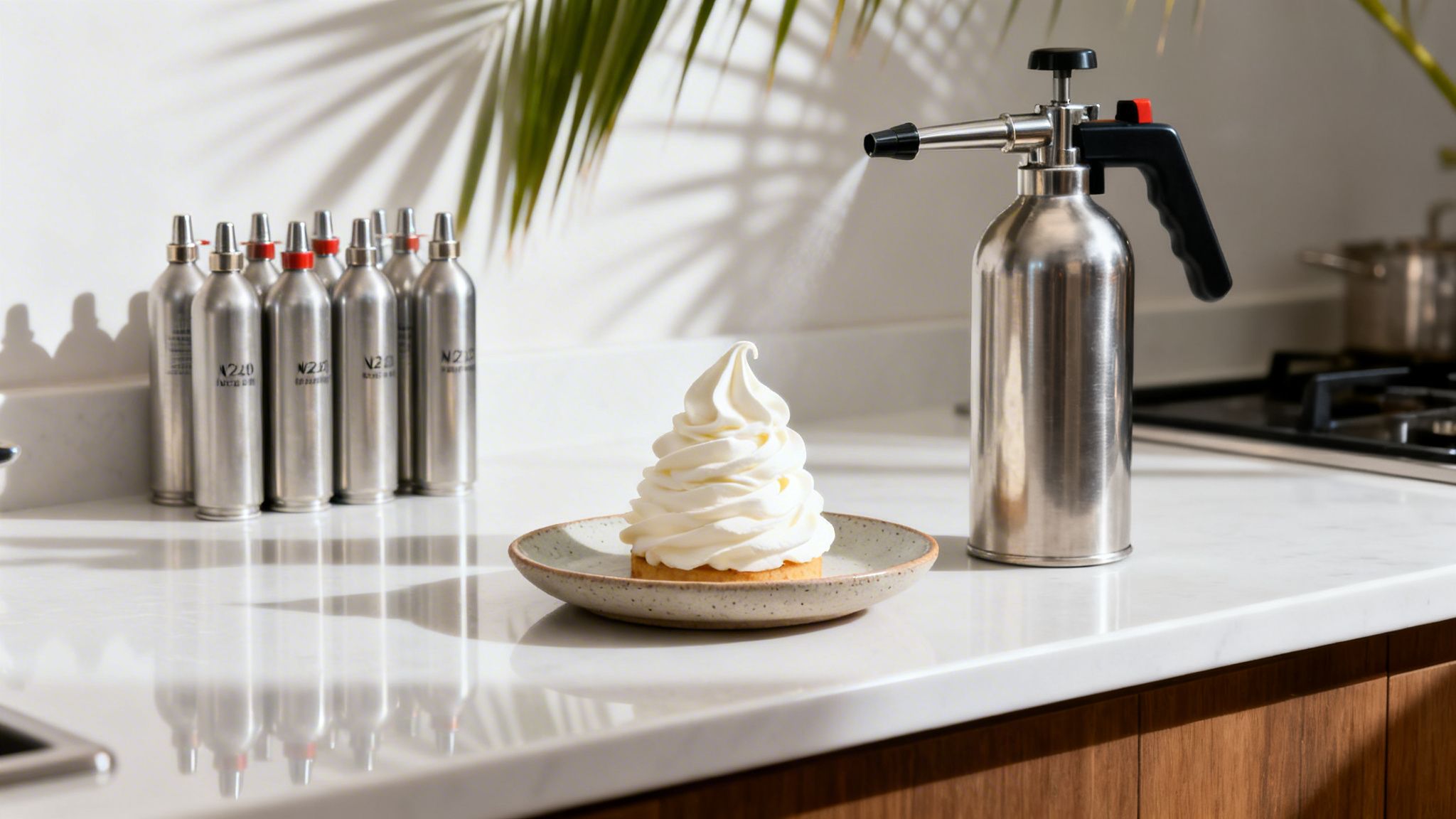

How to Make Whipped Cream (Hacer Nata Montada): A Professional Guide
Summary: This guide provides hospitality professionals in the Canary Islands with expert techniques for making whipped cream (hacer nata montada) using a cream siphon and nitrous oxide (N2O). It covers the advantages of siphons over traditional methods, step-by-step operating instructions, yield optimization with large N2O cylinders, creative flavor infusions, and essential safety and compliance protocols. The focus is on delivering practical, high-value information for improving speed, consistency, and profitability in a professional kitchen or bar.
Key Points:
- Method: A cream siphon with N2O is superior to hand-whisking or electric mixers for speed, yield (up to 4x), and stability (7+ days).
- Ingredients: Use heavy cream with at least 35% fat content.
- Preparation: Chill both the cream and the siphon canister for at least 2 hours before charging for optimal results.
- Technique: Charge the siphon, shake vigorously 5-6 times, and test. Adjust with 1-2 more shakes if needed. Avoid over-shaking.
- Scaling Up: Large format N2O cylinders (670g or 2kg) significantly reduce cost per charge and improve operational efficiency for high-volume venues.
- Creativity: Use the siphon for direct flavor infusions (vanilla, cinnamon, coffee beans) and creating cocktail foams (espumas).
- Safety: Source food-grade E942 N2O from a certified B2B supplier, store cylinders securely, and maintain strict equipment cleaning protocols.
For any serious hospitality venue in the Canary Islands, from a cocktail bar in Tenerife to a high-volume caterer in Lanzarote, how you hacer nata montada isn't a culinary question—it's a business one. The tool for the job isn't a whisk or a mixer; it's a professional cream siphon powered by nitrous oxide (N2O). This guide offers practical, no-fluff information to master this essential technique.
Whipped Cream Methods: A Professional's Comparison
In the relentless pace of a Canarian kitchen, efficiency is profit. While hand-whisking or using an electric mixer might work for a small café, they simply can't compete with a siphon system when volume and consistency are on the line. I've seen kitchens lose valuable minutes during a chaotic service trying to get the right peak on their cream with a mixer, only to have it deflate an hour later.
A siphon isn't just a gadget; it's a fundamental shift in how you manage a core ingredient. Let's break down why it's the undisputed standard.
.tbl-scroll{contain:inline-size;overflow-x:auto;-webkit-overflow-scrolling:touch}.tbl-scroll table{min-width:600px;width:100%;border-collapse:collapse;margin-bottom:20px}.tbl-scroll th{border:1px solid #ddd;padding:8px;text-align:left;background-color:#f2f2f2;white-space:nowrap}.tbl-scroll td{border:1px solid #ddd;padding:8px;text-align:left}MethodSpeed Per LitreTexture & StabilityTypical YieldBest ForHand Whisk10-15 minutesDense, inconsistent. Loses air quickly.~1.8xHome baking, very small-scale prep.Electric Mixer5-8 minutesGood, but can be over-whipped. Stable for a few hours.~2xLow-volume cafés, bakeries.Cream Siphon (N2O)< 1 minuteExceptionally light, fine, and consistent. Stable for 7+ days.Up to 4xHigh-volume bars, restaurants, hotels, catering.
The data speaks for itself. The siphon's advantages in speed, yield, and stability make it the only logical choice for a professional operation that values its time and its bottom line.
The Siphon Advantage: It's All in the Gas
The magic of a cream siphon comes down to physics. When you use a whisk or mixer, you're physically beating air into the cream. The bubbles are large, and the structure is fragile. It's slow and labour-intensive.
A siphon, charged with food-grade E942 nitrous oxide, is a different beast entirely. The N2O gas dissolves directly into the cream's fat content under pressure. When you pull the trigger, the sudden drop in pressure causes the gas to expand instantly, creating a remarkably light foam.
The results are transformative for any kitchen or bar:
- Unbeatable Speed: A litre of cream is ready to serve in less than a minute. That’s the difference between keeping up with a rush of Barraquito orders and falling behind.
- Massive Yield Increase: This is where the numbers really matter. A siphon can quadruple the volume of your liquid cream. One litre of cream yields up to four litres of perfect nata montada, drastically cutting your cost per serving.
- Incredible Stability: Once charged and refrigerated, the cream inside a siphon stays perfectly fresh and stable for over a week. This means you can prep in advance, cutting down on labour during service and all but eliminating waste.
I once consulted for a new hotel in Playa de las Américas that was burning through staff hours and cream using planetary mixers. Switching them to a siphon system for their dessert and cocktail stations wasn't just an "upgrade"—it immediately showed up on their P&L statement through reduced food costs and faster ticket times. It's a no-brainer.
Ultimately, the siphon is the professional standard because it solves the core challenges of a busy hospitality business: speed, consistency, and cost. It’s not just about making better whipped cream; it's about running a smarter, more profitable operation.
If you're ready to equip your team with the right tools, the next step is to explore the professional-grade N2O canisters and siphon systems designed for the demands of our industry.
Your Guide to Flawless Siphon Operation
Right, let’s get our hands dirty and master the cream siphon. Moving from theory to practice is where you see the real value of this tool. A few small details separate decent results from perfect nata montada every single time—even during a chaotic weekend service. This isn't just about screwing on a charger; it’s about a process that guarantees consistency.
Tools & Resources:
- Cream: Heavy cream with at least 35% fat content.
- Equipment: Professional cream siphon (0.5L or 1L), N2O chargers or cylinder with regulator.
- Resource: Food & Wine Guide to Whipped Cream - For understanding cream fat properties.
The foundation for great whipped cream is laid down long before you even touch the siphon. It all starts with the cream you choose. For a stable whip that holds its shape on everything from a complex dessert to a classic Barraquito, you must always use a cream with at least 35% fat content. The cream needs the fat globules to trap the N2O gas; less fat results in a runny, disappointing foam.
Preparing for a Perfect Charge
Temperature is your most important ally here. Your liquid cream and the siphon canister itself must be properly chilled. Store both in the fridge for at least two hours before charging. This cold environment helps the nitrous oxide dissolve far more efficiently into the cream’s fat, giving you that light, stable texture.
Think of it like trying to carbonate a soda. A warm liquid will just fight the gas, but a cold one embraces it. Skipping the chilling step is the single most common mistake, and it almost always ends in a thin, watery cream that won’t hold its form.
This visual shows you exactly where the siphon fits in, moving from old-school techniques to modern, professional efficiency.
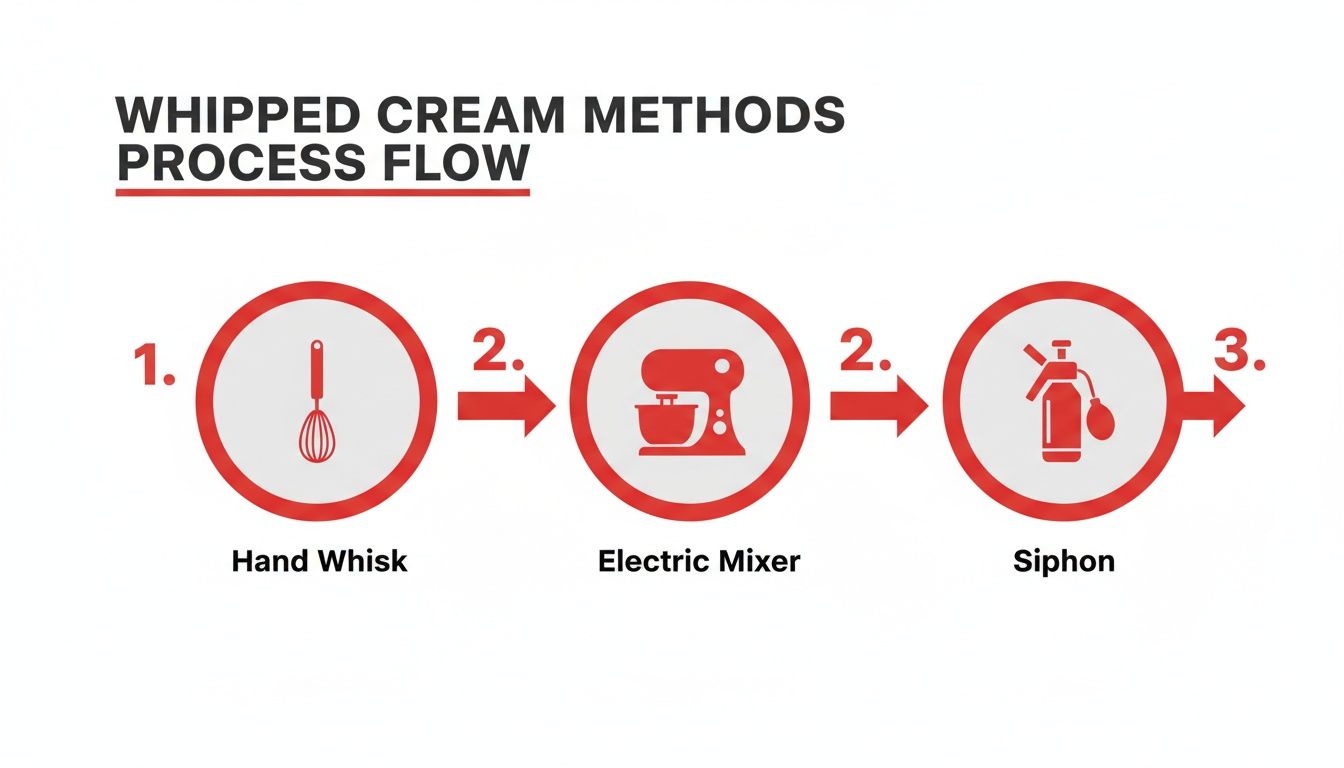
The journey from hand whisk to electric mixer and finally to the siphon shows a clear evolution towards speed and quality in a professional kitchen.
The Correct Charging and Shaking Technique
Once your chilled cream is in the canister, screw the lid on good and tight. Now it’s time to charge it. Pop an N2O charger into the holder and screw it onto the siphon until you hear that distinct hiss—that’s the sound of the gas doing its job.
After charging, the number of shakes is critical. For a standard 0.5L siphon, 5-6 vigorous, sharp shakes is the magic number to start with. Over-shaking will turn the cream into butter.
After those first few shakes, always test a small amount. If it’s still a bit loose, give it just one or two more shakes and test again. This careful approach helps you dial in the perfect texture without accidentally ruining the whole batch. Once it's charged and shaken, your siphon is ready for service or can be stored in the fridge.
If you're curious to learn more about the science behind this, we break it down in our guide on what cream chargers are used for in bars and restaurants. It’s a useful read for understanding why this method is so effective in a professional setting.
Maximizing Yield with Large Format N2O Canisters
For any high-turnover business in the Canary Islands, the endless cycle of single-use 8g chargers is a major bottleneck. Switching to a large-format N2O system isn’t just a minor upgrade; it’s a fundamental change in how you manage efficiency, cost, and quality when you need to hacer nata montada at scale. This is where systems built around 670g or even 2kg cylinders become non-negotiable.
These larger tanks, when paired with a pressure regulator, transform whipped cream production from a tedious task into a streamlined, on-demand operation. You eliminate the waste of hundreds of steel cartridges and reclaim the valuable time your team wastes constantly recharging siphons.
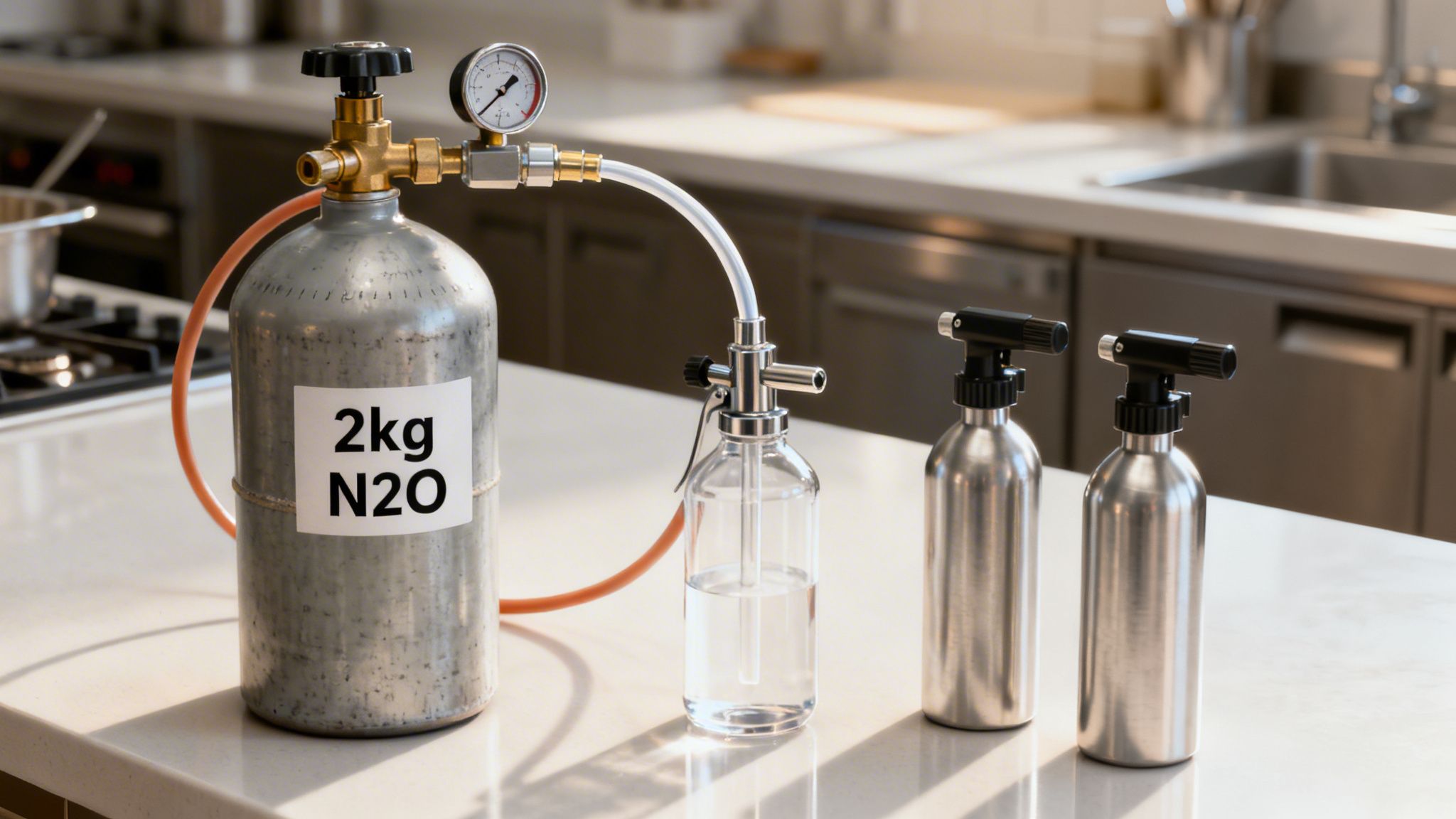
Connecting and Operating a Regulator System
Getting set up is surprisingly straightforward. You simply attach the pressure regulator securely to the thread on your N2O cylinder. A high-pressure hose then connects the regulator’s output valve directly to your siphon’s charging inlet. This direct line is what gives you absolute control.
Instead of the fixed dose from an 8g charger, you can now dial in the exact pressure for the job. This is the secret to achieving different textures for different uses.
For a soft, delicate foam to top a cocktail, you might set the regulator to a lower pressure, around 5-7 bar (75-100 PSI). But for firm, decorative peaks that need to hold their shape on a dessert, you’d push the pressure up to 8-10 bar (115-145 PSI).
This precision means every batch is identical, removing the guesswork and building a repeatable, reliable process.
Calculating Yield for Smart Inventory Management
Understanding the yield from each cylinder is vital for managing your inventory and avoiding stockouts. The maths here is simple, but it’s powerful. A single 8g charger gives you one charge for a 0.5L siphon. A larger tank offers a massive economy of scale, allowing for data-backed procurement decisions.
For a deeper dive into how different sizes stack up for business use, have a look at our detailed comparison of 580g vs 2kg N2O cylinders. It’ll help you figure out the best fit for your specific volume.
To help guide your purchasing decisions, here’s a practical breakdown of what you can expect.
N2O Cylinder Yield and Dosing Guide
The table below gives you a clear estimate of how many 0.5L siphon charges you can get from each cylinder size. It's designed to help businesses like yours forecast usage and control costs effectively.
Note: Yields are approximate and can vary with your pressure settings and technique.
.tbl-scroll{contain:inline-size;overflow-x:auto;-webkit-overflow-scrolling:touch}.tbl-scroll table{min-width:600px;width:100%;border-collapse:collapse;margin-bottom:20px}.tbl-scroll th{border:1px solid #ddd;padding:8px;text-align:left;background-color:#f2f2f2;white-space:nowrap}.tbl-scroll td{border:1px solid #ddd;padding:8px;text-align:left}Cylinder Model/SizeN2O WeightEstimated 0.5L Siphon ChargesBest Use CaseStandard Charger8g1Very low-volume or home use. Inefficient for any serious business.Kings Canisters 670g670g~84 chargesMedium to high-volume bars, mobile catering, and festival pop-ups.Kings Canisters 2kg2,000g (2kg)~250 chargesHigh-volume nightclubs, large hotels, event catering, and central kitchens.
The numbers don't lie. A single 2kg cylinder provides the same output as 250 individual 8g chargers. This means less storage space, significantly less packaging waste, and a drastic drop in your cost per charge. For any serious operation, switching to a large-format system is an investment that pays for itself quickly.
Creating Signature Flavours and Cocktail Foams
Mastering the cream siphon is one thing; turning it into a creative tool is another. This is where you develop the signature touches that set your menu apart.
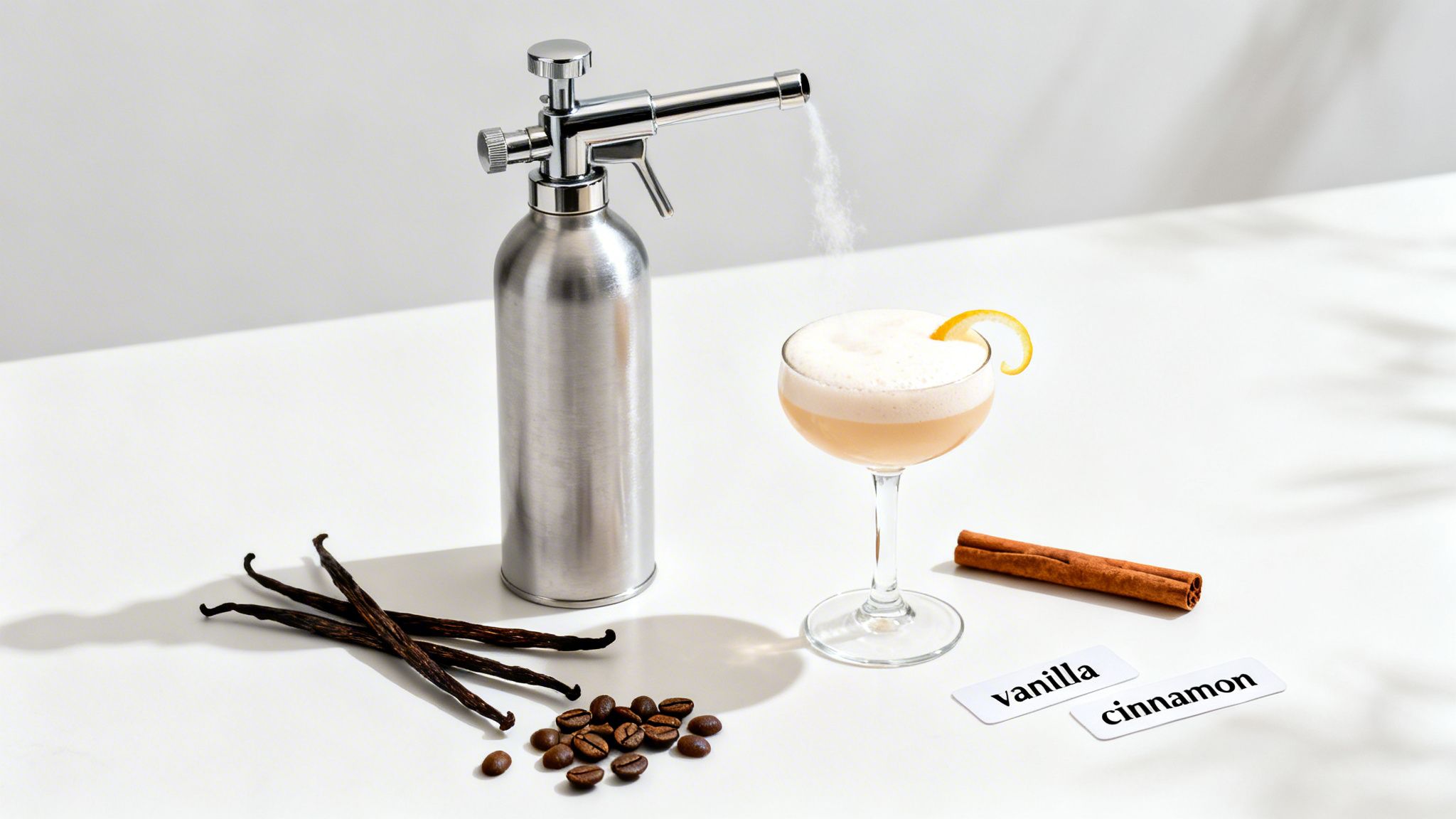
First, let's talk about stability. For intricate desserts or foams that need to hold up, a tiny pinch of a stabiliser mixed into the liquid cream before charging makes all the difference.
- Xanthan Gum: You only need a tiny amount—about 0.1% of the liquid's weight. It gives an incredible hold without affecting the flavour.
- Gelatin: The classic for a firmer set. Bloom a sheet in cold water, gently melt it with a splash of warm cream, then mix it into your main batch before you chill and charge it.
This small step is the secret behind perfect, sharp peaks that don't wilt.
The Art of Direct Siphon Infusion
One of the best tricks of the siphon is its ability to infuse flavours directly. The pressurised N2O environment forces aromatic compounds into the fat of the cream, doing in minutes what would normally take hours.
- For Desserts: Throw a split vanilla bean or a snapped cinnamon stick right into the canister with your cream. Charge it, shake, and let it sit in the fridge for an hour.
- For Coffee Drinks: For a next-level Barraquito, drop a handful of quality coffee beans and a strip of orange zest into the siphon.
A critical tip: always strain the infused liquid through a fine-mesh sieve before dispensing. This stops solid bits from clogging the nozzle and ensures a smooth foam.
Crafting Espumas and Cocktail Foams
The real magic of the siphon isn’t just cream; it's creating espumas (foams) that can transform a drink. You can foam almost any flavourful liquid. Imagine topping a mojito with a weightless mint-lime foam instead of just a garnish.
For a basic fruit espuma, blend fresh fruit purée with a liquid (like water or syrup) and a stabiliser. Strain it, chill it, and charge it in the siphon. The N2O turns that liquid into a delicate foam bursting with pure fruit flavour.
Rapid Infusion for Spirits
A siphon is also a secret weapon for rapid infusions. This technique uses N2O pressure to push liquid into the pores of solid ingredients, pulling out flavour in minutes.
Want to make a quick-spiced rum?
- Drop toasted cinnamon sticks, cloves, and orange peel into a 1L siphon.
- Pour in 500ml of rum.
- Charge the siphon with two N2O chargers.
- Shake it hard for 30 seconds, then rest for 5 minutes.
- Vent the gas carefully, open, and strain your infused rum.
This is how you create bespoke spirits on the fly. If you’re curious about the gear that makes this possible, you can find more on systems like Fast Gas.
Safety and Compliance for Canary Islands Businesses
Using professional-grade nitrous oxide to hacer nata montada brings a new level of responsibility. For any establishment in the Canary Islands, taking safety and legal compliance seriously isn't just good practice—it's essential for protecting your team, guests, and reputation.
This means following strict guidelines for handling, storing, and using food-grade E942 nitrous oxide, adhering to standards from the Spanish food safety agency (AESAN) and broader EU regulations.
The Supplier: Your First Line of Defence
Your single most important decision is choosing your supplier. Sourcing N2O from a certified B2B partner like Kings Canisters Tenerife is not negotiable. A professional supplier must guarantee 99.9% purity and provide full traceability for every cylinder, ensuring the gas is free from industrial contaminants.
When an inspector walks into your kitchen, they will want to see documentation for your gas. A certified B2B supplier provides certificates of analysis and conformity (like ISO 9001 and CE) that prove your due diligence.
The Canary Islands Reality: Logistics and Paperwork
Operating in the Canaries involves unique logistical hurdles. Every good arriving must clear customs. A reputable supplier handles all of this, ensuring your N2O delivery arrives without delays or unexpected fees. Furthermore, a professional partner provides IGIC-compliant invoices, keeping your financial records clean for any audit. For more details, our guide on N2O compliance and legality in the Canary Islands covers these topics extensively.
In Your Venue: Storage and Handling
Once cylinders are on-site, proper storage is mandated by law and is critical for safety. They must be kept in a secure, well-ventilated area, away from public access and heat sources.
- Secure Upright: Always store cylinders chained or strapped in an upright position to prevent falls.
- Keep It Cool: Keep them out of direct sunlight and far from ovens or grills. High temperatures can cause pressure to rise to dangerous levels.
- Let It Breathe: The storage area must have good airflow to prevent gas buildup in the case of a leak.
These are fundamental safety requirements.
Final Step: Equipment and Cleaning Discipline
A strict cleaning and maintenance schedule for your cream whippers, regulators, and hoses is the final, crucial step.
- Daily: Disassemble siphons completely. Wash every part—head, bottle, gasket, and tips—with warm, soapy water. Use the small brush to clean the valve.
- Weekly: Inspect your regulator and hose for wear, cracks, or damage.
- After Cleaning: Sanitize all components according to your kitchen's food safety plan and let them air dry completely before reassembly. This prevents bacteria growth and clogging.
FAQ: Your Top Whipped Cream Questions Answered
We get a lot of questions from bar managers and chefs about getting their hacer nata montada process just right. Here are the answers to the questions we hear most often.
"Why Is My Siphon Giving Me Runny Cream?"
This almost always comes down to one of three things. First, check your cream. It must have a fat content of at least 35%. Less fat won't whip properly. Second is temperature—the biggest culprit. Your cream and the siphon must be chilled for at least two hours. Third is technique. Give a charged siphon 5-6 sharp shakes. Test, then add two more if needed. Don't over-shake, or you'll make butter.
"How Do I Figure Out My N2O Needs for a Big Event?"
Forecast your needs by working backwards from servings. A 0.5L siphon yields about 1.5 litres of cream, or 15-20 standard portions. A 670g N2O cylinder can charge that siphon about 80-84 times.
With these numbers, we can do some simple maths. One 670g cylinder can produce approximately 1,200 servings (80 charges x 15 servings). So, if you're planning a weekend event and expect to serve 2,500 cocktails with foam, you’ll need two 670g cylinders to cover the demand and a third as a backup.
"Can We Prep Siphons Before a Shift Starts?"
Absolutely. You should be doing this. A fully charged and refrigerated siphon will keep cream perfectly fresh and ready for up to 10 days. This workflow is a game-changer for speed and consistency during a rush. Just grab a prepped siphon, give it a couple of gentle shakes to remix, and you're good to go.
For professional venues across the Canary Islands looking to guarantee a reliable supply of pure, certified E942 nitrous oxide, Kings Canisters is your dedicated logistics partner. We manage everything from customs to IGIC-compliant invoicing, ensuring you have the high-quality N2O you need to keep your business running smoothly. Explore our B2B solutions at https://www.kingscanisters.com.