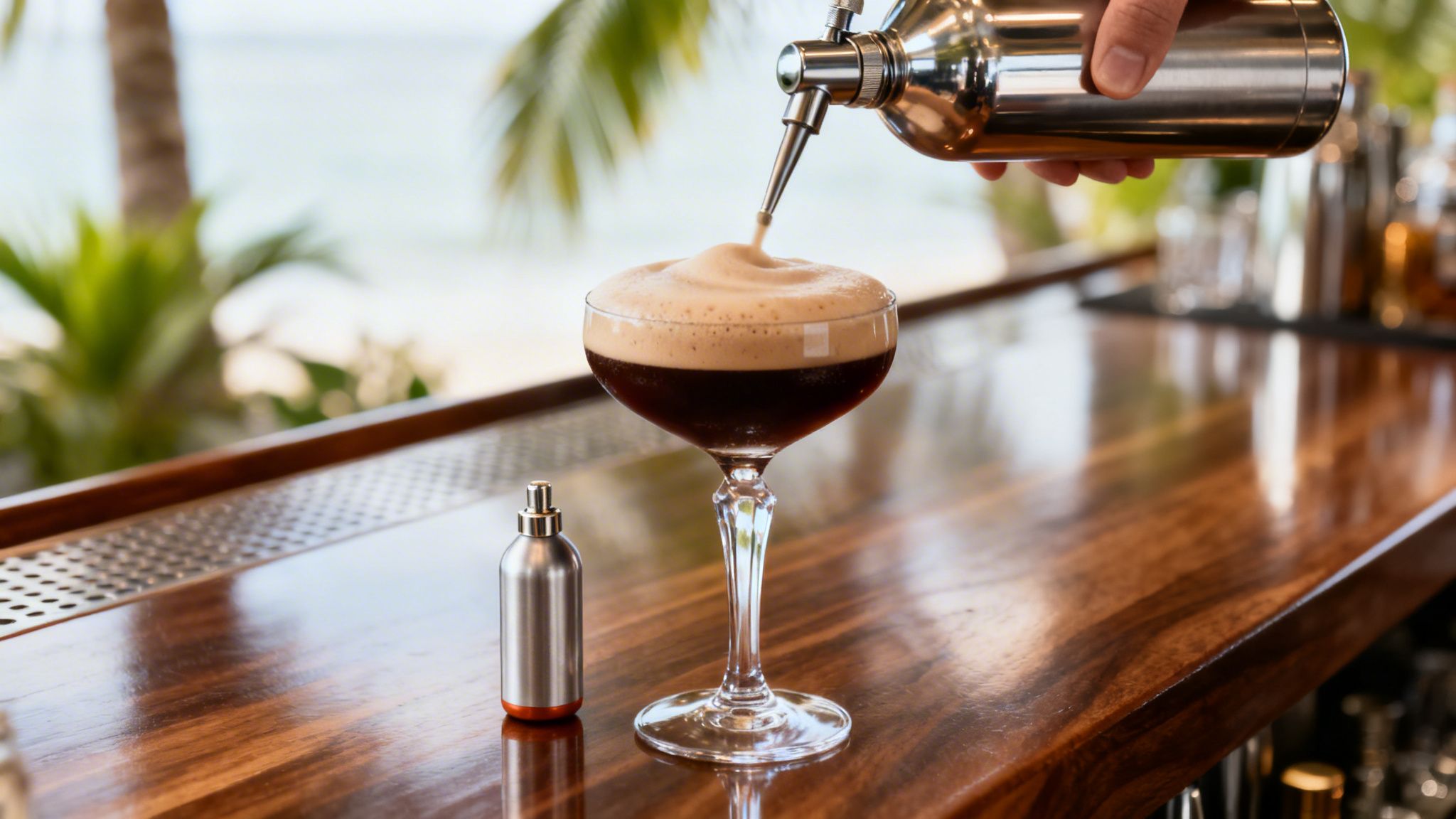

A Professional's Guide to Espuma de Café for Bars and Restaurants
Summary: This guide provides a professional playbook for creating perfect, profitable espuma de café (coffee foam) in high-volume bars and restaurants using food-grade nitrous oxide (N2O). It moves beyond basic recipes to cover advanced techniques, operational efficiency, cost analysis, troubleshooting, and legal compliance. You'll learn how to select the right equipment, stabilize your foam for maximum hold, infuse unique flavors, and troubleshoot common issues to ensure consistent quality and boost your bottom line.
Key Points:
- Method: Using N2O with a siphon is superior for speed, texture, and yield compared to traditional methods.
- Stability: A cold base (coffee + 35% fat cream) and a professional stabilizer (like gelatin or sucrose esters) are non-negotiable for a foam that lasts.
- Efficiency: Bulk N2O cylinders (e.g., 2.2kg, 3.3kg) significantly cut costs and streamline service compared to small chargers.
- Technique: A proper workflow involves chilling all components, not overfilling the siphon, charging correctly, shaking vigorously, and resting the siphon before service.
- Compliance: Using certified food-grade N2O (E942) and adhering to storage regulations is essential for safety and legality.
- Profitability: Mastering espuma de café enhances menu items, justifies premium pricing, and improves operational margins through increased ingredient yield.
Let's be honest, espuma de café has moved beyond a simple menu novelty. For top-tier bars and nightclubs across the Canary Islands, it's become a critical tool for consistency, speed, and—most importantly—profitability.
This isn't another basic recipe guide. This is the professional's playbook for creating that perfect, silky coffee foam using nitrous oxide, built for the realities of a high-volume commercial kitchen.
The Professional Method for Perfect Espuma de Café
When you're running a busy bar or a catering service, inconsistent, hand-whisked foams are a liability. They kill your ticket times and eat into your margins. The real goal is to adopt a system that delivers a flawless, velvety foam for every single espresso martini or signature dessert, without fail.
Mastering this technique is what separates a good bar from a great one. It turns a simple coffee element into a serious profit driver, but only if you get the process right from the start.
Why the Pros Swear by N2O
In a professional setting, there's no room for methods that can't keep up with the rush. Using food-grade nitrous oxide (N2O) with a quality siphon isn't just a shortcut; it's a superior technique that traditional methods simply can't touch.
- Unmatched Texture: N2O delivers a dense, incredibly smooth foam that holds its structure beautifully on cocktails and desserts. It's the texture customers remember.
- Serious Speed: You can charge a siphon in seconds, producing a large batch of foam that’s ready for immediate service. This is a game-changer during a weekend rush.
- Better Yields: The aeration from N2O massively increases the volume of your base liquid. You're literally making your ingredients go further, which is a direct boost to your bottom line.
Practical Tip: The secret to that perfect, long-lasting foam lies in using 99.9% pure, food-grade N2O. Impurities found in lower-grade gas will ruin both the flavour and the stability of your espuma.
Out here in the vibrant bar scene of Tenerife and Gran Canaria, this technique is already paying dividends. Data from high-volume spots in Adeje and Las Palmas show they can serve upwards of 1,200 cups a day during the high season. For them, introducing espuma de café has boosted yields by as much as 40% per N2O cylinder.
This is the standard now. We've designed this guide for the unique pressures of venues in Tenerife, Gran Canaria, and Lanzarote, helping you integrate this proven technique into your daily workflow.
Picking the Right Tool for the Job
Not all N2O cylinders are created equal, especially when you're managing inventory for a busy venue. Choosing the right size is less about the gas itself and more about operational efficiency—reducing tank swaps during a busy service is just as important as the cost per gram.
This quick-reference chart breaks down the most common cylinder sizes we see in professional kitchens across the islands. It's designed to help you match the product to your real-world service volume.
Essential N2O Cylinder Yields for Espuma de Cafe
| Cylinder Model | N2O Volume | Estimated Foams per Cylinder | Best For |
|---|---|---|---|
| 580g Tank | 580 grams | ~70-90 foams | Small to medium-sized cafes, cocktail bars with moderate demand, or mobile catering setups. |
| 2.2kg Cylinder | 2,200 grams | ~300-350 foams | High-volume bars, busy restaurants, and hotel kitchens needing consistent, uninterrupted supply. |
| 3.3kg Cylinder | 3,300 grams | ~450-500 foams | Large-scale event catering, nightclubs, and resort operations where maximum capacity is essential. |
Estimates are based on a standard 30-50ml foam serving size. Actual yield will vary depending on your specific recipe, siphon size, and charging technique.
Making the right choice here streamlines your team's workflow and prevents the dreaded "mid-service stockout." For most established venues, the larger cylinders are a no-brainer for both cost and logistics.
If you're ready to find the right fit for your operation, you can explore our selection of high-yield N2O canisters designed specifically for the hospitality trade.
Mastering the Siphon Workflow for Busy Bars
Picture the scene: it’s a packed weekend night, the dockets are piling up, and your signature espresso martini needs a perfect, long-lasting foam. This is where a professional workflow for espuma de cafe separates the amateurs from the pros. It’s not about just following a recipe; it’s about building a bulletproof system that delivers consistent, stable foam under pressure, every single time.
A great espuma starts with a solid, well-balanced base. For a standard 1-litre siphon, a good starting point is an 800ml/200ml split of strong, chilled coffee and liquid cream (35% fat). But if you want a foam that doesn't collapse before it reaches the customer, stabilisers are non-negotiable.
Fine-Tuning Your Base for Unshakeable Stability
The stabiliser you choose will define the final texture and hold of your espuma. While a simple sugar syrup can add some body, professional agents are what give you that reliable, bar-proof structure.
- Gelatin: This is my go-to for a firm, incredibly durable foam. Use 2-3 gelatin sheets per litre of liquid. Bloom them in cold water first, then gently melt them into a small amount of warm coffee before mixing everything into your chilled base.
- Sucrose Esters: If you’re aiming for a lighter, more delicate texture, sucrose esters are a fantastic option. You only need about 0.5% to 1% of the total liquid's weight, which is roughly 5-10 grams per litre. Just make sure you whisk it into the cold base until it’s completely dissolved.
Practical Tip: Chill everything. Your base liquid and the siphon itself should be in the fridge for at least two hours before you even think about charging. A colder mixture absorbs nitrous oxide far more effectively, giving you a denser, more stable foam that holds its shape, even on a warm drink.
This chart shows you exactly how a refined N2O process directly boosts your output and cuts down on waste.
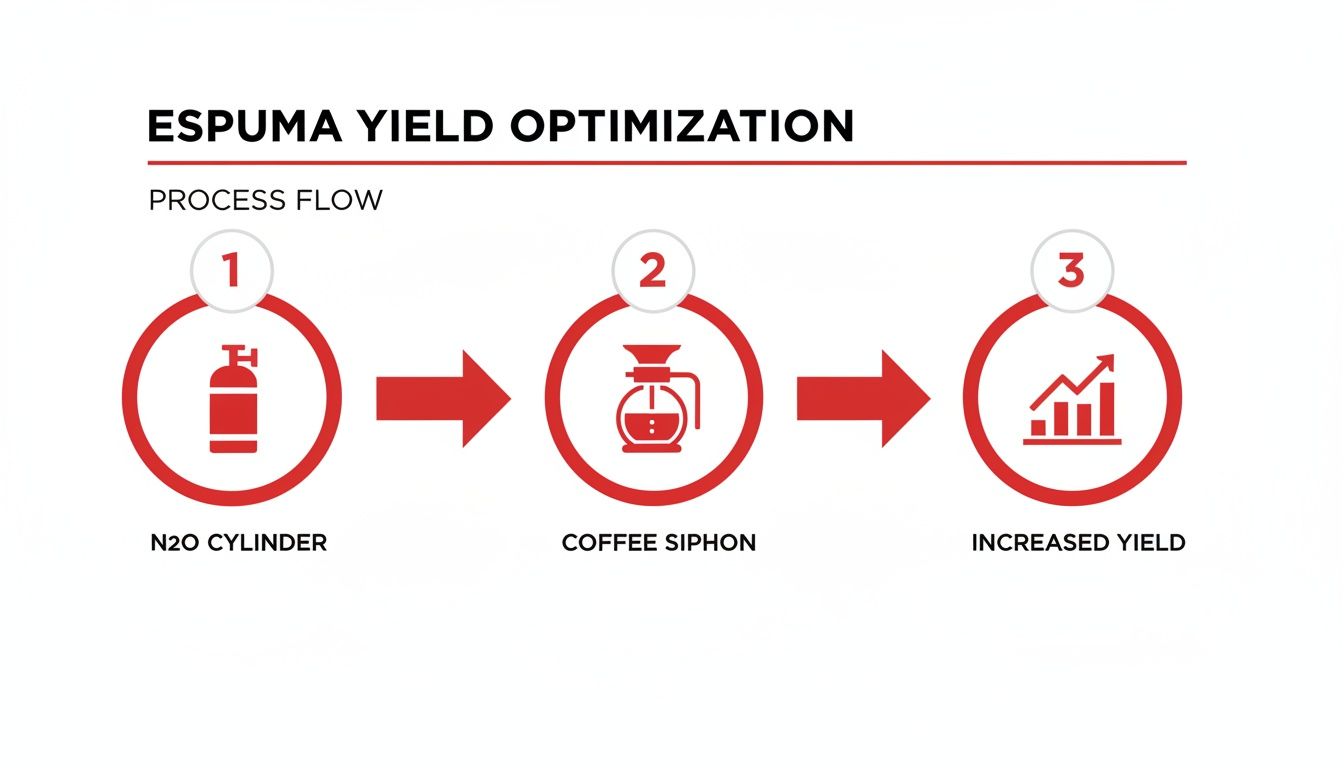
As you can see, making the switch to high-capacity N2O cylinders is a game-changer for maximising your foam production and keeping service flowing smoothly.
The Charge, Shake, and Rest Method
Once your chilled base is in the siphon—and never fill it past the max line—it’s time to charge. Screw the head on tightly, making sure the gasket is seated properly to avoid any leaks. For a 1-litre siphon, you’ll want to use two N2O chargers.
Now for the critical part: the shake and rest. Give the siphon a hard, vigorous shake for 15-20 seconds to get that gas dissolved. Then, and this is the step most people miss, let it rest in the fridge for at least 30 minutes. This allows the gas to fully integrate, giving you that smooth, velvety foam instead of a fizzy, bubbly mess. You can dive deeper into how cream chargers are used in bars in our detailed guide.
Before you start service, make this quick safety check a habit:
- Check the Threads: Make sure the threads on the siphon head and bottle are clean and undamaged.
- Inspect the Gasket: The silicone gasket should be soft and free of cracks. A bad gasket is the number one cause of leaks.
- Clear the Nozzle: Ensure the dispensing nozzle and valve are clear of any old foam or blockages.
This kind of disciplined, repeatable workflow is exactly how the top bars in places like Playa de las Américas can serve flawless espuma de cafe from open to close.
Creative Recipes and Advanced Foam Techniques

Once you’ve got the basic technique for a classic espuma de café down, the real work begins. This is where you stop thinking of foam as a simple garnish and start treating it as a core flavour element. For creative beverage directors, this is your chance to really set your menu apart.
Don't just stick to a standard coffee flavour. By infusing your base liquid before you charge it, you can introduce a whole world of complexity. This single step can turn a decent cocktail into a signature drink that people talk about long after they’ve left the bar.
Infusing Flavours into Your Espuma Base
The process itself isn't complicated, but the possibilities are endless. Before you chill your liquid base, you gently heat it with your chosen flavouring agents. This allows their aromas and tastes to properly meld with the coffee.
Here are a few ideas that work incredibly well:
- Warm Spices: Think whole cinnamon sticks, star anise, or even cracked tonka beans. Steeping these in the warm base adds a deep, aromatic warmth that’s perfect for winter cocktails or richer dessert drinks.
- Citrus Zest: The bright oils from fresh orange or lemon peel can cut straight through the richness of the coffee. This creates a vibrant, zesty foam that works beautifully in layered drinks.
- Savoury & Smoky: For a more avant-garde approach, try a touch of smoked paprika or a sprig of thyme. You get this surprising savoury note that can completely transform a modern espresso martini.
Practical Tip: The key here is subtlety. You’re looking for a flavour that complements the coffee, not one that steamrolls it. Always start with small amounts, taste as you go, and adjust until you hit that perfect balance.
The innovation doesn’t stop with your base liquid. A growing trend in advanced mixology is the use of flavour-infused N2O chargers. Brands like Miami Magic are offering options like strawberry or vanilla, which infuse the flavour directly into the espuma during the charging process. You can dig deeper into the professional applications of different cream chargers on our blog.
Signature Espuma Recipes
To give you a real sense of what’s possible, here are three complete, costed recipes designed for a professional bar or kitchen. Each one uses espuma de café to create a unique and, more importantly, profitable menu item.
1. Volcanic Espresso Martini
This is a smoky, spicy take on the modern classic, inspired by the dramatic landscapes we see here in the Canaries.
- Base (makes ~20 servings): 700ml chilled espresso, 300ml 35% cream, 100g sugar, 2 sheets gelatin, 1 tsp smoked paprika.
- Prep: Gently heat 100ml of the espresso with the sugar and bloomed gelatin until everything is dissolved. Add the paprika and let it steep for about 10 minutes. Strain this mixture, then combine it with the remaining cold espresso and cream. Chill it all down thoroughly.
- Serve: Charge the base in a 1L siphon using 2 N2O chargers. Dispense it over a classic espresso martini. That smoky foam gives an unforgettable first impression and aroma.
This kind of creativity is driving real business. In Gran Canaria's hospitality sector, where espuma de café is becoming a staple on cocktail menus, some bars have reported a 35% revenue increase from their specialty beverage programmes. It's proof that customers are willing to pay for a more inventive coffee experience. The Spanish foodservice market as a whole is booming, projected to hit €0.19 trillion, and this is exactly the kind of innovation leading the charge. You can read the full industry analysis on Mordor Intelligence for more on that.
2. Lanzarote Sunrise
A visually stunning, non-alcoholic layered drink with a bright, citrus-forward foam that really stands out.
- Base: 800ml cold brew concentrate, 200ml orange syrup, zest of one orange.
- Prep: Simply combine all the ingredients, let them chill and infuse for at least 2 hours, and then strain out the zest.
- Serve: In a tall glass, build your layers with grenadine and orange juice. Finish with a generous topping of the citrus-coffee foam.
3. Deconstructed Tiramisu
A highly profitable and simple-to-plate dessert that flips a classic on its head. It’s a favourite in high-volume kitchens because of its speed.
- Base: 500ml mascarpone, 300ml strong coffee, 200ml sugar syrup, 2 egg yolks.
- Prep: Whisk the egg yolks and sugar syrup over a bain-marie until pale and thick. Fold this into the mascarpone, then gently mix in the coffee.
- Serve: Dispense a big cloud of the rich tiramisu foam over a bed of crushed ladyfinger biscuits and finish with a dusting of high-quality cocoa powder.
Optimising Operations for Profit and Compliance
Bringing high-volume espuma de café onto your menu isn't just a creative flourish—it's a smart business move that hits your bottom line directly. But to really see the payoff, you have to look past the recipe itself and analyse the real-world operational costs and efficiencies you stand to gain.
Too many bar managers miscalculate the true cost-per-serving. They factor in the coffee and sugar, but they forget the gas. Properly understanding your nitrous oxide consumption is the key to making smarter purchasing decisions that can seriously boost your profitability.
Maximising Margins with Bulk N2O
For any venue with decent footfall, relying on tiny 8g chargers is an operational bottleneck. Constantly stopping to reload siphons slows down service, creates a mountain of metal waste, and is far more expensive in the long run. The obvious move for any serious operation is to switch to larger, high-capacity N2O cylinders.
Let's look at a real-world scenario. Moving from individual chargers to a single 2.2kg N2O cylinder can easily slash your gas costs by over 33%. This isn't just pocket change; it's a massive reduction in your cost of goods that adds pure margin to every cocktail and dessert you serve.
Practical Tip: The real win with larger cylinders isn't just the money. It's the time. Fewer cylinder changes mean your bartenders stay in their rhythm, service times drop, and you don't lose momentum during a chaotic Saturday night rush. It’s all about building a workflow that’s faster and more profitable.
When you weigh the N2O siphon method against the old ways of doing things, the numbers speak for themselves. In a busy bar environment, time and consistency are everything.
N2O Foam vs Traditional Methods Cost and Time Analysis
| Metric | N2O Siphon Method | Traditional Methods (Whisking/Frother) |
|---|---|---|
| Time per Serving | < 10 seconds | 1-3 minutes |
| Consistency | Highly consistent, dense foam | Variable, often airy and quick to collapse |
| Labour Cost | Minimal; prep in batches | High; requires active staff time per order |
| Ingredient Yield | Maximises volume by up to 4x | Minimal volume increase |
As the table shows, the efficiency gains from an N2O system are undeniable. You're serving customers faster with a better, more consistent product, all while using less staff time per drink.
Ensuring Safety and Full Compliance
Profitability is great, but it means nothing without safety and legal compliance. Using food-grade nitrous oxide (E942) is non-negotiable, and it comes with specific storage and handling rules set by authorities like AESAN. For any professional bar or restaurant, following these rules is fundamental.
To stay audit-ready, you must work with a supplier who provides full traceability. Always insist on cylinders that carry both ISO 9001 and CE certifications. This is your guarantee that the gas is pure and the cylinder itself is built to the highest European safety standards. For a deeper dive into the local rules, our guide on N2O compliance in the Canary Islands is a must-read.
Having a reliable local supplier who actually understands Canary Islands logistics is invaluable. They’ll provide proper IGIC-ready invoices for your accounts and ensure timely deliveries, preventing the dreaded stockout during peak tourist season and keeping your operation running without a hitch.
Troubleshooting Common Espuma de Café Issues

Even in the most well-oiled bar, things go wrong. It’s the middle of a frantic service, the dockets are piling up, and suddenly your espuma de café is failing you. A quick, accurate diagnosis is the only thing that will keep drinks moving and protect your reputation for quality.
Think of this as your rapid-fire guide to fixing the most common foam failures. A perfect espuma is a delicate balance of temperature, chemistry, and technique. When one of those is off, the whole drink suffers. Getting it right every single time is what separates the good bars from the great ones.
Solving Texture and Stability Problems
Most of the time, when an espuma misbehaves, it’s a problem with its texture or how long it holds up. It's usually a simple process error that’s easy to correct once you know what to look for.
If your foam sputters out of the siphon looking thin, watery, or just plain sad, the culprit is almost always your base recipe. You need more fat or a better stabiliser.
- The Fix for Runny Foam: Go back to your cream. A low-fat cream or a watery milk alternative just doesn’t have the lipids needed to build a stable foam structure. Aim for a cream with at least 35% fat—no exceptions. Also, double-check that your stabiliser, whether it's gelatine or sucrose esters, is measured precisely for your batch size. Don't eyeball it.
Now, what if your foam looks incredible coming out of the siphon but deflates into a puddle before it even reaches the customer? This is a classic sign of a temperature or gas issue.
- The Fix for Collapsing Foam: Get everything colder. And I mean aggressively cold. Your liquid base and the siphon itself need to be properly chilled. A lukewarm mixture will not absorb N2O effectively, period. Also, make sure you’re using the right number of chargers for your siphon. For a 1-litre siphon, two chargers is the standard. One just won’t cut it.
Practical Tip: An inconsistent texture—foam that’s dense in some parts and bubbly in others—almost always points to lazy shaking. You need a quick, hard shake for 15-20 seconds, followed by a short rest in the fridge. That rest is crucial; it allows the gas to fully dissolve. Don’t skip it.
Handling Siphon-Specific Issues
Beyond the foam itself, the hardware can throw you a curveball. Knowing how to handle your siphon when it acts up is a non-negotiable skill for any professional.
A clogged nozzle is a headache we’ve all dealt with, usually caused by tiny, undissolved bits of gelatine or other particles in your base.
- The Fix for a Clogged Nozzle: First, whatever you do, never force the lever. Start by running the siphon’s tip under hot water to melt any solidified fats. If that doesn't work, you need to safely release all the pressure. Hold the siphon upright and slowly press the lever until all the gas has hissed out. Only then can you unscrew the head and give the nozzle and valve a proper clean with a small brush.
If you hear that dreaded hissing sound as you charge the siphon, you’ve got a gas leak. In my experience, it’s almost always the head gasket.
- The Fix for a Gas Leak: Stop immediately and depressurise the siphon completely. Unscrew the head and take a close look at the main silicone gasket. If it’s cracked, dry, or out of place, it can’t create a proper seal. If it shows any signs of wear, replace it. A pack of spare gaskets is one of the cheapest and most important investments you can make for your bar.
Frequently Asked Questions (FAQ)
Here are direct answers to the most common questions from bar managers and chefs about making professional espuma de café.
Can I prepare the Espuma de Cafe base in advance?
Yes, and you absolutely should for efficiency. Batch-prepping your base liquid (coffee, cream, stabilizer, etc.) at the start of a shift is standard practice in high-volume kitchens. You can mix your base and keep it chilled for up to 48 hours. When an order comes in, simply pour the pre-made liquid into a chilled siphon, charge it, and serve. This "prep-and-charge" model keeps service fast without sacrificing quality.What is the best coffee to use for a stable espuma?
A freshly pulled, high-quality espresso shot is the gold standard. The natural crema and oils create a perfect foundation for a dense, stable foam. However, in a high-volume setting, a top-tier cold brew concentrate is the next best option for consistency and flavor without tying up your espresso machine. Avoid instant coffee, as it lacks the essential solids and oils needed to build a durable foam.How long does a charged siphon of espuma de cafe last?
It is perfectly safe to store a fully charged, sealed professional siphon in a commercial refrigerator. Keeping it cold is essential for the foam's quality. A properly charged and sealed siphon will hold its pressure and foam quality for several days. Just give it a light shake before each use to re-integrate the gas with the liquid.How do I comply with N2O storage regulations?
Compliance is not optional. In the Canary Islands, food-grade nitrous oxide (E942) is regulated by AESAN and local health authorities. To remain compliant and audit-proof, follow these key rules:- Store all N2O cylinders upright in a cool, dry, well-ventilated area.
- Keep cylinders away from direct sunlight and any heat sources (ovens, grills).
- Only work with a supplier who provides fully certified products (CE, ISO 9001) and proper, IGIC-compliant invoices for traceability.
Find N2O for Espuma de Cafe in the Canary Islands
Ready to make your beverage programme more consistent and profitable? As a local business serving Tenerife, Gran Canaria, Fuerteventura, and Lanzarote, we provide certified, high-purity N2O with the reliable delivery and IGIC-ready invoices you need to operate professionally.
Kings Canisters is not just a supplier; we're your logistics partner on the ground in the Canary Islands. Visit us at https://www.kingscanisters.com to lock in your supply and focus on what you do best.