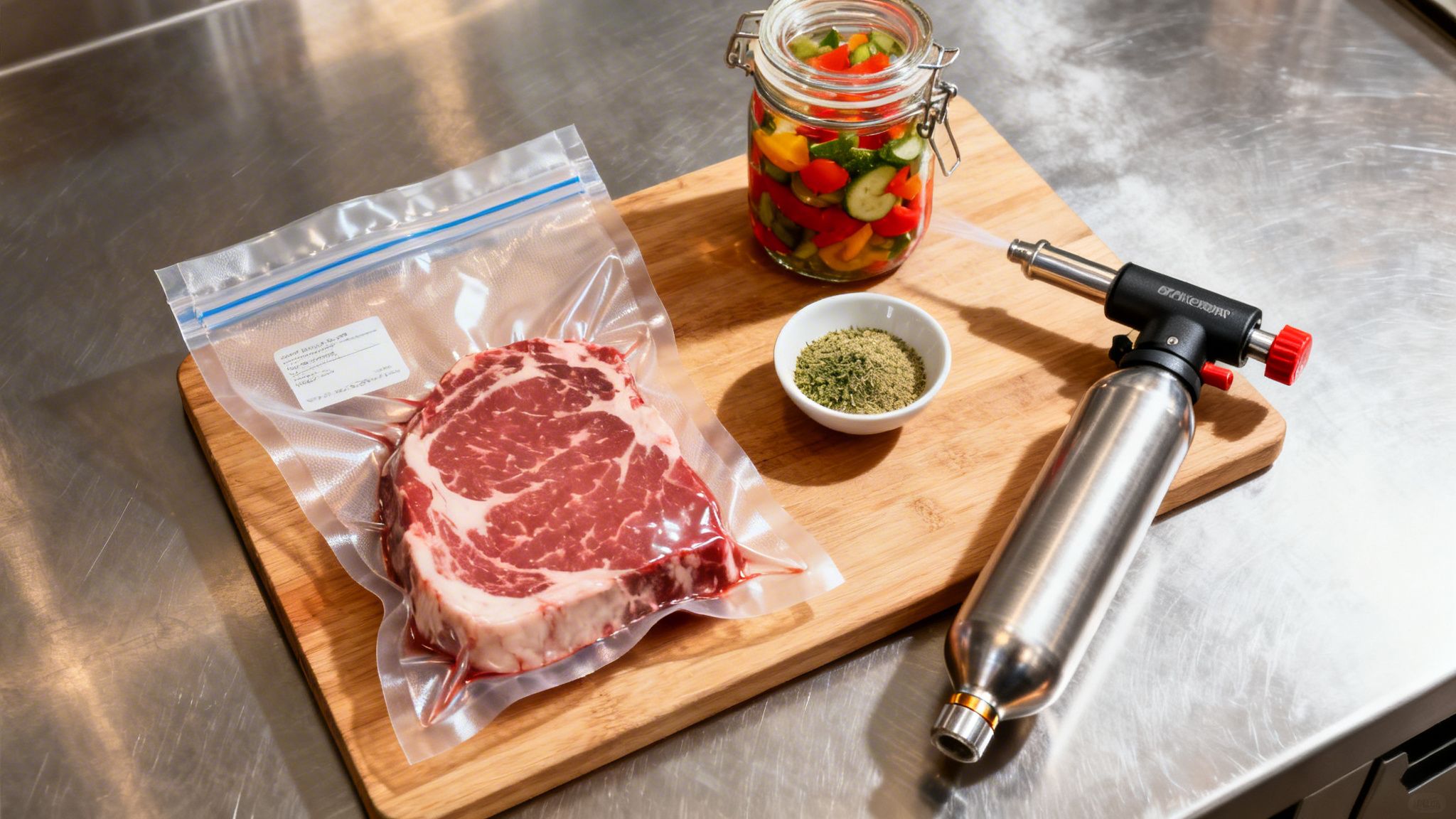

Food Preservation Methods for Professional Kitchens
Summary
This guide provides professional chefs, bar managers, and restaurateurs with practical, actionable strategies for food preservation. Moving beyond basic storage, it covers foundational techniques like chilling and freezing, advanced methods such as vacuum sealing, dehydration, and fermentation, and innovative applications using nitrous oxide (N2O) for rapid infusions and foams. The focus is on providing real-world value by reducing waste, ensuring food safety, enhancing menu creativity, and improving profitability. It also addresses the unique logistical and compliance challenges faced by hospitality businesses, particularly in regions like the Canary Islands, emphasizing the importance of reliable B2B partnerships.
Key Points
- Foundation is Key: Mastering chilling (1-4°C) and freezing (-18°C) with a strict FIFO (First-In, First-Out) system is the most cost-effective way to reduce waste and ensure safety.
- Advanced Techniques Create Value: Vacuum sealing, dehydration, and fermentation are not just for preservation; they are creative tools for developing unique flavors, textures, and signature menu items.
- Innovation with N2O: Food-grade nitrous oxide (E942) enables rapid flavor infusions in minutes and the creation of light, stable foams (espumas), adding a modern, high-value touch to dishes and drinks.
- Compliance is Non-Negotiable: Adherence to HACCP standards and strict traceability for specialized products like N2O is essential for protecting customers, reputation, and your business license.
- Strategic Sourcing is Crucial: For island economies, a reliable B2B supplier who understands local logistics and provides certified, compliant products is a critical business asset, not just a vendor.
- Practical Tools: A chamber vacuum sealer is a high-ROI investment. Commercial dehydrators and cream whippers (siphons) unlock advanced culinary applications.
Welcome to the definitive guide on food preservation methods, written for professionals in the trenches of a busy kitchen. This isn't some academic paper; it's a practical playbook for your restaurant, bar, or catering business to slash waste, lock in food safety, and boost your bottom line. Getting these techniques right is fundamental to running a tight ship.
Mastering Food Preservation in Your Professional Kitchen
Effective food preservation isn't just about making things last longer. It’s a core discipline for any financially healthy and creative kitchen. For those of us in hospitality, truly understanding these methods is what turns your inventory from a ticking clock into a strategic asset. It’s how you minimise what goes in the bin, control your costs, and make sure every single ingredient you buy works as hard as you do.
With the right approach, you can transform a surplus of seasonal produce into a high-value jar of pickles for your winter menu or safely prep expensive cuts of meat for faster service without compromising on quality. It’s all about working proactively, not reactively.
The Real Cost of Food Waste
Let’s be honest, food waste is a brutal drain on profits and resources, a pain felt even more sharply in island economies. The Canary Islands, for example, have the unfortunate distinction of being Spain's second-highest region for food waste.
But there's good news. I've seen first-hand how smart initiatives can turn this problem around. A recent collaboration between Asaga and Ashotel, for instance, managed to convert 570 tonnes of hotel waste into top-quality compost. It’s a powerful real-world example of a circular economy in action, proving that waste is just a resource in the wrong place. Understanding this context is why mastering the various conservacion de alimentos metodos isn't just good practice—it's a business imperative.
From Basic Storage to Culinary Innovation
If you think preservation just means a bigger fridge, you're missing a huge opportunity. Yes, chilling and freezing are the bedrock, but a wider arsenal of techniques is where the real creativity begins.
- Operational Wins: Batch prepping with methods like vacuum sealing makes your service faster and your dishes more consistent. It’s a game-changer during a busy rush.
- Menu Development: Techniques like fermentation or dehydration aren't just for preservation; they create incredible, complex flavours that can become your signature.
- Cost Control: By preserving ingredients when they are at their peak freshness—and lowest price—you protect your business from market spikes and those all-too-common supply chain hiccups.
Mastering food preservation is the bridge between simply managing stock and unlocking real culinary innovation. It’s what allows a kitchen to run with financial discipline while pushing the boundaries of flavour and texture.
Think of this guide as your go-to manual. We're going to break down the fundamental concepts and build up to advanced applications, giving you the checklists, temperature targets, and practical examples you need to put these strategies to work. Whether you’re running a massive hotel kitchen in Adeje or a small cocktail bar in Las Palmas, these insights are designed to protect your profits and elevate your menu. For deeper dives, feel free to explore our other articles on product education.
The Foundation of Preservation: Chilling and Freezing
In any professional kitchen, chilling and freezing are the absolute cornerstones of food preservation. Don't just think of them as storage; see them for what they are—your primary tools for quality control. They work by hitting the brakes on the two biggest enemies of fresh food: microbial growth and enzymatic decay.
Chilling doesn't stop these processes entirely, but it definitely puts them in slow motion. By holding foods between 1°C and 4°C, you drastically cut down the speed at which bacteria can multiply. Freezing, on the other hand, is like hitting the pause button. Once the temperature drops below -18°C, microbial activity grinds to a near-total halt.
This simple flow chart shows exactly how a solid preservation strategy is tied directly to your kitchen's bottom line.
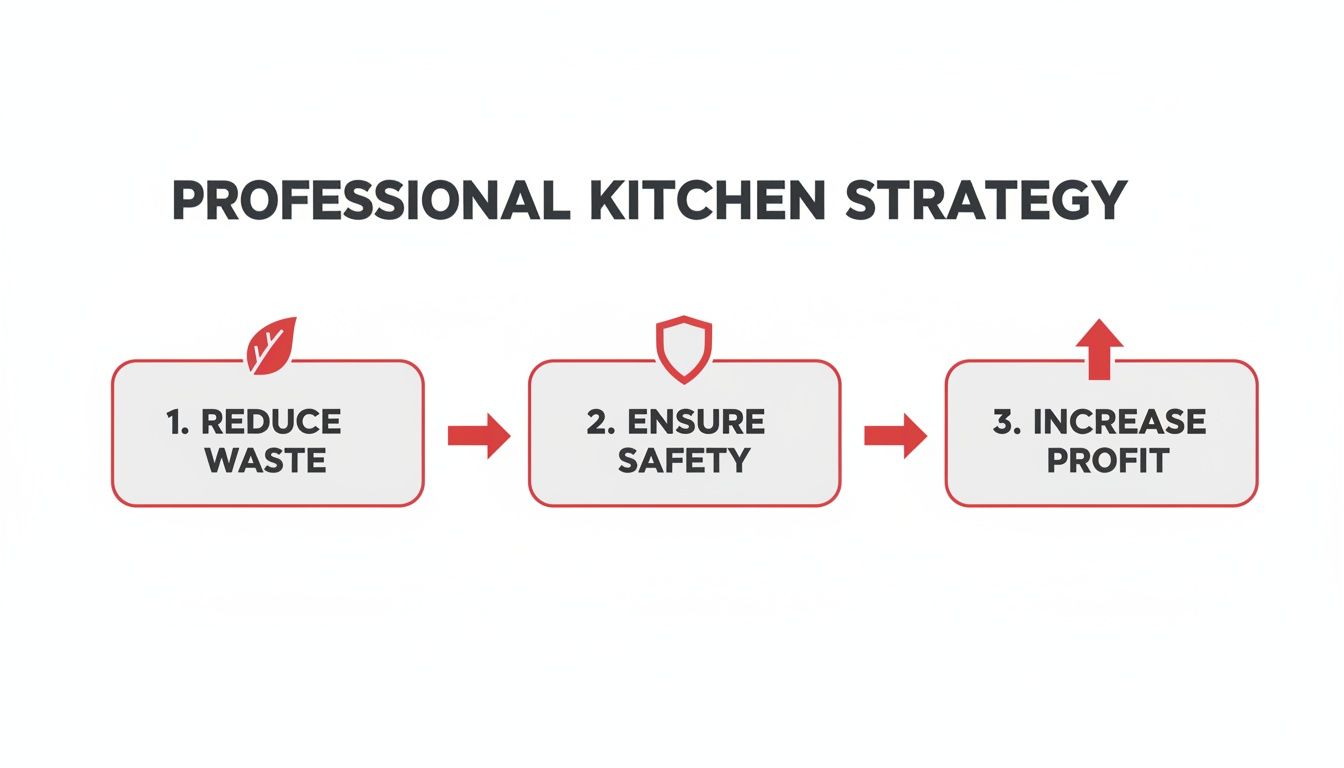
As you can see, getting these fundamental methods right is the first step to cutting waste. That discipline is what ensures safety, and both of those things drive profitability.
Navigating the Temperature Danger Zone
If there's one concept you need to burn into your team's memory, it's the Temperature Danger Zone. This is the range, typically from 5°C to 63°C, where pathogenic bacteria have a party. In this zone, their numbers can double in as little as 20 minutes. Your most important job is to move perishable foods through this zone as quickly as possible.
This means your fridges and freezers must be correctly calibrated and constantly checked. In today's world, digital thermometers for every single unit are completely non-negotiable.
Chilling Targets:
- Meats and Seafood: Keep these between 0°C and 2°C for maximum freshness and safety.
- Dairy and Eggs: Store them between 2°C and 4°C.
- Prepared Foods: Must be held at or below 4°C.
Freezing Targets:
- The gold standard for long-term preservation is a consistent -18°C or lower. Any fluctuation above this temperature, even for a short time, can start to degrade quality.
The rule couldn't be simpler: keep cold food cold (below 5°C) and hot food hot (above 63°C). Every minute your product spends in between is a direct risk to your ingredients, your reputation, and your customers.
Practical Implementation and Stock Rotation
Knowing the science is one thing, but making it happen during the chaos of a busy service is something else entirely. I've found that success always comes down to simple, repeatable systems that become second nature.
Your most powerful, no-cost tool for this is the FIFO (First-In, First-Out) system. It's a basic principle that ensures older stock gets used before newer stock, stopping forgotten items from expiring on the back of a shelf. It sounds obvious, but you’d be surprised how many kitchens let this slip.
Quick Implementation Checklist:
- Label Everything. No exceptions. All incoming and prepped foods get a label with the product name and the date it was received or made. Use a consistent, clear format.
- Organise Your Shelves. Create designated zones for different food types. A classic rule is raw meat on the bottom shelf to prevent drips from contaminating anything below. Always place new deliveries at the back.
- Daily Checks. Make it someone's responsibility to conduct daily temperature log checks and a quick FIFO audit of high-turnover items. This isn't micromanagement; it's building discipline.
Avoiding Common Pitfalls Like Freezer Burn
One of the most common ways kitchens accidentally waste money is with freezer burn. This happens when frozen food gets exposed to air, causing moisture to escape and leaving behind those familiar dry, tough, and discoloured patches. It's not a safety issue, but it completely ruins the texture and flavour of your product.
To prevent this, proper packaging is your best defence. Using high-quality, airtight containers or, even better, vacuum-sealing portions before freezing creates a solid barrier against air. It’s a simple step that can dramatically extend the life and quality of your frozen inventory.
Mastering chilling and freezing isn't just about ticking compliance boxes; it’s about protecting the investment you've made in every single ingredient that comes through your door. For more deep dives into optimising your kitchen, check out our guides on operations support.
Advanced Techniques: Sealing, Drying, and Fermentation
Chilling and freezing are the workhorses of any professional kitchen, no doubt. They’re your daily drivers for keeping things fresh. But to truly set your menu apart, you need to go deeper into the world of conservacion de alimentos metodos.
This is where you move beyond simple cold storage and into techniques that don't just preserve ingredients but actively transform them. We're talking about creating complex, unique flavours and textures that become your signature. These aren't just preservation methods; they're creative tools.
This section dives into three of the most powerful: vacuum sealing, dehydration, and fermentation. Each one opens up a different set of culinary possibilities, from locking in perfect freshness for sous-vide to creating intensely savoury powders from scratch.
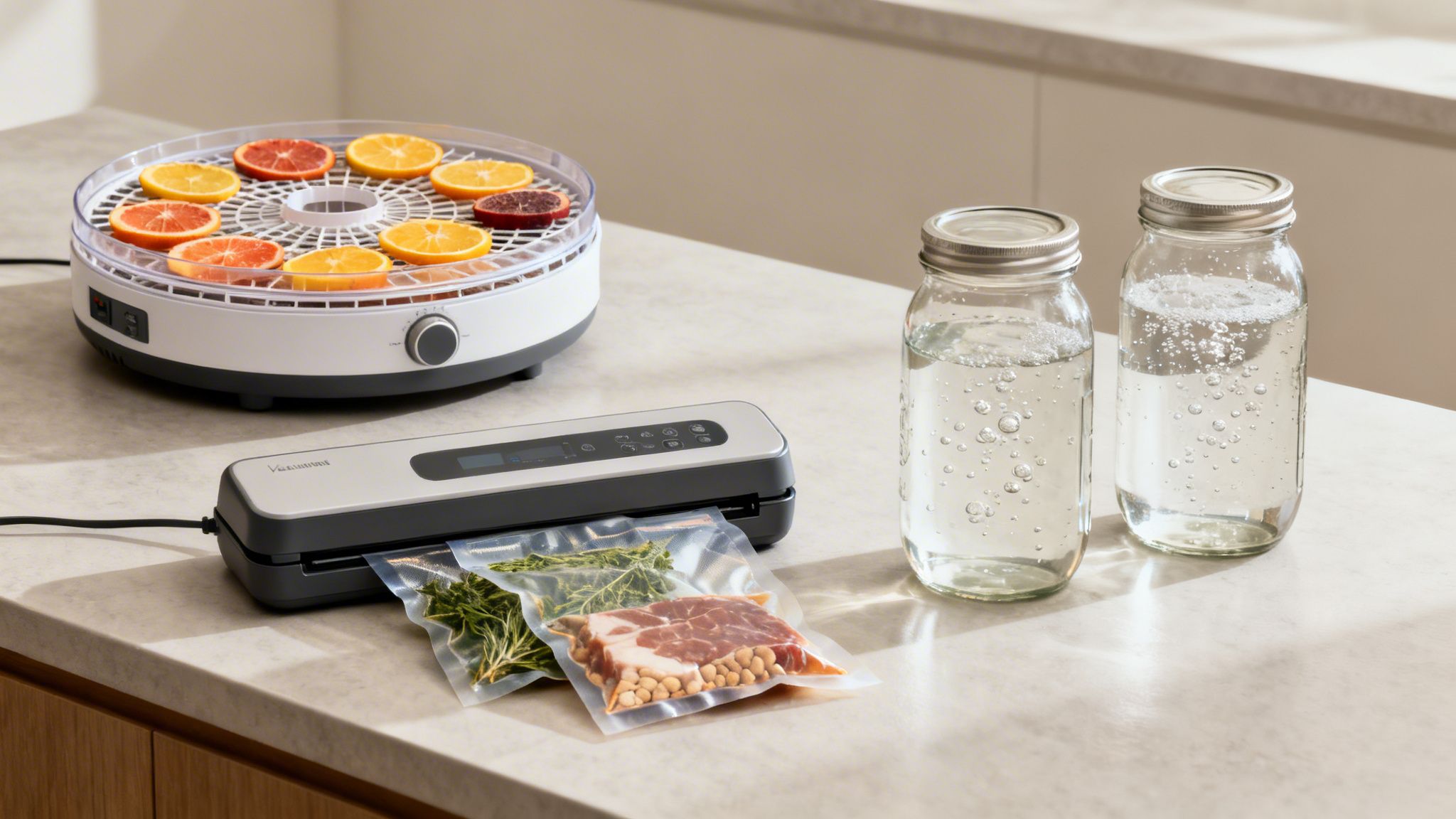
When you get these right, you’re not just managing inventory. You’re building a pantry of proprietary ingredients that no one else has, making your dishes genuinely impossible for competitors to replicate.
The Power of Vacuum Sealing
In any modern professional kitchen, vacuum sealing—envasado al vacío—is an absolute cornerstone. The science is straightforward but the impact is massive. By removing almost all the oxygen from a package, you slam the brakes on the growth of aerobic bacteria and mould.
The result? The refrigerated life of everything from prime cuts of meat to delicate vegetables is dramatically extended. We're not talking a few extra days, either. Proper vacuum sealing can take vegetables that would normally last a few days and keep them perfectly fresh for over two weeks.
But its real value in a working kitchen goes way beyond storage. For anyone serious about sous-vide, a vacuum sealer is non-negotiable. It’s what guarantees that perfect, complete contact between the food and the water bath, giving you the even, precise cooking you’re after. It also happens to lock in every bit of moisture and flavour, which is why sous-vide results are so consistently superior.
Key Applications for Vacuum Sealing:
- Portion Control: Pre-portioning sauces or proteins for service is a game-changer for speed and consistency on the line. It cuts waste and streamlines plating.
- Marinades: The pressure from the vacuum actually helps open up the pores in proteins, forcing marinades to penetrate faster and more deeply than they ever could just sitting in a tub.
- Batch Prepping: Get ahead of a busy service. You can prep components for your most complex dishes well in advance, knowing they'll be identical and ready to go when the orders start firing.
Dehydration: From Fresh to Flavour Powder
Dehydration is one of the oldest tricks in the book, but its applications in a modern kitchen are more relevant than ever. The principle is simple: remove the water, and you create an environment where the microorganisms responsible for spoilage just can't survive.
What you're left with is a completely shelf-stable product with a flavour so concentrated it’s practically a new ingredient.
Dehydration is alchemy for the modern chef. It transforms the perishable into the permanent, turning a fresh tomato into a potent umami powder or a surplus of mushrooms into a savoury, long-lasting garnish.
A good commercial dehydrator gives you precise control over temperature and airflow, which is the key to getting consistent, high-quality results. You can make everything from fruit leathers and crispy vegetable garnishes to intense flavour powders for spice blends, sauces, and even doughs. Imagine finishing a seafood dish with a fine dusting of powder made from local dehydrated prawns. It's a simple touch that adds a layer of complexity you can’t get any other way.
Unlocking Flavour with Fermentation
This is where preservation stops being a science and starts becoming an art form. Fermentation is the controlled use of beneficial microbes—bacteria, yeasts, and moulds—to fundamentally transform the chemical structure of food. It doesn't just preserve; it creates bold, funky, sour, and deeply savoury flavours that are totally unique.
This practice has been part of human history for millennia, including right here in the Canary Islands. The islands' agricultural history goes back nearly 2,000 years, with Indigenous inhabitants using incredibly sophisticated methods for storing grains and legumes. In fact, genetic analysis has shown that modern lentils grown here are direct descendants of crops cultivated back in the 200s AD. This legacy, largely maintained and passed down by Indigenous women, ensured the survival of crops perfectly adapted to our hot, dry climate. You can read more about these incredible findings on Canarian crop history at ScienceDaily.com.
Today, we can apply those same ancient principles to create modern culinary magic:
- House-Made Pickles: Fermenting local vegetables is a fast track to a tangy, probiotic-rich condiment that blows away anything you can buy in a jar.
- Kombucha or Water Kefir: Offer your guests unique, house-brewed non-alcoholic drinks that carry a story.
- Sourdough Starters: A living, breathing starter can become the heart and soul of your entire bread programme.
- Miso and Garums: For the more advanced kitchen, creating your own fermented pastes and sauces unlocks a level of umami that becomes your secret weapon.
Modern Preservation: N2O Infusions and Foams
Forget the old-school conservacion de alimentos metodos for a moment. In today’s fast-paced kitchens and bars, some of the most exciting techniques aren't just about preserving food, but about creating entirely new textures and flavours in seconds. The workhorse behind this magic is food-grade nitrous oxide (N2O)—a gas that does a lot more than just whip cream.
For a chef or mixologist with a creative streak, N₂O is a secret weapon. It’s the key to pulling off signature flavour infusions in minutes and whipping up delicate, stable foams that completely transform a dish. This isn't just kitchen theatre; it's about adding real value, texture, and a serious wow-factor to your menu.
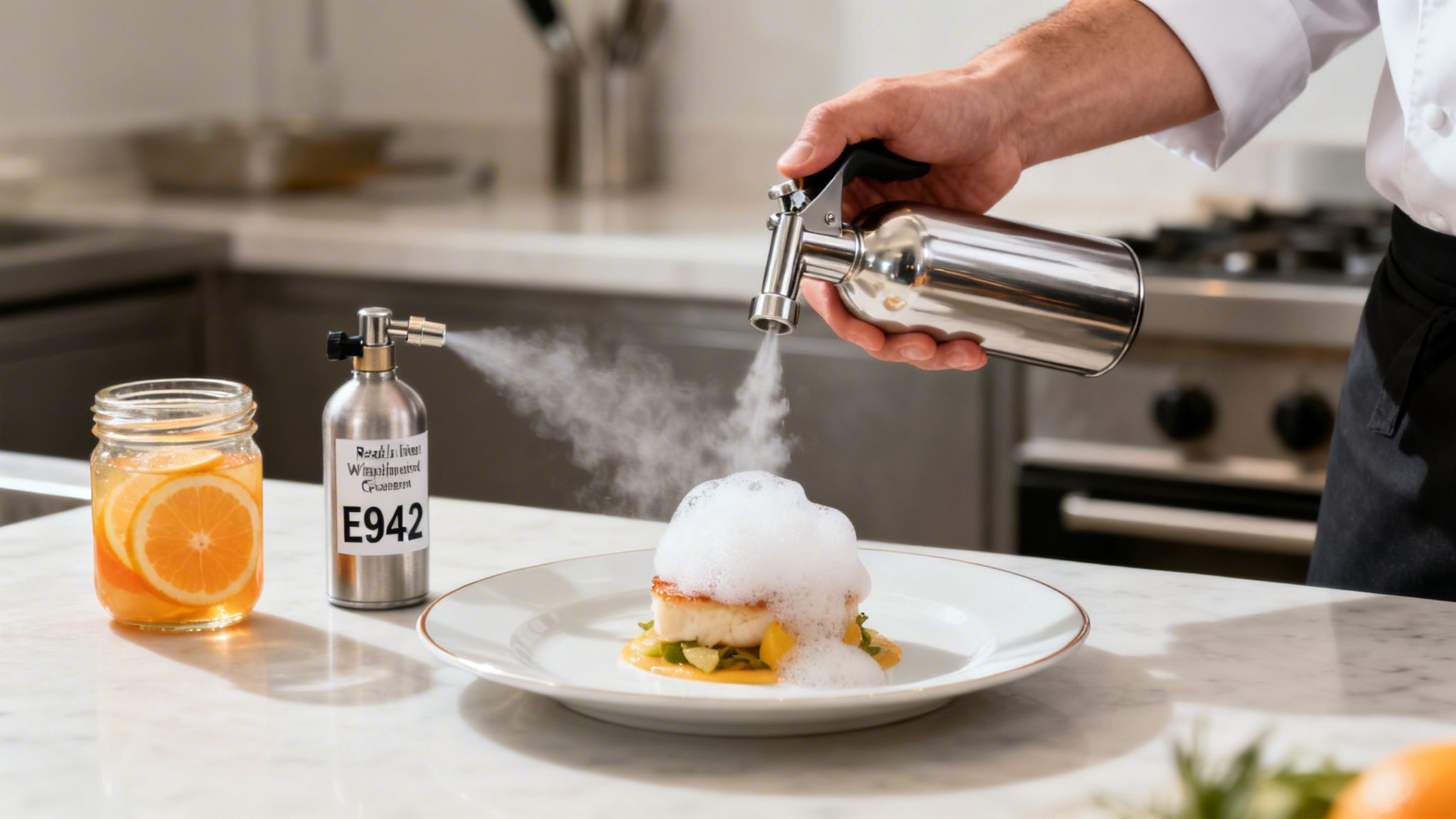
Here we see it in action. A simple liquid is turned into a sophisticated, airy foam that holds its shape and delivers a concentrated punch of flavour without adding weight. It's the perfect finishing touch for delicate dishes where you want flavour, not liquid.
The Science of Rapid Infusion
Think about infusing a spirit. A bottle of tequila with chillies or a jar of olive oil with rosemary—traditionally, you’re waiting days, maybe even weeks, for the flavour to develop. With nitrous oxide, you can get it done in under two minutes.
The process is a brilliant bit of applied physics. You take your liquid (say, gin) and your flavouring agent (fresh basil leaves, citrus peel) and place them in a cream whipper. When you charge it with N₂O, the intense pressure forces the gas deep into the cells of the solid ingredients.
Then comes the magic. When you release the pressure, the gas erupts from the cells, ripping the flavour and aroma compounds out with it and instantly infusing the surrounding liquid.
Key Advantages of Rapid Infusion:
- Speed: Create a bespoke infused spirit or oil right in the middle of a busy service. No more week-long prep times.
- Freshness: You capture the bright, volatile notes of fresh ingredients, avoiding the dull, “stewed” flavour that comes from long steeping times.
- Consistency: The process is repeatable, giving you the exact same flavour profile batch after batch.
This is a game-changer for any bar or restaurant that prides itself on a unique drinks menu. Imagine a guest ordering a G&T, and you offer to infuse the gin with fresh, local botanicals right there on the spot. That’s an experience they’ll remember.
Crafting Perfect Foams and Espumas
Nitrous oxide is also your ticket to creating ethereal, light-as-air foams, often called espumas. Unlike a heavy, fat-based whipped cream, an N₂O foam can be made from almost any liquid—fruit juices, vegetable purées, even savoury broths.
It works because N₂O dissolves completely into liquid under pressure. When you dispense it from the siphon, the pressure plummets, and the dissolved gas expands into millions of tiny, uniform bubbles. The result is an incredibly light texture that delivers pure, unadulterated flavour.
To get it right every time, there are a few rules I've learned to live by:
- Use a Stabiliser: Most liquids need a little help to hold their structure. A tiny amount of gelatine, lecithin, or agar-agar provides the backbone for a stable foam.
- Demand Purity: Never, ever cut corners here. Always use certified food-grade N₂O (E942). Industrial-grade gas is not safe for consumption and can ruin your creations with oily residues and a metallic taste.
- Obsess Over Hygiene: A cream whipper must be stripped down and sanitised meticulously after every single use. If you're working with dairy or sugar, this is non-negotiable to prevent nasty bacterial growth.
Mastering the technique is only half the battle. Understanding the safe handling and legal side of using these tools is just as critical. For a full rundown, have a read of our guide on nitrous oxide compliance and logistics in our knowledge hub. Once you have this method dialled in, you can add a layer of genuine sophistication to your dishes and drinks that makes your menu impossible to ignore.
Navigating Logistics and Compliance in Your Region
Let’s be honest. Mastering your conservacion de alimentos metodos is a huge win, but it’s only half the job. For any of us working in hospitality here in the Canary Islands, the real daily grind is logistics and compliance. Getting this wrong doesn't just mean a headache; it can sink your profits.
I've seen fantastic venues struggle because their supply chain was a mess. This isn't about theory—it's about the practical steps you need to take to manage inter-island transport, find suppliers who actually get it, and stay on the right side of the law. Think of this as your playbook for building an operation that’s not just creative, but also resilient and audit-proof.
The Reality of Our Island Supply Chains
Working in an archipelago throws a wrench in the works that mainland businesses just don't have to deal with. Our modern diet in the Canaries leans heavily on imported and processed foods. It’s a situation experts call 'double insularity'—we’re cut off from the mainland, and then we have the added logistical hurdles of getting goods between the islands.
This is why preserved, frozen, or reconstituted foods often make more financial sense for suppliers. It also explains why a reliable local partner is worth their weight in gold. If you want to dive deeper, there’s some great research on the supply chain dynamics in the Canary Islands at PMC.
That’s why vetting your suppliers is one of the most critical tasks you'll undertake. A good partner isn’t just dropping off boxes; they’re your first line of defence against the chaos of port delays and customs paperwork.
Questions I Always Ask Potential Suppliers:
- Cold Chain Proof: How do you guarantee temperature from the port to my door? I want to see your temperature logs, not just hear promises.
- Stock & Backup Plans: What happens when a ferry is cancelled? Do you hold stock locally on the island, or am I waiting for a shipment from Barcelona?
- Delivery Windows: My kitchen is chaos from 11:00 AM. Can you deliver before 8:00 AM? A supplier who disrupts your service isn't a real partner.
Compliance: The One Area You Can't Afford to Mess Up
In our trade, compliance is everything. It’s what protects your customers, your reputation, and your licence to operate. The gold standard here is HACCP (Hazard Analysis and Critical Control Points), which gives you a clear system for spotting and managing food safety risks from delivery to service.
But it goes beyond general safety. When you’re dealing with specific products like food-grade nitrous oxide (E942), the rules on traceability are incredibly strict.
Think of traceability as your product's passport. From the moment it's manufactured to the moment you use it, you must be able to prove its origin, purity, and that it has been handled correctly. This is your best defence in an audit.
Any professional B2B supplier should hand you this documentation without you even having to ask. It’s non-negotiable. This includes:
- Certificates of Purity: Hard proof that the N2O is food-grade E942 and free from industrial nasties.
- Traceability Records: Lot numbers and batch info that trace right back to the factory.
- Compliant Invoicing: A proper, IGIC-ready invoice with your CIF/NIF. No consumer receipts, no excuses.
The Right Partner Is a Business Strategy
Choosing your supplier isn’t just an operational task; it’s a strategic decision. A true partner takes the logistical nightmare off your plate—customs clearance, compliant storage, all the paperwork—so you can focus on creating incredible food and drinks for your guests.
This is especially true for specialised items like N2O. By working with a dedicated B2B wholesaler who lives and breathes the local landscape, you’re not just buying gas. You’re buying a stable, safe, and fully compliant supply chain. They handle the headaches so you don't have to. We break this down even further on our blog, where you can find more on the importance of compliance and legal standards for professionals.
At the end of the day, a strong supplier relationship is one of the best preservation methods you can have for your business itself.
FAQ: Your Questions on Food Preservation Methods
After walking through the different methods of food preservation, from basic chilling to more advanced rapid infusions, it’s only natural for questions to pop up. This is where we get practical. Here, I'll tackle the common queries I hear from chefs, bar managers, and hotel operators who are trying to make these techniques work in the real world.
What is the most cost-effective preservation method for a small restaurant?
For any small restaurant or bar, the best place to start is by mastering the fundamentals: chilling and freezing. It’s the bedrock of any professional kitchen.
Implementing a strict FIFO (First-In, First-Out) system is the first step. It costs nothing but discipline and immediately starts cutting your waste bill down. Seriously, it's free money.
Your next best move is to invest in a quality chamber vacuum sealer. Yes, there's an upfront cost, but a good machine pays for itself faster than you’d think. It allows you to:
- Drastically extend the life of your most expensive proteins, like fish and prime cuts of meat.
- Batch-prep ingredients for sous-vide, which locks in consistency and flavour.
- Prevent perfectly good pre-portioned items from spoiling, saving them from the bin during service.
Get your cold storage discipline down and add a vacuum sealer. Those two things will give you the biggest financial return before you ever need to think about more complex equipment.
How do I ensure safety when using N2O for infusions?
When you're working with nitrous oxide, safety is everything. There’s no room for error. It really comes down to three non-negotiable rules that protect your staff, your customers, and your creations.
- Source Certified Gas: Only ever use certified, food-grade E942 nitrous oxide. I can't stress this enough. Get it from a reputable B2B supplier who can give you purity certifications and full traceability. Never, ever bring industrial or medical-grade gas into your kitchen.
- Practice Impeccable Hygiene: Your cream whipper or siphon needs to be completely stripped down and sanitised after every single use. This is especially vital when you’re working with dairy or sugar, as any residue left behind is a perfect breeding ground for bacteria.
- Adhere to Pressure Guidelines: Always follow the manufacturer’s instructions for your specific siphon. Over-pressurising the equipment won't just ruin your infusion—it can lead to dangerous equipment failure.
If you want to dig deeper into this, our guide on what cream chargers are used for in bars and restaurants is a great resource.
A quick thought on this: your responsibility for safety begins with your supplier. If they can’t provide audit-ready documentation for purity and traceability, find someone who can. It’s that simple.
What preservation methods work best for local and seasonal produce?
This is where preservation gets really exciting—it’s how you make the most of incredible local and seasonal ingredients long after their season ends. The best method really depends on the ingredient and what you want to do with it.
- Dehydration: This is fantastic for concentrating the flavours of things like local tomatoes, wild mushrooms, or tropical fruits. You can turn them into potent, shelf-stable powders, unique garnishes, or long-lasting snacks that scream local flavour.
- Pickling and Fermentation: These ancient techniques are perfect for capturing the soul of local vegetables like carrots, cabbage, or peppers. You can create tangy, complex additions for your menu that are available all year round.
- Rapid Infusion (N2O): To capture those delicate, fresh notes from local herbs or fruits, nothing beats rapid infusion. It lets you pull vibrant flavours into cocktails, syrups, or sauces in minutes, all without the heat that would kill their fresh character.
How can I standardise preservation across multiple locations?
Getting consistency across multiple venues is a common headache, but it’s completely solvable with a clear strategy built on two pillars: consistent processes and a single supply chain.
First, you need one unified HACCP plan that every kitchen follows without deviation. This means identical procedures for chilling, labelling, stock rotation, and temperature logging. When everyone uses the same checklists and logs, you guarantee everyone is playing by the same rules. It's crucial for brand consistency and, more importantly, for safety.
Second, consolidate your purchasing. Find a single, reliable supplier who can deliver consistently to all your locations. This is the most effective way to ensure every kitchen receives the exact same certified products. It simplifies your inventory, streamlines ordering, and protects your brand’s reputation from top to bottom.
Local Business Information
Kings Canisters is the premier B2B supplier of high-purity, food-grade N2O (E942) for professional kitchens and bars across the Canary Islands. We provide fully compliant, certified products with the reliable inter-island logistics your business depends on. Our services are tailored for the hospitality industry, ensuring you have a stable supply of essential tools for modern culinary innovation. We handle customs, provide all necessary traceability documentation, and deliver directly to your establishment, from Las Palmas to Adeje.
Ready to streamline your kitchen's creative output and ensure a compliant, reliable supply chain? Kings Canisters is the leading B2B partner for food-grade N2O in the Canary Islands, providing certified, pure products with the logistics and documentation your professional operation demands. Stabilise your stock and unlock new menu possibilities by visiting https://www.kingscanisters.com.
{"@context": "https://schema.org","@type": "WebPage","name": "A Professional Guide to Food Preservation Methods (Conservacion de Alimentos Metodos)","description": "The definitive guide for professional kitchens on food preservation methods. Learn practical techniques from chilling and vacuum sealing to N2O infusions to reduce waste, ensure safety, and enhance your menu.","url": "https://www.kingscanisters.com/es/blog-post/conservacion-de-alimentos-metodos","keywords": "conservacion de alimentos metodos, food preservation methods, professional kitchen, food safety, vacuum sealing, dehydration, rapid infusion, N2O, HACCP","mainEntity": {"@type": "Article","headline": "Food Preservation Methods for Professional Kitchens","author": {"@type": "Organization","name": "Kings Canisters"},"publisher": {"@type": "Organization","name": "Kings Canisters","logo": {"@type": "ImageObject","url": "https://www.kingscanisters.com/logo.png"}},"image": ["https://cdn.prod.website-files.com/688a3d2287c1d82fac2f5f70/69b26b80cf6e48164cdf5cdc_food-preservation-methods-kitchen-strategy.jpeg","https://cdn.prod.website-files.com/688a3d2287c1d82fac2f5f70/69b26b80cf6e48164cdf5ce4_food-preservation-methods-dehydrator-sealer.jpeg","https://cdn.prod.website-files.com/688a3d2287c1d82fac2f5f70/69b26b80cf6e48164cdf5ce0_food-preservation-methods-culinary-foam.jpeg"],"datePublished": "2024-05-20","dateModified": "2024-05-20","mainEntityOfPage": {"@type": "WebPage","@id": "https://www.kingscanisters.com/es/blog-post/conservacion-de-alimentos-metodos"}},"speakable": {"@type": "SpeakableSpecification","xpath": ["/html/head/title","/html/head/meta[@name='description']/@content"]},"faqPage": {"@type": "FAQPage","mainEntity": [{"@type": "Question","name": "What is the most cost-effective preservation method for a small restaurant?","acceptedAnswer": {"@type": "Answer","text": "For a small restaurant, the most cost-effective methods are mastering chilling/freezing and implementing a strict FIFO (First-In, First-Out) system. The next best investment is a quality chamber vacuum sealer, which extends the shelf life of expensive proteins and enables efficient batch prepping, providing a high return on investment."}},{"@type": "Question","name": "How do I ensure safety when using N2O for infusions?","acceptedAnswer": {"@type": "Answer","text": "To ensure safety with N2O, always use certified food-grade E942 gas from a reputable supplier, practice impeccable hygiene by sanitizing your cream whipper after each use, and strictly adhere to the manufacturer's pressure guidelines to prevent equipment failure."}},{"@type": "Question","name": "What preservation methods work best for local and seasonal produce?","acceptedAnswer": {"@type": "Answer","text": "The best method depends on the desired outcome. Dehydration is excellent for concentrating flavors into powders or garnishes. Pickling and fermentation are perfect for creating tangy, complex condiments. Rapid infusion with N2O is ideal for capturing the fresh, delicate notes of herbs and fruits in liquids without using heat."}},{"@type": "Question","name": "How can I standardise preservation across multiple locations?","acceptedAnswer": {"@type": "Answer","text": "Standardize preservation across multiple locations by implementing a unified HACCP plan with identical procedures for all kitchens and consolidating your purchasing with a single, reliable supplier who can deliver the same certified products to all your venues. This ensures consistency, safety, and brand protection."}}]},"hasPart": {"@type": "WebPageElement","name": "Local Business Information","hasPart": {"@type": "LocalBusiness","name": "Kings Canisters","description": "Leading B2B supplier of food-grade N2O (E942) in the Canary Islands for professional culinary use.","address": {"@type": "PostalAddress","addressLocality": "Las Palmas","addressRegion": "Canary Islands","addressCountry": "ES"},"areaServed": {"@type": "GeoShape","description": "Canary Islands"},"url": "https://www.kingscanisters.com","telephone": "+34-XXX-XXX-XXX"}}}