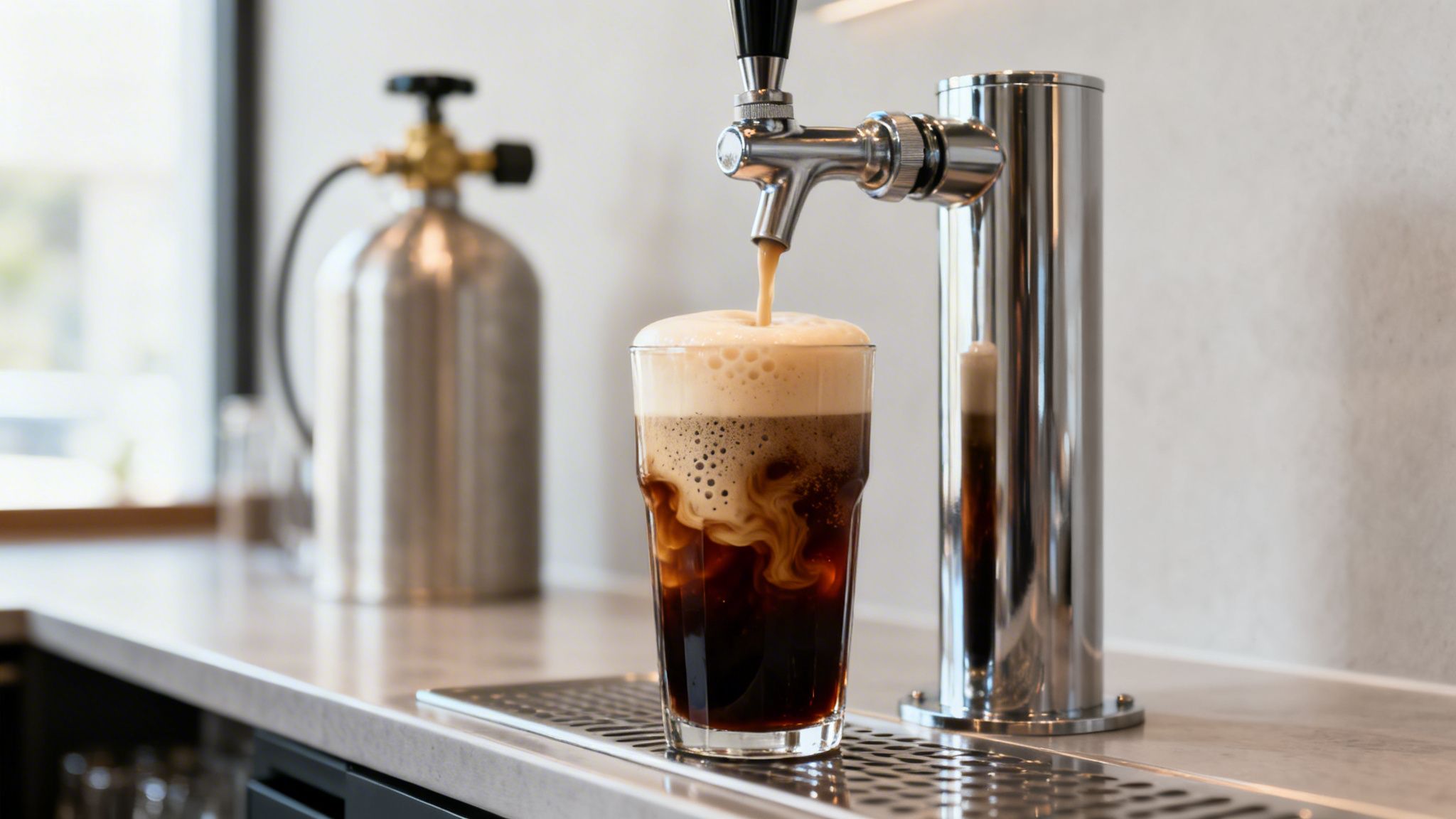

Your Practical Guide to Cold Brew Nitro for Hospitality
Summary and Key Points
This guide offers a practical walkthrough for hospitality businesses on mastering cold brew nitro. We cover the essential science behind its signature creamy texture, compare different service models (kegs, countertop units, cans), provide a detailed equipment and operations checklist, and discuss critical safety and supply logistics specific to regions like the Canary Islands. The focus is on providing actionable information to help you add this high-margin, premium beverage to your menu efficiently and profitably.
- What It Is: Cold brew coffee infused with pure nitrogen (N2) gas, creating a creamy, velvety texture and a cascading visual effect, justifying a premium price.
- The Science: Nitrogen's low solubility creates millions of tiny, stable bubbles, resulting in a smooth mouthfeel and dense head, unlike the fizziness of CO2.
- Essential Distinction: Use pure Nitrogen (N2) for coffee, not Nitrous Oxide (N2O), which is for whipped cream and has a sweet taste.
- Full Kegs: Best for high volume, lowest cost-per-serve.
- Countertop Dispensers: Flexible, smaller footprint for moderate demand.
- Ready-to-Drink Cans: Zero upfront cost, ultimate convenience.
Why Cold Brew Nitro Is a Smart Play for Your Venue
For anyone running a hospitality business, from Tenerife to Gran Canaria, it's easy to dismiss nitro coffee as just another trend. But looking past the hype reveals a durable and highly profitable addition to your offerings. This isn't just about serving better coffee; it's a strategic move to boost revenue, give customers something memorable, and modernise your beverage programme.
It’s an incredibly simple proposition: you’re offering the premium experience of a craft beverage in a non-alcoholic format that easily justifies a higher price point.
This guide provides a practical look at what makes this drink work. We’ll cover the science, the operational nuts and bolts, and how to integrate it profitably into your bar, club, or catering business.
Boost Your Revenue and the Customer Experience
The moment a customer sees that cascading pour, their perception of the drink changes. It’s visual theatre that immediately signals quality. This allows you to confidently position nitro as a premium item with margins that far exceed your standard coffee sales.
Think of it as an affordable luxury. It’s a small indulgence for your patrons that makes their visit feel more special and gives them a reason to come back. For many, it's become the go-to sophisticated daytime drink or a desirable non-alcoholic option for the evening. This dedication to quality aligns with our company ethos, which you can learn about by learning about our mission.
The real value for your patrons boils down to consistency. A guest who falls in love with your nitro coffee will be genuinely disappointed if the tap runs dry. Keeping a reliable supply is more critical for customer loyalty than almost any other factor, turning a simple coffee into a dependable highlight of their experience.
Stay Ahead of the Demand Curve
The growing appetite for premium coffee isn't just a local trend; it's global. The worldwide market for nitro cold brew is exploding, projected to jump from USD 1.57 billion in 2025 to USD 3.22 billion by 2034, according to Data Insights Reports.
What's fuelling this? A clear consumer shift towards smoother, less acidic coffee and the grab-and-go convenience of ready-to-drink options. For any venue in the Canary Islands, this global momentum signals a massive opportunity. It also makes one thing crystal clear: having a reliable supply chain isn't just an advantage, it's essential for success.
Understanding the Science Behind That Silky Cascade
What separates a standard iced coffee from a premium cold brew nitro experience? The answer is in the science that creates its signature creamy head and that mesmerising cascade in the glass. For any operator, understanding this is fundamental to delivering a product that consistently justifies its higher price point.
The magic comes down to one crucial ingredient: pure, food-grade nitrogen (N2) gas. When infused into cold brew coffee under high pressure, it behaves completely differently from the carbon dioxide (CO2) used in fizzy drinks.
The Power of Tiny Bubbles
Think about the difference between a glass of cola and a proper pint of stout. The cola has large, sharp bubbles from CO2, a gas that is highly soluble in liquid. Those bubbles rush to the surface, creating an aggressive fizziness.
Nitrogen, on the other hand, is the opposite. It has extremely low solubility in liquids. Instead of dissolving easily, the nitrogen forms millions of stable, microscopic bubbles that stay suspended throughout the coffee.
The result isn't fizz, it's texture. These tiny bubbles deliver a rich, velvety mouthfeel and a dense, long-lasting creamy head. This effect smooths out the coffee's flavour profile, dialling down perceived acidity and bitterness while amplifying natural sweetness and chocolatey notes.
When you pour a cold brew nitro from a stout tap, the liquid is forced through a restrictor plate—a small disc with tiny holes. This agitation forces the nitrogen out of the liquid, kicking off that famous cascading effect. It’s pure theatre.
This visual and textural appeal isn't just for show; it directly impacts your bottom line.
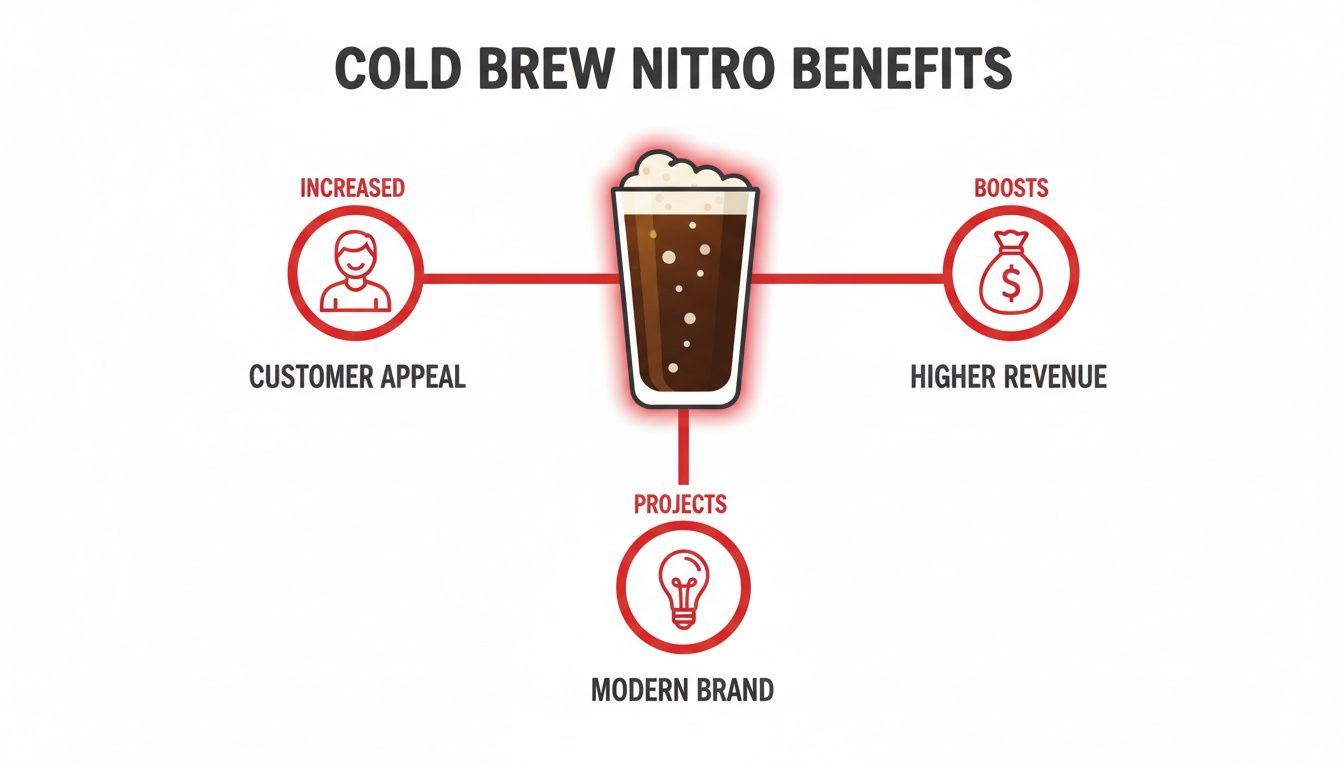
Mastering the nitro process creates a premium product that customers seek out, ultimately building a more profitable, forward-thinking brand.
N2 vs N2O: A Critical Distinction for Your Bar
A common and costly mistake is confusing the gas for nitro coffee with the gas for whipped cream. They are absolutely not interchangeable. Using the wrong one will ruin your product and disappoint your customers.
Here's a straightforward look at the two gases.
Nitrogen (N2) vs Nitrous Oxide (N2O) in Beverage Programs
| Attribute | Nitrogen (N2) | Nitrous Oxide (N2O) |
|---|---|---|
| Primary Use | Nitro Coffee & Stout Beers | Whipped Cream & Culinary Foams |
| Solubility | Very Low in liquids. Creates tiny, stable bubbles. | High in fats and liquids. Creates light, airy foams. |
| Taste Profile | Inert & Tasteless. Preserves the drink's original flavour. | Slightly Sweet. Can alter the taste of the base liquid. |
| Texture Created | Dense, creamy, velvety. Similar to a stout. | Light, fluffy, airy. Ideal for dessert toppings. |
| Visual Effect | Produces the signature "cascading" effect. | No cascade; creates a quick, static foam. |
| Ideal For | Adding a rich mouthfeel and creamy head to coffee and beer. | Rapidly infusing flavours and creating light textures in cocktails and desserts. |
In short, the two gases serve completely different functions.
Understanding this difference is non-negotiable. It dictates your equipment choices, gas supply logistics, and staff training. For a successful cold brew nitro programme, you must use pure, food-grade nitrogen.
While Kings Canisters specialises in supplying the highest quality nitrous oxide for your culinary foams and cocktail infusions, we believe in empowering our partners with the right knowledge for every application.
Choosing the Right Cold Brew Nitro Service Model
Deciding to add cold brew nitro to your menu is one thing; figuring out how to serve it is the next step. Your choice shapes upfront costs, daily workflow, space requirements, and the consistency of the final product.
The needs of a high-volume bar in Las Palmas are different from a small cafe or a mobile event caterer in Adeje. Let's walk through the three main ways to serve nitro coffee: full keg systems, countertop units, and ready-to-drink cans.
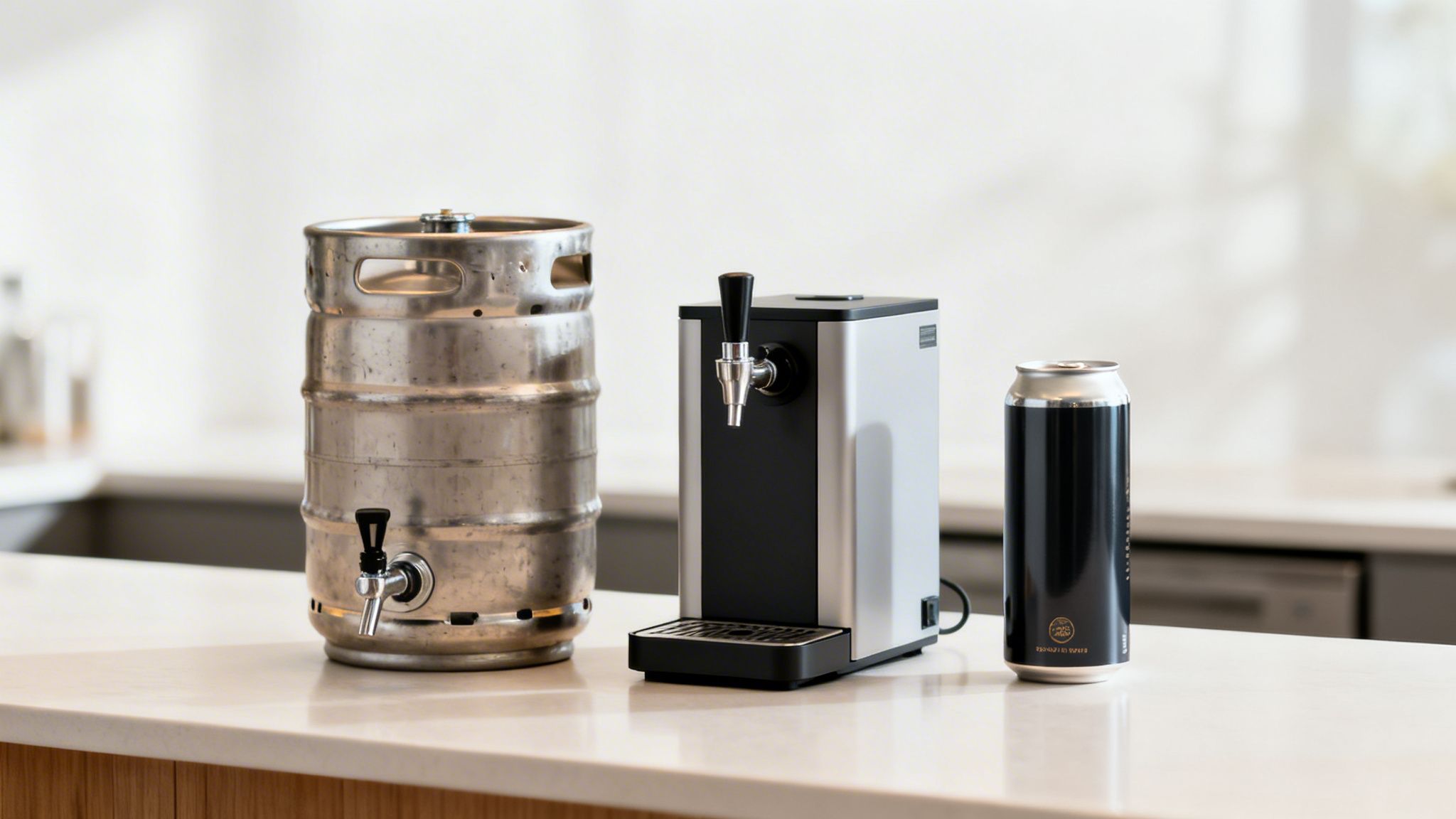
Full Keg Systems: The High-Volume Powerhouse
For venues expecting to pour a serious amount of nitro coffee, a full keg system is the professional standard. It consists of a keg of cold brew connected to a high-pressure nitrogen cylinder, running through a stout tap.
The payoff is the lowest cost-per-serve, which means fantastic profit margins once the initial investment is paid off. You also get perfect, consistent pours. The downside? It requires the biggest upfront investment in equipment—kegerator, nitrogen cylinder, regulators, and lines—and takes up significant floor space.
This setup is built for businesses where cold brew nitro is a core part of the menu. To see how to build a reliable supply partnership, take a look at our guide on how to open a wholesale account with Kings Canisters.
Countertop Dispensers: Flexibility in a Smaller Footprint
If you don't have space for a full kegerator, compact countertop dispensers are a brilliant middle ground. These all-in-one units house a small refrigeration system and infuse nitrogen on demand from a cartridge or small tank.
They are ideal for cafés, smaller restaurants, or as a second service point. Because they are essentially plug-and-play, setup is a breeze and staff training is minimal.
Countertop units give you the full, premium nitro experience without the logistical headache of a big keg system. The initial cost is lower, and the impressive pour becomes a visual talking point on your counter.
The trade-off is a slightly higher cost-per-serve compared to a keg, and the smaller capacity may not keep up during the busiest rushes.
Ready-to-Drink Cans: Ultimate Convenience and Consistency
The simplest route to adding cold brew nitro is the ready-to-drink (RTD) can. The coffee is pre-infused with nitrogen, released by a widget when the can is opened, creating the signature cascade.
This model comes with undeniable advantages:
- Zero Upfront Cost: No equipment to buy, install, or maintain.
- Absolute Consistency: Every can is identical, guaranteeing quality control.
- Ultimate Portability: Perfect for grab-and-go, hotel minibars, or event catering.
The catch is the cost. RTD cans have the highest cost-per-serve, which eats into profit margins. You also miss the "on-tap" theatre. However, as a risk-free way to test the market, they are unbeatable.
Your Essential Equipment and Operations Checklist
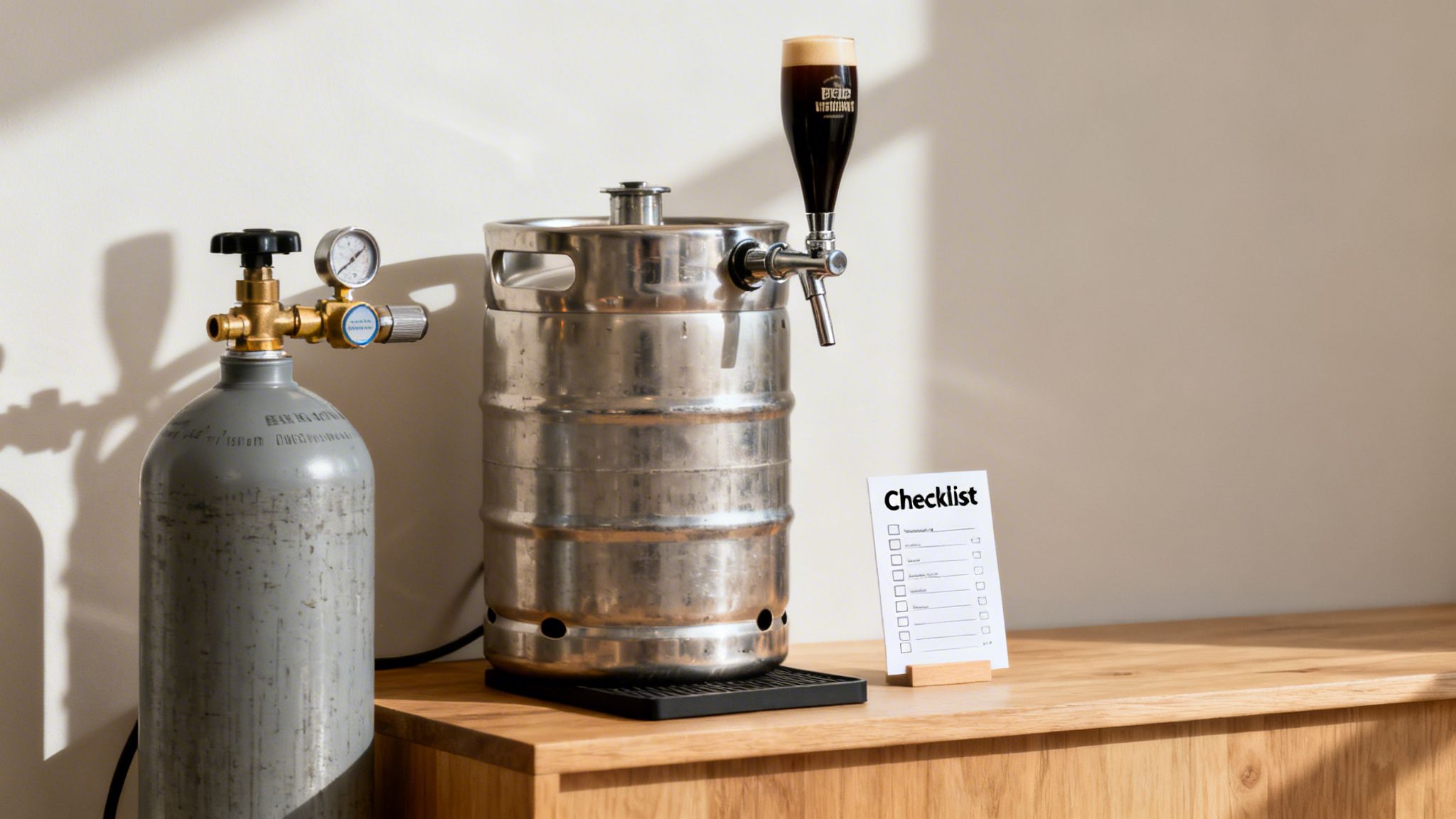
A brilliant cold brew nitro programme is built on the right hardware and simple, repeatable daily habits. This is your operational playbook, covering the core components, sourcing decisions, and training needed to pour a perfect glass every time.
Essential Tools for Your Draft System
The heart of any kegged nitro setup is a specific collection of parts. Get one part wrong, and you’ll serve a flat, disappointing drink.
Here’s the non-negotiable tool list:
- Kegs: Food-grade stainless steel kegs (Corny or Sankey style). They must be kept spotlessly clean.
- Nitrogen Cylinder: Must be pure, food-grade nitrogen (N2). Do not use N2O or beer gas blends.
- Nitrogen Regulator: This crucial device connects to the cylinder and controls pressure. A dual-gauge regulator is recommended to monitor tank and line pressure.
- Stout Faucet: This is the magic wand. A proper stout faucet has a built-in restrictor plate that agitates the liquid to create the thick, creamy head. A standard beer tap will not work.
- Gas and Liquid Lines: Use food-grade tubing rated for high pressures.
To Brew or To Buy Your Cold Brew
One of the first major operational decisions is whether to brew cold brew in-house or buy it pre-made.
Brewing In-House
- Pros: Lower cost-per-litre, total flavour control, and "house-made" marketing appeal.
- Cons: Labour-intensive, requires dedicated space/equipment, and achieving batch-to-batch consistency is challenging.
Buying Pre-Made
- Pros: Perfect consistency in every keg, saves significant staff time, and simplifies inventory.
- Cons: Higher cost-per-litre, less control over flavour, and dependence on a supplier.
For most bars and restaurants, buying pre-made cold brew from a trusted local supplier is the smartest way to start. It eliminates a major variable and lets your team focus on service.
Storage and Staff Training
Proper storage and handling protect your investment. Cold brew kegs must stay refrigerated. Nitrogen cylinders need to be stored upright in a cool, well-ventilated space, always chained securely to a wall.
The most important system in your venue is your team. A premium product like nitro cold brew can be instantly ruined by a bad pour or a dirty faucet.
Your staff training should be simple and direct:
- The Perfect Pour: Teach staff to pull the faucet handle forward all the way, fast. A slow pull results in a flat drink.
- Daily Cleaning Routines: At the end of every shift, the faucet must be rinsed with water. Once a week, deep clean the entire line with a food-safe line cleaner to dissolve coffee oils.
While nitrogen (N2) is key to perfect coffee, many modern bars also use nitrous oxide (N2O) for cocktail foams. You can discover more about what cream chargers are used for in bars and restaurants to see how these gases can work together in your beverage programme.
Navigating Gas Supply and Safety in the Canary Islands
A great cold brew nitro programme is built on operational safety and smart logistics, especially when dealing with high-pressure gas cylinders in the Canary Islands. Managing compressed nitrogen is a serious responsibility that demands respect and proper handling procedures.
Local Business Spotlight: Sourcing Gas in the Canary Islands
Finding a reliable gas supplier in the Canary Islands is crucial. Local businesses understand the unique challenges of inter-island logistics, customs, and IGIC tax regulations. A mainland supplier may not grasp the difference between a delivery to Adeje and one to Arrecife, leading to delays and compliance issues.
- Canary Gas & Welding Supplies (Tenerife & Gran Canaria): A long-standing provider with a strong reputation for reliable delivery of certified industrial and food-grade gases across the main islands. They understand the hospitality sector's needs.
- Gases de Canarias (All Islands): Offers comprehensive coverage with a focus on safety and compliance, providing on-site consultations for proper storage and handling setups.
When vetting a local supplier, ask for proof of ISO, CE, and AESAN certifications and ensure they provide proper, IGIC-ready invoices.
The Non-Negotiables of Handling and Storage
Your safety protocol must be simple, clear, and followed by everyone.
- Secure Upright Storage: All nitrogen cylinders (full or empty) must be stored upright in a cool, dry, well-ventilated area, chained or strapped to a wall.
- Keep It Clear: Store cylinders away from heat sources, flammable materials, and busy walkways.
- Move It Right: Always use a purpose-built trolley to move a cylinder. Never roll or drag them.
- Train Your Team: Staff must understand the risks, including proper connection/disconnection of regulators and emergency procedures.
Here's the core principle: treat every cylinder with caution. An "empty" tank still has residual pressure. A moment of carelessness can have serious consequences.
Understanding the local rules for all gases is crucial. For a deeper look into regulations for other common gases, you may want to read our guide on N2O compliance in the Canary Islands. Partnering with a local expert ensures your operation is safe, legal, and secure.
Integrating Nitro Coffee for Maximum Profitability
A perfect cold brew nitro is one part of the equation; turning it into a reliable profit centre is the real work. This requires smart menu strategy, pricing, and a clear view of your operational costs.
Calculating Your Cost Per Serve
Before setting a price, you need to know exactly what each pour costs. This is a foundational piece of your financial strategy.
Your formula needs to account for:
- Cost of Cold Brew: The price per litre of your coffee.
- Cost of Nitrogen Gas: Divide the cost of a full nitrogen cylinder by the number of serves you get.
- Equipment Amortisation: Spread the cost of your kegerator and hardware over thousands of future servings.
- Labour and Waste: Factor in staff time and a small buffer for spillage.
Once you have that final cost, price your nitro to hit a healthy gross margin, which for a premium product like this should be between 70-85%.
Menu Placement and Upselling Strategies
How you position cold brew nitro on your menu is half the battle. Don't just list it under "Iced Coffee." Give it its own space, like "Signature Draft" or "Speciality Beverages," to signal its premium quality.
Many venues mistakenly see nitro coffee as only a daytime item. In high-end bars and clubs, it's a powerful non-alcoholic option for the evening menu, offering a sophisticated choice for guests who aren't drinking alcohol.
This is also a huge opportunity for upselling:
- Flavoured Syrups: Offer house-made or premium vanilla, caramel, or seasonal flavours for a small surcharge.
- Nitro Mocktails: Combine nitro with fruit purées, bitters, or artisanal sodas to create entirely new drinks.
- Dessert Pairings: Actively promote nitro as the perfect partner for a specific dessert.
These strategies encourage a higher spend while making the customer's experience more memorable.
The Broader Market Opportunity
Your investment in a cold brew nitro programme is a strategic move backed by clear market trends. The global cold brew market is projected to grow from USD 2.39 billion in 2025 to an incredible USD 9.76 billion by 2032 (source: Allied Market Research). The data is clear: consumers are actively seeking out premium cold coffee.
By offering a best-in-class, non-alcoholic option, you're not just adding a drink; you're widening your customer base and cementing your reputation for innovation. As you advance, understanding how different gas formats can optimise costs is the next step. Our guide on choosing between 580g and 2kg N2O cylinders is a great resource for streamlining your operations.
Frequently Asked Questions (FAQ)
Can I Use the Same Gas for Whipped Cream and Nitro Coffee?
Absolutely not. This is a critical distinction. Nitro coffee requires pure, food-grade nitrogen (N2), which is an inert gas that creates a velvety texture without altering the coffee's flavor. Whipped cream uses nitrous oxide (N2O), which dissolves into fats to create an airy foam but imparts a distinct sweetness that would ruin the taste of nitro coffee. The two gases and their equipment must be kept completely separate.
What Is the Average Startup Cost for a Kegged Nitro System?
The initial investment depends on your existing setup. If you're converting an existing beer tap, a basic conversion kit (regulator, stout faucet, tubing) can cost between €200 and €400. If you are starting from scratch, a new commercial-grade single-tap kegerator typically costs between €700 and €2,000. While this seems steep, the high profit margin on nitro coffee often leads to a quick return on investment in high-traffic locations.
How Long Does a Keg of Cold Brew Stay Fresh Once Tapped?
Once tapped and properly pressurized with pure nitrogen, a keg of cold brew will easily stay fresh for 2 to 4 weeks. The nitrogen is an excellent preservative; as an inert gas, it displaces all oxygen from the keg, preventing the oxidation that causes coffee to taste stale and bitter. This significantly reduces waste compared to batch-brewing hot coffee throughout the day.
Do I Need a Special Faucet for Nitro Coffee?
Yes, this is non-negotiable. You absolutely must use a stout faucet to serve proper cold brew nitro. A standard beer tap will not work. A stout faucet contains a restrictor plate (a small disc with tiny holes) that forces the coffee through under high pressure. This agitation is what creates the iconic cascading effect and the thick, creamy head that defines the drink. Using a standard tap will only result in a flat, disappointing coffee.
Elevate your entire beverage programme with the highest quality, fully certified food-grade gases. Kings Canisters provides reliable, compliant, and island-specific logistics for all your nitrous oxide needs, ensuring your culinary creations are as impressive as your coffee. Explore our product range and set up your B2B account at https://www.kingscanisters.com.